
Introduction
Choosing the right home improvement tools can make everyday repairs, maintenance projects, renovations, and DIY tasks significantly easier, faster, and safer. Whether you are assembling furniture, hanging shelves, repairing household fixtures, measuring a room, painting a wall, installing hardware, or taking on a larger renovation project, having the right tools can make a major difference in the quality of the final result.
However, buying home improvement tools in 2026 is not always as simple as choosing the most popular product or the one with the highest number of reviews. The market has expanded considerably, with thousands of options available across online marketplaces such as Amazon and AliExpress, as well as local hardware stores and specialist retailers. Tools that look similar on the surface can differ substantially in power, materials, battery performance, precision, durability, ergonomics, included accessories, warranty coverage, and overall value.
The rapid development of cordless technology has also changed the way people approach home improvement projects. Modern cordless drills, screwdrivers, work lights, sanders, saws, and other power tools can provide impressive performance without requiring a permanent connection to a power outlet. At the same time, traditional corded tools can still be an excellent choice for demanding tasks where continuous power is more important than portability. Understanding these differences is essential before making a purchase.
Another important consideration is that the “best” home improvement tool is not necessarily the most expensive or most powerful option. A professional contractor may require a completely different tool from a homeowner who occasionally performs basic repairs. A beginner may benefit from a versatile household tool kit, while an experienced DIY enthusiast may prefer individual high-performance tools designed for specific applications. The right choice depends on how often you plan to use the tool, what type of work you intend to perform, your experience level, available workspace, power requirements, and your overall budget.
This is especially important when shopping online. Product listings can contain extensive specifications, technical terminology, customer reviews, ratings, photographs, accessories, and promotional claims. Comparing these details can become confusing when different manufacturers use different specifications or when two products have similar prices but very different capabilities. A lower-priced tool may provide excellent value for occasional household use, while a more expensive model may be the better long-term investment for frequent or demanding projects.
This complete buying guide is designed to help you make those decisions with greater confidence.
Instead of simply presenting a list of individual products, we will explain the key factors that should be considered before buying home improvement tools in 2026. You will learn how different categories of tools work, when each type is useful, what specifications matter most, how to compare corded and cordless models, how battery systems affect long-term ownership, and how to evaluate power, torque, durability, ergonomics, and overall value.
We will also examine common tool categories including cordless drills and power tools, household tool kits, screwdrivers and precision tools, laser distance meters, measuring equipment, work lights, headlamps, painting tools, tool accessories, and magnetic organizers. These categories cover many of the tools commonly used for household repairs, maintenance, DIY projects, furniture assembly, renovation work, and general workshop tasks.
Beyond specifications, this guide will focus on practical buying decisions. A tool can have impressive technical numbers but still be uncomfortable to use for extended periods. Another tool may have fewer features but offer better reliability, simpler operation, and greater value for a beginner. Similarly, a compact cordless tool may be ideal for working in tight spaces, while a corded model may be more appropriate for long-duration projects where battery limitations could become inconvenient.
We will also discuss the differences between shopping on Amazon and AliExpress. Both marketplaces can offer a wide range of home improvement products, but buyers should understand differences in brand availability, pricing, shipping, warranties, seller reliability, product documentation, and after-sales support. Comparing the headline price alone may not provide an accurate picture of the actual value of a tool.
Safety is another critical part of choosing and using home improvement equipment. Power tools and even basic hand tools can cause injuries when they are poorly maintained, incorrectly operated, or used for applications they were not designed to handle. Selecting the appropriate tool, understanding its limitations, using suitable protective equipment, and following the manufacturer’s instructions are all essential parts of responsible DIY and home maintenance.
Finally, buying the right tool is only the beginning. Proper maintenance, battery care, cleaning, storage, and organization can significantly affect the useful life and performance of your equipment. A well-maintained tool can remain reliable for years, while improper storage or neglect can reduce performance and increase the risk of damage.
By the end of this guide, you should have a much clearer understanding of what to look for when buying home improvement tools in 2026. Whether you are purchasing your first household toolkit, upgrading an existing collection, preparing for a renovation, building a DIY workshop, or looking for more capable equipment for professional-level work, the goal is to help you choose tools based on performance, practicality, durability, safety, and long-term value rather than price or popularity alone.
The best tool is ultimately the one that matches the job, the user, and the expected workload. With the right information and a careful comparison process, you can avoid unnecessary purchases, choose equipment that suits your needs, and build a more useful and reliable home improvement toolkit.
🧰 What You’ll Find in This Guide
Buying home improvement tools can involve much more than comparing prices and choosing a product with a high rating ⭐. The right tool depends on the type of work you plan to perform, how frequently you will use it, your experience level, the environment in which you will use it, and the performance you expect over time.
This guide takes a comprehensive approach to choosing home improvement tools in 2026. Instead of focusing only on individual products, it explains the features, specifications, practical considerations, and purchasing factors that can help you make better decisions across different tool categories.
🔧 Understanding Different Types of Home Improvement Tools
The guide begins by explaining the major categories of tools commonly used for household repairs, maintenance, DIY projects, renovations, decorating, furniture assembly, and workshop tasks.
You will learn about cordless drills and power tools, household tool kits, screwdrivers and precision tools, laser distance meters, measuring equipment, work lights, headlamps, painting tools, tool accessories, and magnetic organizers.
Understanding the purpose of each category can help you avoid buying tools that are either too basic for your requirements or unnecessarily advanced for the work you actually perform.
⚡ Choosing the Right Power Tools
Power tools can significantly reduce the time and physical effort required for many home improvement projects. However, different tools are designed for different applications.
This guide explains what to consider when choosing cordless drills and other power tools, including power output, torque, speed settings, battery capacity, charging systems, tool compatibility, portability, and expected workload.
You will also learn why the most powerful tool is not always the best option for every homeowner or DIY user.
🔌🔋 Comparing Corded and Cordless Tools
One of the most important decisions when purchasing power tools is whether to choose a corded or cordless model.
Cordless tools offer mobility and convenience, making them particularly useful when working away from power outlets or moving around different areas of a home. Corded tools, on the other hand, can provide continuous operation without requiring battery changes or recharging.
This guide will explain the advantages and limitations of both options so you can choose the format that better matches your projects.
🔋 Understanding Batteries and Charging Systems
Battery technology has become an important part of modern home improvement equipment.
For cordless tools, battery capacity, voltage, charging speed, battery availability, and compatibility can have a major effect on the overall user experience.
We will explain how to evaluate battery systems and why it can be beneficial to choose tools that share compatible batteries when building a larger collection.
The guide will also cover practical considerations such as charging time, spare batteries, battery storage, and the long-term cost of maintaining a cordless tool system.
💪 Evaluating Power, Torque, and Performance
Technical specifications can be confusing, especially for first-time buyers.
Terms such as torque, RPM, voltage, power, capacity, and speed may appear throughout product listings, but not every specification has the same importance for every application.
This section explains how to interpret important performance specifications and determine which ones actually matter for the type of work you intend to perform.
Rather than choosing a tool based purely on the largest number in a product description, you will learn how to evaluate specifications in the context of real-world use.
🛠️ Assessing Build Quality and Durability
A tool that performs well when new may not necessarily be a good long-term investment.
Build quality, materials, internal components, construction, battery quality, switches, grips, moving parts, and overall manufacturing standards can influence how well a tool performs after months or years of use.
This guide explains the signs that can indicate better construction and helps you understand why durability should be considered alongside initial purchase price.
🤲 Considering Ergonomics and Ease of Use
Comfort is often overlooked when comparing tools online.
A tool may have excellent specifications but become difficult to use if it is excessively heavy, poorly balanced, uncomfortable to grip, or difficult to control.
We will discuss factors such as weight, handle design, balance, vibration, controls, accessibility, visibility, and overall ease of operation.
These considerations can become particularly important during longer projects where a tool may be used repeatedly for extended periods.
👨🔧 Choosing Tools for Beginners
If you are building your first home improvement toolkit, it is easy to purchase more equipment than you actually need.
This guide provides practical advice for beginners, including which types of tools are most versatile, when a household tool kit makes sense, and when purchasing individual tools may be a better approach.
The goal is to help beginners build a useful collection gradually instead of spending money on specialized equipment that may rarely be used. 🏠
🧑🔧 Choosing Tools for Experienced DIY Users and Professionals
More experienced users generally have different requirements.
Someone who regularly performs renovations, woodworking, construction-related tasks, repairs, or advanced DIY projects may need higher performance, greater durability, improved precision, longer battery life, and specialized accessories.
This guide explains how advanced users can evaluate tools based on workload and application rather than simply choosing products marketed as “professional.”
🛒 Amazon vs AliExpress
Online marketplaces can offer very different purchasing experiences.
Amazon and AliExpress both provide access to a wide range of home improvement tools, but differences can exist in pricing, seller selection, brand availability, shipping, warranties, returns, product documentation, and after-sales support.
This section explains what buyers should consider when comparing tools across these platforms and why the cheapest listed price should not automatically determine the final purchasing decision.
💰 Comparing Price and Overall Value
Price is important, but it should not be considered in isolation.
A low-cost tool may provide excellent value when used occasionally for simple household tasks. A more expensive model may offer better value for someone who uses the tool frequently and depends on greater performance and durability.
We will look at how to compare the total value of a tool by considering performance, included accessories, battery costs, expected lifespan, warranty, replacement parts, maintenance, and frequency of use.
⚠️ Avoiding Common Buying Mistakes
Many tool-buying mistakes happen because buyers focus on appearance, discounts, ratings, or technical specifications without considering their actual requirements.
This guide highlights common mistakes such as buying excessive power, choosing incompatible batteries, ignoring tool weight, overlooking accessories, purchasing based solely on price, failing to check seller information, and selecting specialized tools for tasks that could be handled by more versatile equipment.
Recognizing these mistakes before purchasing can save money and prevent frustration later. 💡
🦺 Understanding Safety Requirements
Safety should always be part of the purchasing decision.
Different tools require different levels of caution, protective equipment, operating knowledge, and workspace preparation. Even relatively simple tools can become hazardous when used incorrectly.
The guide explains basic safety considerations and emphasizes the importance of reading manufacturer instructions, using appropriate protective equipment, maintaining tools properly, and selecting equipment suitable for the intended application.
🧹 Maintaining and Storing Your Tools
Proper maintenance can help protect your investment.
Cleaning tools after use, inspecting components, caring for batteries, keeping accessories organized, protecting equipment from moisture, and storing tools correctly can all contribute to longer service life.
This guide includes practical maintenance and storage recommendations that can help keep your home improvement equipment ready for future projects. 🗄️
❓ Frequently Asked Questions
The FAQ section addresses common questions buyers may have before purchasing home improvement tools.
Topics include choosing between corded and cordless tools, selecting a first toolkit, understanding battery voltage, determining how much power is necessary, deciding whether expensive tools are worth the investment, comparing online marketplaces, and maintaining tools over the long term.
These answers are designed to provide quick guidance while complementing the more detailed explanations throughout the article.
✅ Making a Final Buying Decision
The final section brings the major considerations together into a practical decision-making framework.
Instead of recommending one tool for every type of user, the guide focuses on matching the tool to the job, frequency of use, experience level, performance requirements, budget, and long-term expectations.
By the end of this guide, you should be able to evaluate home improvement tools more confidently and identify which features genuinely matter for your specific needs.
The goal is not simply to buy more tools. It is to build a practical, reliable, safe, and cost-effective toolkit 🧰 that provides useful performance when you actually need it.
🔍 How We Evaluate Home Improvement Tools
Choosing a home improvement tool should involve more than looking at its price, star rating, or the number of reviews on an online marketplace. A tool may look attractive in a product listing but still be unsuitable for a particular job, difficult to operate, uncomfortable during extended use, or expensive to maintain over time.
For this buying guide, we look at home improvement tools from a practical, real-world perspective. The objective is to understand whether a tool can deliver useful performance for its intended application while offering reasonable durability, ease of use, safety, and overall value.
Different users also have different requirements. A homeowner performing occasional repairs does not necessarily need the same equipment as an experienced DIY enthusiast, tradesperson, or professional contractor. Therefore, evaluation should always consider the intended user and workload rather than assuming that one tool is automatically the best choice for everyone.
Here are the key factors to consider when evaluating home improvement tools in 2026.
⚙️ 1. Performance and Functionality
The first consideration is whether the tool can effectively perform the job it was designed for.
For power tools, this can include factors such as power output, torque, operating speed, cutting capacity, drilling capacity, runtime, precision, and available settings. For hand tools, functionality may depend more on construction, precision, grip, versatility, and the quality of the working end.
A tool does not necessarily need the highest performance specifications available. What matters is whether its capabilities match the intended workload.
For example, a homeowner who occasionally assembles furniture or installs shelves may not require the same level of performance as someone regularly drilling into masonry or completing demanding renovation projects.
💪 2. Power and Torque
Power and torque are particularly important when evaluating drills, drivers, saws, grinders, and other powered equipment.
Higher torque can be useful when driving larger fasteners or working with materials that require greater rotational force. However, maximum torque alone should not determine a purchase.
A good tool should provide an appropriate balance between power, speed, control, and usability. Multiple speed settings, adjustable torque levels, and suitable operating modes can sometimes be more useful than simply having the highest maximum output.
The intended material and application should always be considered when comparing performance specifications.
🔋 3. Battery Performance
For cordless equipment, battery performance can have a major impact on practical usability.
We consider factors such as battery capacity, voltage, charging time, runtime, battery availability, charger compatibility, and whether additional batteries are easily available.
A cordless tool may offer excellent performance but become inconvenient if its battery takes a long time to charge or replacement batteries are difficult or expensive to obtain.
For users building a collection of cordless tools, battery-platform compatibility can also provide significant long-term convenience. Several tools that use the same battery system can reduce the need to purchase separate batteries and chargers for every tool.
🛠️ 4. Build Quality
Build quality is an important indicator of how well a tool may perform over time.
We consider the materials used in the body, handles, moving components, switches, battery connections, adjustment mechanisms, and other critical areas.
A well-built tool should feel stable and appropriately constructed for its intended workload. This does not necessarily mean that every tool needs to be heavy or made entirely from premium materials. Good design is about using appropriate materials and construction methods for the application.
For frequently used tools, stronger construction can become particularly important because repeated use places greater stress on components.
🧱 5. Durability and Expected Lifespan
Durability is closely related to build quality but deserves separate consideration.
A tool should be evaluated according to how well it is expected to handle its intended workload over time. Occasional household use places very different demands on equipment compared with daily professional use.
We therefore consider whether a tool appears appropriate for light-duty, medium-duty, or heavier applications.
Replacement parts, consumables, battery availability, maintenance requirements, and manufacturer support can also influence the practical lifespan of a tool.
🤲 6. Ergonomics and Comfort
A tool can have excellent specifications and still be unpleasant to use.
Ergonomics includes the shape and design of the handle, overall weight, balance, grip, control placement, vibration, and how easily the user can operate the tool.
This becomes particularly important during longer projects.
For example, a lightweight drill may be easier to control when installing multiple fixtures, while a well-balanced work light or headlamp can make extended tasks more comfortable. Similarly, a screwdriver with an ergonomic handle can reduce hand fatigue during repetitive work.
Comfort is therefore not simply a convenience feature. It can influence control, accuracy, productivity, and user fatigue.
🎯 7. Precision and Control
Precision is essential for many home improvement tasks.
Measuring tools, screwdrivers, drills, cutting tools, painting equipment, and installation tools may all require different levels of control.
For example, precision screwdrivers need to engage fasteners accurately without damaging their heads. Laser measuring devices need to provide reliable measurements. A drill should offer sufficient control for both delicate and demanding applications.
When evaluating a tool, we consider whether its design allows the user to perform the intended task accurately and consistently.
🧰 8. Versatility
Versatility can significantly increase the value of a tool.
A versatile tool may be capable of handling several related tasks, reducing the need to purchase multiple pieces of equipment.
Household tool kits are a good example. A well-designed kit may include screwdrivers, pliers, measuring equipment, hex keys, bits, sockets, and other commonly used accessories.
However, versatility should not come at the expense of quality. A large kit containing dozens of low-quality accessories may provide less practical value than a smaller kit containing the tools that are actually needed.
📦 9. Included Accessories
The accessories included with a tool can affect its overall value.
When evaluating products, it is important to look beyond the main tool and examine what comes in the package.
Depending on the product category, useful accessories may include drill bits, screwdriver bits, batteries, chargers, carrying cases, blades, sanding accessories, measuring components, mounting hardware, or storage solutions.
However, buyers should also consider the quality and usefulness of these accessories. A package containing many inexpensive accessories is not automatically better than a package containing fewer but more useful components.
🛡️ 10. Safety Features
Safety should be considered before performance or convenience.
Depending on the tool, useful safety features may include protective guards, trigger locks, automatic shutoff systems, overload protection, thermal protection, secure grips, LED work lights, and other design elements intended to reduce operational risks.
Users should also consider whether the tool is appropriate for their experience level.
No safety feature can replace proper operation. Buyers should always read the manufacturer’s instructions and use appropriate protective equipment for the task.
🏠 11. Suitability for the Intended User
One of the most important evaluation factors is whether the tool matches the person using it.
For beginners, simplicity, versatility, manageable weight, clear controls, and ease of operation can be more important than advanced specifications.
For experienced DIY users, greater power, precision, durability, and accessory compatibility may become more important.
Professional users may place additional emphasis on heavy-duty construction, consistent performance, battery-platform compatibility, serviceability, replacement parts, and long-term reliability.
Therefore, a tool should be evaluated according to its target user rather than simply being labelled “best.”
💰 12. Price-to-Performance Value
A good tool should provide reasonable value for its purchase price.
We do not consider the cheapest option automatically the best value. Likewise, a higher price does not automatically guarantee better performance.
Instead, price should be compared with the tool’s capabilities, construction, included accessories, expected lifespan, battery requirements, warranty, and intended frequency of use.
A moderately priced tool may be the smartest choice for occasional household repairs, while investing in a premium model may make more sense for someone who uses the equipment frequently.
🛒 13. Marketplace and Seller Considerations
When buying online, the seller and marketplace can be just as important as the product itself.
We recommend checking the seller’s reputation, product specifications, customer feedback, return policy, warranty information, shipping conditions, and availability of replacement parts.
Buyers should also verify that the product listing accurately describes what is included in the package.
This is particularly important when comparing products across different marketplaces, where similar-looking tools may have different specifications, accessories, warranties, or regional versions.
⭐ 14. Customer Reviews and Real-World Feedback
Customer reviews can provide useful information that may not appear in technical specifications.
Reviews can reveal practical details about battery life, comfort, durability, accuracy, noise, accessories, packaging, ease of use, and long-term performance.
However, reviews should be evaluated carefully.
A single negative review does not necessarily mean a product is poor, while a large number of positive reviews does not guarantee that it is suitable for every user. It is better to look for recurring patterns across multiple reviews and pay attention to feedback from customers using the tool for a similar purpose.
📋 15. Specifications and Manufacturer Information
Reliable product specifications are essential for making informed comparisons.
Important information can include dimensions, weight, voltage, battery capacity, operating speed, torque, material, working range, included accessories, charging requirements, and compatibility.
Where possible, buyers should compare specifications from the manufacturer’s information with the marketplace listing to identify inconsistencies.
Technical specifications should support the purchasing decision, not replace practical judgment.
♻️ 16. Long-Term Ownership Value
The initial purchase price is only one part of the total cost of owning a tool.
Long-term value can be affected by battery replacements, accessories, consumables, maintenance, replacement parts, storage requirements, and the expected service life of the equipment.
A slightly more expensive tool may ultimately be more economical if it lasts longer, performs more consistently, requires fewer replacements, or works with a battery platform the user already owns.
⚖️ Our Overall Evaluation Approach
Ultimately, no single specification determines whether a home improvement tool is a good purchase.
We look at the complete picture:
- ⚙️ Performance and functionality
- 💪 Power and torque
- 🔋 Battery and charging performance
- 🛠️ Build quality
- 🧱 Durability
- 🤲 Ergonomics and comfort
- 🎯 Precision and control
- 🧰 Versatility
- 📦 Included accessories
- 🛡️ Safety
- 🏠 User suitability
- 💰 Price-to-performance value
- 🛒 Marketplace and seller considerations
- ⭐ Real-world customer feedback
- 📋 Product specifications
- ♻️ Long-term ownership value
The most suitable home improvement tool is the one that delivers the right combination of performance, reliability, usability, safety, and value for the specific job.
This evaluation approach helps buyers look beyond marketing claims and make more informed decisions based on what they actually need from their tools.
🔧 Types of Home Improvement Tools
Home improvement tools come in many different shapes, sizes, and categories, each designed for specific tasks around the house, workshop, garage, garden, or renovation site. From simple screwdrivers and measuring tapes to cordless drills, laser distance meters, power sanders, and specialized equipment, the right tool can make a project considerably easier and more efficient.
Understanding the different categories of home improvement tools is an important first step before making a purchase. Instead of buying tools based on appearance or popularity, it is better to identify the type of work you regularly perform and then choose equipment designed for those applications.
A practical home toolkit does not necessarily need to contain dozens of tools. For many households, a carefully selected combination of versatile hand tools, measuring equipment, basic power tools, lighting, and useful accessories can handle a surprisingly wide range of common maintenance and DIY tasks.
Below are the major categories you should understand when building or upgrading a home improvement toolkit in 2026.
🪛 1. Hand Tools
Hand tools are the foundation of almost every home improvement toolkit.
They do not normally require electricity or batteries and are useful for everyday repairs, assembly, installation, adjustment, and maintenance tasks.
Common hand tools include:
- 🪛 Screwdrivers
- 🔧 Adjustable wrenches
- 🔩 Combination wrenches
- 🗜️ Pliers
- 🔨 Hammers
- 📏 Measuring tapes
- 🔪 Utility knives
- 🔑 Hex keys
- 🧰 Ratchets and sockets
- ✂️ Cutting tools
Hand tools are particularly useful because they are generally portable, easy to store, and ready to use without charging.
A basic household toolkit should usually include several commonly needed hand tools before investing heavily in specialized equipment.
⚡ 2. Power Tools
Power tools use electricity or batteries to perform tasks that would otherwise require considerably more manual effort.
They can be especially useful for drilling, fastening, cutting, sanding, grinding, and other demanding applications.
Common power tools include:
- ⚡ Cordless drills
- 🔩 Impact drivers
- 🪚 Circular saws
- 🪵 Jigsaws
- 🌀 Sanders
- ⚙️ Grinders
- 🔨 Rotary hammers
- 🪛 Electric screwdrivers
Power tools can save considerable time, but they also require greater attention to safety and correct operation.
For occasional household work, a compact drill or multi-purpose cordless tool may be sufficient. More demanding projects may require specialized equipment with higher performance and durability.
🔋 3. Cordless Tools
Cordless tools have become increasingly popular because they combine portability with the convenience of powered operation.
Modern cordless tools commonly use rechargeable lithium-ion batteries and may be available as part of a shared battery platform.
The major advantages include:
- 🔋 No power cable during operation
- 🚶 Greater freedom of movement
- 🏠 Easy use in different areas of a home
- 🚗 Convenient transportation
- 🛠️ Useful for outdoor and remote tasks
However, cordless tools also have limitations. Battery runtime, charging time, replacement battery costs, and battery availability should all be considered before purchasing.
For users who plan to own several cordless tools, selecting a compatible battery ecosystem can provide significant long-term convenience.
🔌 4. Corded Power Tools
Corded tools receive continuous power through an electrical outlet.
They can be particularly useful for long-duration tasks where uninterrupted operation is more important than portability.
Advantages can include:
- 🔌 Continuous operation
- ⚡ No battery charging
- 🛠️ Suitable for extended projects
- 💪 Consistent power availability
The main disadvantage is reduced mobility because the tool must remain connected to a suitable power source.
Corded equipment can be particularly practical in workshops, garages, and other areas where electrical outlets are readily accessible.
🧰 5. Household Tool Kits
Household tool kits combine multiple basic tools into a single package.
They are especially useful for beginners, homeowners, renters, students, and anyone who wants a basic collection without purchasing every tool separately.
A typical household toolkit may contain:
- 🪛 Screwdrivers
- 🗜️ Pliers
- 🔨 Hammer
- 📏 Measuring tape
- 🔩 Wrenches
- 🔑 Hex keys
- 🧰 Sockets
- 🔪 Utility knife
- 🔩 Fastening accessories
The quality and contents of kits can vary significantly.
A larger number of pieces does not automatically mean better value. It is more important to check whether the kit contains useful tools made from suitable materials and whether the included components are appropriate for your expected tasks.
🎯 6. Screwdrivers and Precision Tools
Screwdrivers are among the most frequently used tools in any home.
Standard screwdrivers are useful for furniture assembly, hardware installation, appliance maintenance, electrical accessories, and general repairs.
Precision tools are designed for smaller fasteners and delicate components.
They can be particularly useful for:
- 💻 Electronics
- 📱 Small devices
- 🕹️ Controllers
- 👓 Small mechanical components
- 🔧 Precision hardware
- 🧩 Detailed assembly work
When choosing screwdrivers, pay attention to handle comfort, tip quality, material, size selection, and compatibility with the fasteners you commonly encounter.
📏 7. Measuring Tools
Accurate measurements are essential for successful home improvement projects.
Traditional measuring tapes remain one of the most useful tools for everyday work, while modern digital and laser measuring devices can provide additional convenience and speed.
Measuring tools may include:
- 📏 Measuring tapes
- 📐 Rulers
- 📐 Levels
- 🔴 Laser distance meters
- 📍 Stud finders
- 📊 Digital measuring devices
For projects involving furniture placement, flooring, wall installation, room measurements, or renovation planning, reliable measuring equipment can help reduce errors and material waste.
💡 8. Work Lights and Headlamps
Good lighting is often overlooked until you actually need it.
Work lights and headlamps can be extremely useful when working in garages, basements, workshops, cabinets, ceilings, crawl spaces, or areas with limited natural light.
Work lights generally provide broader illumination, while headlamps allow the user to direct light wherever they look while keeping both hands free.
When choosing lighting equipment, consider:
- 🔆 Brightness
- 🔋 Battery life
- 🔌 Charging method
- 💧 Water resistance
- 🧲 Mounting or magnetic features
- 🎯 Beam pattern
- 🤲 Comfort
A reliable work light can improve visibility and may also make detailed work safer and more comfortable.
🎨 9. Painting and Decorating Tools
Painting tools are essential for homeowners carrying out decorating, renovation, or maintenance projects.
Common painting equipment includes:
- 🖌️ Paint brushes
- 🎨 Rollers
- 🪣 Paint trays
- 🧽 Surface preparation tools
- 📏 Masking accessories
- 🔪 Scrapers
- 🧹 Cleaning tools
The quality of painting equipment can influence the finish of a project.
For larger surfaces, rollers can provide faster coverage, while brushes are useful for edges, corners, trim, and detailed areas.
Surface preparation is equally important. Scrapers, sanding tools, cleaning equipment, and suitable preparation accessories can help produce a cleaner and more durable finish.
🧲 10. Tool Accessories and Organizers
Accessories can significantly expand the usefulness of your existing tools.
Examples include:
- 🧲 Magnetic trays
- 🧲 Magnetic organizers
- 🔩 Drill bit sets
- 🪛 Screwdriver bit sets
- 🧰 Storage cases
- 🔧 Socket sets
- 🪚 Replacement blades
- 📦 Tool boxes
- 🗄️ Wall-mounted organizers
Magnetic organizers can be particularly useful for keeping screws, nuts, bolts, bits, and other small components in one place while working.
Good organization can also reduce the time spent searching for tools and help protect equipment from unnecessary damage.
🪚 11. Cutting Tools
Cutting tools are used for materials such as wood, plastic, drywall, packaging materials, and other suitable surfaces.
Depending on the application, they can include:
- 🔪 Utility knives
- 🪚 Hand saws
- ⚡ Circular saws
- 🪚 Jigsaws
- ✂️ Shears
- 🔪 Specialized cutting tools
The appropriate cutting tool depends heavily on the material, thickness, required precision, and frequency of use.
Powered cutting tools require particular attention to safety because incorrect operation can result in serious injury.
🌀 12. Sanding and Surface Preparation Tools
Sanding tools are useful for preparing wood, walls, painted surfaces, furniture, and other materials before finishing.
They can include:
- 🧽 Sandpaper
- 🌀 Orbital sanders
- 🔧 Detail sanders
- 🪵 Sanding blocks
- 🧹 Surface-cleaning accessories
For small jobs, manual sanding may be perfectly adequate. For larger projects, an electric sander can significantly reduce the time and effort required.
The correct abrasive material and grit should also be selected according to the surface and desired finish.
🔨 13. Drilling and Fastening Tools
Drilling and fastening are among the most common home improvement tasks.
A cordless drill can be used for applications such as:
- 🪛 Driving screws
- 📍 Creating pilot holes
- 🪵 Drilling wood
- 🔩 Working with suitable metal
- 🧱 Certain masonry applications when the tool is designed for them
- 🪑 Furniture assembly
Impact drivers and specialized rotary or hammer tools can provide additional capabilities for users who regularly perform more demanding work.
The key is to match the tool and accessory to the material rather than assuming that one drill or driver is suitable for every application.
📐 14. Leveling and Installation Tools
Leveling and alignment tools are important when installing shelves, cabinets, frames, fixtures, furniture, and other items.
Useful equipment can include:
- 📐 Spirit levels
- 🔴 Laser levels
- 📏 Measuring tapes
- 📍 Stud finders
- 📐 Squares
Accurate alignment can make the difference between a professional-looking installation and one that appears uneven or poorly positioned.
🧹 15. Cleaning and Maintenance Tools
Home improvement projects often create dust, debris, and other material that needs to be removed.
Useful equipment can include:
- 🧹 Brushes
- 🧽 Cleaning tools
- 💨 Blowers
- 🧹 Shop vacuums
- 🗑️ Debris collection accessories
Keeping the workspace clean is not only about appearance. Proper cleanup can improve visibility, protect equipment, reduce contamination, and create a safer working environment.
🏠 Choosing the Right Combination for Your Home
You do not need every category of tool to build a useful home improvement collection.
For many homeowners, a practical starting combination could include:
Basic household maintenance:
🧰 A quality household toolkit + 📏 measuring tape + 🔨 hammer + 🪛 screwdrivers + 🗜️ pliers
DIY and furniture projects:
🔋 Cordless drill + 🪛 screwdriver/bit set + 📏 measuring tools + 📐 level
Renovation projects:
⚡ Suitable power tools + 📏 accurate measuring equipment + 💡 work lighting + 🎨 painting tools + 🧰 storage and accessories
Advanced DIY or workshop use:
🛠️ Higher-performance power tools + 🔋 compatible battery platform + 🎯 precision measuring equipment + 🧲 organized accessories + 🦺 appropriate safety equipment
The best combination depends on the projects you expect to perform rather than the number of tools you can fit into a toolbox.
✅ The Bottom Line
Home improvement tools can be divided into many categories, but the most important principle is simple: choose the tool according to the job.
A homeowner who performs occasional repairs may benefit most from versatile hand tools and a reliable cordless drill. Someone completing frequent renovation projects may need a broader collection of power tools, measuring equipment, lighting, painting supplies, and specialized accessories.
Understanding these categories makes the next purchasing decisions much easier. Once you know which type of tool you actually need, you can compare its performance, durability, ergonomics, battery system, accessories, safety features, and price more effectively.
In the next section, we will take a closer look at cordless drills and power tools, including what to consider when comparing power, torque, batt
ery systems, speed, accessories, and overall performance. 🔧⚡
⚡ Cordless Drills & Power Tools
Cordless drills and other power tools have become essential equipment for many homeowners, DIY enthusiasts, renovators, and professional users. Modern battery-powered tools can make drilling, fastening, cutting, sanding, grinding, and other tasks considerably faster and more convenient than relying entirely on traditional hand tools.
The biggest advantage of cordless equipment is freedom of movement. Without a permanent power cable, you can work in different rooms, garages, workshops, outdoor areas, construction spaces, and locations where electrical outlets are inconvenient or unavailable. However, convenience alone should not determine which tool you buy.
When choosing a cordless drill or power tool, you need to consider the tool’s intended application, power, torque, speed, battery system, weight, ergonomics, durability, accessories, charging requirements, and long-term value.
🔧 What Is a Cordless Drill?
A cordless drill is a battery-powered tool designed primarily for drilling holes and driving screws or other fasteners.
Many modern models offer adjustable speed settings, variable triggers, clutch positions, LED work lights, keyless chucks, and multiple operating modes.
A typical cordless drill can be useful for:
- 🪑 Furniture assembly
- 🪛 Driving screws
- 🪵 Drilling wood
- 🔩 Drilling suitable metal
- 📍 Creating pilot holes
- 🏠 Installing shelves and fixtures
- 🧰 General household repairs
- 🔨 Light-to-medium DIY projects
Some models also include hammer-drill functionality for suitable masonry applications.
The important point is to understand that not every cordless drill is designed for every material. Always check the manufacturer’s specifications and use the appropriate bit and operating mode for the material.
⚙️ Drill Driver vs Hammer Drill
Two common cordless drill categories are the standard drill driver and the hammer drill.
A drill driver is generally designed for drilling and screwdriving. It is a versatile choice for everyday household tasks and many DIY projects.
A hammer drill adds a hammering action that can make it more suitable for drilling into certain masonry materials when the tool is specifically designed for that application.
For a homeowner who mainly assembles furniture, installs hardware, and works with wood or suitable metal, a standard drill driver may provide everything needed.
For users who frequently work with masonry, a hammer-drill model may provide additional versatility.
However, more capability often means additional weight, cost, and complexity. Choose the tool according to your actual workload rather than purchasing features you are unlikely to use.
💪 Understanding Torque
Torque is one of the most important specifications to understand when comparing cordless drills.
Torque refers to the rotational force produced by the tool. Higher torque can be useful when driving larger screws, working with tougher materials, or performing applications that require greater rotational force.
However, maximum torque should not be viewed as the only measure of quality.
A useful cordless drill should provide a suitable combination of:
- 💪 Torque
- ⚡ Power
- 🎯 Control
- 🔄 Speed
- 🪛 Clutch adjustment
- 🔋 Battery performance
For many household applications, having adjustable torque settings can be more useful than simply having extremely high maximum torque.
The correct torque setting can also help prevent overdriving screws or damaging softer materials. This is particularly useful when working with furniture, wood, plastic, and other materials where excessive force can cause damage.
🔄 Speed Settings and Variable Control
Speed control affects how effectively a cordless drill can handle different tasks.
Many drills offer multiple mechanical speed ranges combined with a variable-speed trigger.
Lower speeds can provide greater control for applications such as driving screws, while higher speeds can be useful for suitable drilling applications.
A variable trigger allows the user to increase or decrease speed gradually rather than operating the tool at a single fixed speed.
When comparing models, look for a control system that feels predictable and easy to operate. Good speed control can improve accuracy and make the tool more versatile.
🪛 Clutch Settings
The adjustable clutch is an important feature for screwdriving.
A clutch allows the user to select different levels of resistance before the drill stops applying additional rotational force.
This can help reduce the risk of:
- 🔩 Stripping screw heads
- 🪵 Driving screws too deeply
- 🧱 Damaging materials
- 🪛 Over-tightening fasteners
For general household use, a drill with multiple clutch settings can provide much better control than a basic model without adjustable torque management.
🔋 Battery Voltage
Cordless power tools are commonly sold with different battery voltage systems.
Voltage can provide some indication of the tool’s power class, but it should not be used as the only comparison point.
A higher-voltage tool is not automatically better for every user.
Higher-powered systems can provide greater performance for demanding applications, but they may also be heavier, larger, and more expensive.
For basic household work, a compact lower-voltage system may be easier and more comfortable to use. More demanding applications may justify a higher-performance platform.
The best choice depends on the workload rather than the largest voltage number in the product listing.
🔋 Battery Capacity and Runtime
Battery capacity is another important factor for cordless tools.
Battery capacity is commonly expressed in ampere-hours (Ah). In general terms, a higher-capacity battery can provide more stored energy, although actual runtime depends on the tool, workload, operating conditions, battery technology, and other factors.
A larger battery can increase runtime but may also add weight.
For short household tasks, a compact battery can provide excellent balance and portability. For extended projects, having a higher-capacity battery or an additional battery can reduce interruptions.
🔄 Battery Platform Compatibility
One of the smartest considerations when building a cordless tool collection is battery compatibility.
Many manufacturers offer families of tools that use the same battery platform.
For example, one battery system may support a drill, impact driver, work light, sander, saw, and other compatible tools.
This can provide several advantages:
- 🔋 Fewer batteries to purchase
- 🔌 Fewer chargers
- 💰 Lower long-term costs
- 🧰 Easier storage
- 🔄 Convenient battery swapping
If you expect to purchase multiple cordless tools over time, choosing a battery platform early can be an important long-term decision.
⚡ Brushless vs Brushed Motors
Cordless power tools may use either brushed or brushless motor technology.
Brushed motors have traditionally been common in many power tools and can provide useful performance at a lower purchase price.
Brushless motors use electronic control rather than traditional brushes and are commonly associated with improved efficiency, reduced mechanical wear, and potentially longer runtime or tool life depending on the design and application.
Brushless tools are often attractive to frequent users because they can provide a strong combination of performance and efficiency.
However, a brushed tool can still be perfectly suitable for occasional household work.
If you use a tool only a few times a year, paying a significant premium for advanced motor technology may not always provide the best value.
🪶 Weight and Portability
Weight can have a major effect on comfort.
A powerful drill may be impressive on paper but become tiring when used overhead or for extended periods.
When comparing cordless drills, consider:
- ⚖️ Tool weight
- 🔋 Battery weight
- 🤲 Handle design
- ⚖️ Overall balance
- 📏 Physical size
- 🚪 Accessibility in tight spaces
Compact drills can be particularly useful for furniture assembly, cabinets, shelves, and other areas where space is limited.
Larger tools may provide greater performance but can be less convenient for detailed or overhead work.
💡 Built-In LED Lighting
Many modern cordless drills include an integrated LED work light.
Although it may seem like a minor feature, it can be extremely useful when working inside cabinets, under furniture, in corners, or in poorly illuminated areas.
The placement of the light also matters. A well-positioned LED can illuminate the working area more effectively than a light positioned too far from the chuck or bit.
🧰 Chuck Type and Bit Compatibility
The chuck holds the drill bit or accessory in place.
Many modern cordless drills use keyless chucks, allowing users to change bits without a separate chuck key.
When purchasing a drill, check the chuck size and compatibility with the accessories you intend to use.
A versatile chuck can make the tool suitable for a broader range of common bits, but compatibility should always be verified before purchasing accessories.
🪛 Drill Bits and Accessories
A cordless drill is only as useful as the accessories used with it.
Depending on your projects, you may need:
- 🪵 Wood drill bits
- 🔩 Metal drill bits
- 🧱 Suitable masonry bits
- 🪛 Screwdriver bits
- 🔩 Nut drivers
- 🧲 Magnetic bit holders
- 🧰 Bit storage cases
Cheap accessories may wear quickly or perform poorly, particularly when working with harder materials.
When evaluating a drill package, check whether included accessories are actually useful and whether their quality appears appropriate for the intended application.
⚡ Other Cordless Power Tools
Cordless technology now extends far beyond drills.
Depending on the battery platform and manufacturer, users may find cordless versions of:
- 🪛 Impact drivers
- 🪚 Circular saws
- 🪵 Jigsaws
- 🌀 Sanders
- ⚙️ Grinders
- 🔨 Rotary hammers
- 💡 Work lights
- 🌿 Outdoor power equipment
- 🔧 Multi-tools
This can make a compatible battery ecosystem particularly valuable for users who plan to expand their toolkit.
🪛 Cordless Screwdrivers
For very light tasks, a compact cordless screwdriver can sometimes be more convenient than a full-size drill.
These tools are generally designed for fastening and small household jobs rather than demanding drilling applications.
They can be useful for:
- 🪑 Furniture assembly
- 🖼️ Light installation work
- 🧰 Small repairs
- 🔩 Repetitive screwdriving
Their smaller size can make them easier to handle, especially for users who do not need the additional power of a full-size drill.
🏠 Choosing a Cordless Drill for Home Use
For a typical homeowner, versatility should usually be a priority.
A practical household drill should ideally provide:
- 🔋 Reliable rechargeable battery
- ⚙️ Adjustable speed
- 🪛 Multiple clutch settings
- 🔄 Forward and reverse operation
- 💡 LED work light
- 🤲 Comfortable grip
- 🧰 Common accessory compatibility
- ⚖️ Manageable weight
You do not necessarily need a professional-grade model for basic household tasks.
A well-designed mid-range drill can often provide a better balance of performance, price, comfort, and versatility.
🧑🔧 Choosing a Tool for Advanced DIY or Professional Use
Frequent and professional users generally place greater demands on their equipment.
For intensive use, it can make sense to prioritize:
- 💪 Higher performance
- 🔋 Larger battery options
- ⚡ Brushless motors
- 🧱 Durable construction
- 🔄 Advanced control settings
- 🧰 Broad accessory compatibility
- 🔧 Replacement parts and serviceability
- 🔋 Established battery ecosystem
Professional users should also consider how quickly batteries can be charged, whether spare batteries are readily available, and how easily the tool can be serviced or repaired.
💰 Don’t Buy More Power Than You Need
One of the most common mistakes is assuming that maximum power always means maximum value.
A very powerful drill may cost more, weigh more, and be less comfortable for simple tasks.
If your primary activities involve furniture assembly, hanging pictures, installing shelves, and occasional household repairs, a compact versatile drill may be a better choice than a heavy-duty professional model.
On the other hand, demanding renovation work can justify additional power and durability.
The correct approach is to match the tool’s capabilities to your expected workload.
🛒 What to Check Before Buying Online
Before purchasing a cordless drill or power tool online, carefully review:
- 🔋 Battery type and capacity
- ⚡ Voltage and performance specifications
- 💪 Torque information
- 🔄 Speed ranges
- 🪛 Clutch settings
- ⚖️ Tool and battery weight
- 🧰 Included accessories
- 🔌 Charger specifications
- 🔋 Availability of replacement batteries
- 🛠️ Warranty and support
- ⭐ Customer feedback
- 🛒 Seller reputation
- 💰 Total purchase cost
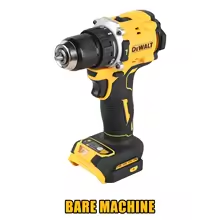
Pay particular attention to whether the listed price includes the battery and charger. Some power tools are sold as “tool only” versions, meaning the battery and charger must be purchased separately.
A product that appears inexpensive may therefore become considerably more expensive once the required accessories are added.
⚠️ Safety Comes First
Cordless power tools should always be used responsibly.
Before operating a drill or other powered equipment:
- 🦺 Use appropriate protective equipment
- 👓 Protect your eyes from debris
- 🧤 Use suitable hand protection when appropriate
- 📖 Read the manufacturer’s instructions
- 🔋 Inspect batteries before use
- 🪛 Use the correct accessory
- 🧱 Confirm that the tool is suitable for the material
- 🛑 Keep hands away from moving components
- 🔌 Follow charging and battery-storage instructions
Never use a tool beyond its intended application simply because it appears powerful enough to handle the job.
✅ Final Buying Advice for Cordless Drills and Power Tools
A good cordless drill or power tool should make your work easier rather than introduce unnecessary complexity.
For beginners and occasional homeowners, simplicity, comfort, versatility, and reasonable price are often the most important factors.
For frequent DIY users, performance, battery compatibility, durability, and accessory availability become increasingly important.
For professional users, long-term reliability, high performance, serviceability, battery ecosystem, and workload capacity may justify a higher investment.
The best cordless power tool is therefore not necessarily the most powerful or most expensive model. It is the one that provides the right combination of power, control, battery performance, durability, comfort, and value for the work you actually intend to perform. 🔧⚡
In the next section, we will look at household tool kits and explain what a useful kit should contain, how many pieces you really need, what quality factors to consider, and when buying a complete toolkit makes more sense than purchasing individual tools. 🧰
🧰 Household Tool Kits
A household tool kit is one of the most practical purchases for anyone who wants to handle everyday repairs, maintenance tasks, furniture assembly, and basic DIY projects without buying every tool separately. Instead of starting with an empty toolbox and purchasing individual items one at a time, a well-designed toolkit can provide a convenient collection of commonly used equipment in a single package.
For beginners, homeowners, renters, students, and occasional DIY users, a household tool kit can be an excellent starting point. However, not every toolkit offers the same quality or usefulness. Some kits may contain dozens or even hundreds of pieces but include many inexpensive accessories that you may rarely use. Others contain fewer components but focus on better-quality tools that are more useful for everyday work.
The key is to evaluate a toolkit based on what it contains, how well the tools are made, how practical the selection is, and whether the overall package provides good long-term value.
🏠 What Is a Household Tool Kit?
A household tool kit is a collection of hand tools and accessories assembled for common home maintenance and DIY tasks.
Depending on the size and purpose of the kit, it may include:
- 🪛 Screwdrivers
- 🔨 Hammer
- 🗜️ Pliers
- 🔧 Adjustable wrench
- 📏 Measuring tape
- 🔩 Wrenches
- 🔑 Hex keys
- 🧰 Ratchet and socket components
- 🔪 Utility knife
- ✂️ Cutting accessories
- 🔩 Screwdriver bits
- 🧲 Magnetic accessories
- 📦 Storage case
Some larger kits may also include specialized tools or a cordless screwdriver.
The important distinction is that a household toolkit is generally designed for general-purpose maintenance, rather than replacing every specialized tool required for advanced construction or professional work.
🧰 Why Buy a Complete Tool Kit?
Buying a complete toolkit can provide several advantages.
💰 Better Starting Value
Purchasing a kit can sometimes cost less than buying the same basic tools individually.
This can be especially useful for someone starting their first toolkit and needing several different types of equipment at once.
However, price should not be the only consideration. A cheap kit filled with low-quality components may provide less value than a smaller, better-built collection.
📦 Convenient Storage
Many household tool kits come with a dedicated carrying case.
A well-designed case can help keep tools organized and make it easier to locate the correct item when needed.
Good organization also reduces the chance of losing small components such as screwdriver bits, sockets, hex keys, and fasteners.
🔧 Variety of Tools
A complete kit can provide tools for many different household situations.
For example, one toolkit might allow you to assemble furniture, tighten loose screws, measure a wall, hang a picture, adjust hardware, and perform basic repairs without purchasing additional equipment.
🚗 Portability
A compact toolkit can be moved easily between rooms, stored in a vehicle, or taken to another location.
This can be particularly useful for renters, students, property owners, and people who perform occasional maintenance work in different locations.
🪛 Essential Tools Every Basic Kit Should Have
A useful household toolkit should focus on tools that are likely to be used regularly.
🪛 Screwdrivers
A basic set should ideally include multiple screwdriver types and sizes.
Common options include:
- Phillips
- Slotted or flat-head
- Various handle sizes
- Different shaft lengths
The correct screwdriver should match the fastener to avoid damaging the screw head.
🔨 Hammer
A general-purpose hammer is useful for tasks such as:
- 🖼️ Hanging suitable fixtures
- 🔨 Light assembly work
- 🪵 Basic woodworking
- 📦 Breaking down packaging
- 🔧 Minor household repairs
The handle should provide a secure and comfortable grip, while the head should be appropriately constructed for general household applications.
🗜️ Pliers
Pliers are extremely versatile.
A good basic toolkit may include combination pliers or similar general-purpose designs.
They can be useful for:
- 🔩 Holding components
- 🔧 Bending suitable materials
- 🪛 Gripping small objects
- ✂️ Cutting suitable wire with the appropriate plier type
Specialized pliers may be purchased later if your projects require them.
🔧 Adjustable Wrench
An adjustable wrench can handle a range of nut and bolt sizes without requiring a complete collection of individual wrenches.
For basic household maintenance, it can be one of the most useful tools in a compact kit.
📏 Measuring Tape
A measuring tape is essential for furniture assembly, hanging fixtures, planning layouts, measuring spaces, and many other household projects.
Look for a tape that is easy to read, reasonably durable, and comfortable to use.
🔑 Hex Keys and Allen Wrenches
Hex keys are commonly needed for furniture assembly, bicycles, appliances, hardware, and various mechanical components.
A toolkit containing multiple hex key sizes can save you from having to purchase a separate set later.
Metric sizes are particularly common in many international products, while other measurement systems may be used depending on the market and application.
When buying a toolkit, check which sizes are included rather than assuming the set contains every size you need.
🧰 Ratchets and Socket Sets
Larger household kits may include ratchets and sockets.
These tools can make tightening and loosening nuts and bolts much easier than using an adjustable wrench for every task.
A socket set can be particularly useful for:
- 🚗 Basic automotive tasks
- 🛠️ Furniture repairs
- 🔩 Mechanical assembly
- 🔧 Household maintenance
For general household use, you do not necessarily need an extremely large socket collection. A practical selection of commonly used sizes can be more useful than an oversized set containing many rarely needed pieces.
🔪 Utility Knives and Cutting Tools
Utility knives are useful for opening packages, cutting suitable materials, trimming, and various general-purpose tasks.
A good design should allow the blade to be controlled securely and replaced when necessary.
Always use cutting tools on appropriate materials and follow safe handling practices.
🔩 Screwdriver Bit Sets
Some household toolkits include interchangeable screwdriver bits.
These can significantly increase versatility without requiring a separate screwdriver for every fastener type.
Common bit types can include:
- Phillips
- Slotted
- Torx
- Hex
- Other specialized profiles
The quality of the bits is important. Poorly manufactured bits can wear quickly or damage fasteners.
🧲 Magnetic Features
Some modern toolkits include magnetic bit holders, magnetic trays, or magnetic screwdrivers.
These features can make small components easier to manage during repairs.
A magnetic screwdriver tip can help hold suitable screws during installation, while a magnetic tray can help prevent small metal components from rolling away during a project.
Magnetic accessories are convenient, but they should be viewed as useful additions rather than a substitute for overall tool quality.
📦 Tool Case and Organization
The storage case deserves more attention than many buyers give it.
A good case should:
- 🧰 Keep tools securely positioned
- 📦 Make components easy to identify
- 🚗 Be reasonably portable
- 🔒 Prevent tools from moving excessively
- 🗂️ Provide logical organization
A poorly designed case can become frustrating if tools fall out of their positions every time it is moved.
For larger toolkits, organization becomes even more important because locating a small component in a cluttered case can waste considerable time.
🛠️ Tool Material and Construction
The materials used in the tools can have a major effect on durability.
Many quality hand tools use hardened steel or other suitable metal alloys for working components.
When evaluating a toolkit, pay attention to:
- 🧱 Material quality
- 🔩 Finish and construction
- 🤲 Handle design
- 🔧 Joint quality
- 🪛 Tip durability
- 🛠️ Overall fit and finish
Avoid judging quality solely by the number of pieces listed on the package.
A 100-piece kit is not automatically better than a 40-piece kit if many of those 100 pieces are low-value accessories.
⭐ How to Evaluate Tool Kit Reviews
Customer reviews can help reveal how a toolkit performs after actual use.
When reading reviews, look for recurring comments about:
- 🛠️ Tool durability
- 🪛 Screwdriver tip quality
- 🔧 Wrench strength
- 🧰 Case durability
- 🧲 Magnetic performance
- 📦 Missing components
- 🤲 Comfort
- 🔩 Fit and compatibility
Try to identify patterns rather than relying on a single review.
A product with several users reporting the same problem deserves additional investigation before purchase.
⚖️ Piece Count vs Actual Usefulness
One of the biggest mistakes buyers make is focusing on piece count.
Manufacturers and marketplaces may advertise a toolkit as containing 100, 120, or even more pieces. However, the total can include duplicates, small accessories, storage components, or inexpensive items that contribute little practical value.
Instead, create a simple checklist of the tools you actually need.
For example:
Basic homeowner:
🪛 Screwdrivers + 🔨 hammer + 🗜️ pliers + 🔧 adjustable wrench + 📏 measuring tape
DIY user:
Add 🔑 hex keys + 🧰 sockets + 🔩 bits + 🔪 utility knife
Advanced home workshop:
Add more specialized hand tools and then supplement the kit with individual power tools and precision equipment.
This approach can produce a more useful collection without unnecessary spending.
👨🔧 Tool Kits for Beginners
Beginners generally benefit from simplicity.
A starter toolkit should ideally contain the basic tools needed for common household tasks without overwhelming the user with unnecessary components.
Look for:
- 🪛 Several common screwdriver types
- 🔨 A general-purpose hammer
- 🗜️ Pliers
- 🔧 Adjustable wrench
- 📏 Measuring tape
- 🔑 Hex keys
- 🔪 Utility knife
- 🧰 Organized storage
Once you understand which tools you use most frequently, you can gradually expand your collection.
🏠 Tool Kits for Homeowners
Homeowners may benefit from a broader selection because maintenance requirements can vary considerably.
A homeowner’s toolkit can be expanded with:
- 🔩 Socket sets
- 🪛 Larger bit collections
- 📐 Level
- 🧲 Magnetic accessories
- 💡 Portable work light
- 🔋 Cordless drill
- 🧰 Additional storage
The goal is to create a practical collection that covers routine maintenance without filling your storage space with tools that rarely get used.
🧑🔧 Tool Kits for Advanced DIY Users
Experienced DIY users may find that complete household kits eventually become limiting.
Advanced users often prefer to purchase high-quality individual tools according to their specific projects.
For example, instead of relying on the screwdriver set included in a general toolkit, an experienced user may purchase a dedicated professional-grade screwdriver set.
The same principle applies to pliers, sockets, measuring tools, and other equipment.
A starter toolkit can therefore be an excellent foundation, but it does not need to remain the complete toolkit forever.
💰 When Is a Tool Kit Better Than Individual Tools?
A complete toolkit is generally attractive when:
- 🏠 You are starting from scratch
- 🧰 You need several basic tools
- 💰 You want a convenient initial package
- 📦 You prefer organized storage
- 🔧 Your projects are mostly general-purpose
Buying individual tools may make more sense when:
- 🛠️ You already own basic equipment
- 🎯 You need specialized tools
- 💪 You require professional-level durability
- 🔧 You have specific performance requirements
- 🧰 You want to build a customized collection
There is no universal answer. The right approach depends on what you already own and the type of work you perform.
⚠️ Common Household Tool Kit Mistakes
Before purchasing a kit, avoid these common mistakes:
❌ Choosing the highest piece count
More pieces do not automatically mean better value.
❌ Buying solely because of a discount
A large advertised discount does not guarantee that the underlying product is good quality.
❌ Ignoring materials
Low-quality working components can wear quickly.
❌ Forgetting about storage
A toolkit with poor organization can become inconvenient to use.
❌ Buying tools you will never use
Specialized accessories can increase the price without providing meaningful value.
❌ Ignoring replacement options
For frequently used tools, replacement components and consumables can matter over time.
🦺 Safety When Using Household Tool Kits
Even basic hand tools should be used correctly.
Before starting a project:
- 👓 Use appropriate eye protection when necessary
- 🧤 Use suitable protective equipment
- 🪛 Select the correct tool for the fastener
- 🔨 Keep your workspace clear
- 🧰 Inspect damaged tools before use
- 🛑 Do not use tools for applications they were not designed for
- 📖 Follow manufacturer instructions where applicable
A damaged screwdriver, cracked handle, loose hammer head, or worn cutting tool should not be treated as harmless simply because it is a hand tool.
🏆 How to Choose the Best Household Tool Kit
When comparing household toolkits in 2026, focus on usefulness rather than quantity.
A strong toolkit should offer a practical selection of commonly needed tools, reasonable build quality, comfortable handling, durable working components, useful accessories, and convenient storage.
Before purchasing, ask yourself:
- 🏠 What types of repairs do I normally perform?
- 🧰 Which tools do I already own?
- 🔧 Which tools am I most likely to use?
- 💰 Is the kit providing genuine value?
- 🛠️ Are the tools built well enough for my expected workload?
- 📦 Is the storage case practical?
- 🔩 Are the included accessories actually useful?
- ⭐ Do customer reviews show consistent real-world performance?
A thoughtfully selected household tool kit can become the foundation of a reliable home maintenance collection. Rather than chasing the largest piece count, focus on quality, practicality, versatility, and the tools you are genuinely likely to use.
In the next section, we will explore screwdrivers and precision tools, including the different types, tip designs, materials, ergonomics, precision requirements, and what to look for when choosing tools for everything from everyday repairs to delicate electronics work. 🪛🎯
🪛 7. Screwdrivers & Precision Tools
Screwdrivers are among the most basic and useful tools in any home improvement collection. From tightening a loose cabinet handle to assembling furniture, installing hardware, repairing appliances, or working on small electronic devices, the right screwdriver can make the job faster, easier, and safer.
However, not all screwdrivers are designed for the same type of work. Different screw heads require different tip shapes, while precision jobs may require much smaller tools and greater control. A good buying decision should therefore consider tip type, size, material quality, handle design, magnetic features, durability, and the type of work you expect to perform.
Whether you are building your first household toolkit or upgrading an existing collection, investing in the right screwdriver set can provide excellent long-term value.
🔩 Understanding Common Screwdriver Types
The first step is choosing screwdriver tips that match the screws you commonly encounter.
Phillips Screwdrivers (+)
Phillips screwdrivers are extremely common in furniture, household hardware, appliances, electronics, and general DIY projects. A quality set should ideally include several Phillips sizes because using the wrong size can reduce grip and make the screw easier to damage.
Flat-Head or Slotted Screwdrivers (—)
Slotted screwdrivers have a straight tip and remain useful for many traditional screws, electrical components, brackets, fixtures, and general household applications. Different widths are useful because one size does not fit every slotted screw.
Torx Screwdrivers (★)
Torx screws use a star-shaped pattern and are increasingly common in electronics, appliances, automotive components, furniture, and equipment. If you regularly assemble or repair modern products, having Torx drivers or bits can be very useful.
Hex or Allen Drivers (⬡)
Hexagonal fasteners are commonly found in furniture, bicycles, machinery, fixtures, and DIY equipment. A hex key set or interchangeable hex bits can save considerable time when assembling products.
Pozidriv Screwdrivers
Pozidriv looks similar to Phillips but uses a different tip design. Some furniture and hardware products use Pozidriv screws, so a comprehensive bit set can be more practical than relying exclusively on Phillips drivers.
🔧 Full-Size vs Precision Screwdrivers
The size of the screwdriver should match the size and sensitivity of the job.
Standard screwdrivers are designed for everyday household work such as:
- Furniture assembly
- Cabinet installation
- Door hardware
- Wall fixtures
- General repairs
- Appliance maintenance
- Household hardware
Precision screwdrivers are much smaller and are designed for delicate work where greater control is required.
They can be useful for:
- Small electronics
- Watches
- Eyeglasses
- Small household devices
- Cameras
- Computer components
- Small screws and fasteners
For a general household toolkit, having both standard and precision screwdrivers provides much better coverage than purchasing only one type.
🧰 Screwdriver Bit Sets
An interchangeable bit system can be an excellent choice when you want many screwdriver types without purchasing a large number of individual handles.
A useful bit set may include:
- Phillips bits
- Slotted bits
- Torx bits
- Hex bits
- Pozidriv bits
- Security-style bits
- Multiple sizes
The major advantage is versatility. Instead of storing dozens of separate screwdrivers, you can use one compatible handle with different bits.
For homeowners and DIY users with limited storage space, a well-organized bit set can be particularly convenient.
🧲 Are Magnetic Tips Worth It?
Magnetic screwdriver tips can make many tasks easier.
A magnetic tip can help hold a screw against the screwdriver while you position it, particularly when working in tight or awkward areas.
This can be useful for:
- Furniture assembly
- Working inside cabinets
- Small repairs
- Installing hardware
- Working in narrow spaces
However, magnetic tips should not be considered essential for every task. Some applications may require non-magnetic tools, so users who work on specialized equipment should choose accordingly.
📏 Choosing the Right Shaft Length
Shaft length affects accessibility and control.
A long screwdriver can help reach screws located deep inside cabinets, appliances, fixtures, or other recessed areas.
A short screwdriver can be easier to control in confined spaces where a long shaft would be difficult to position.
For most home users, having a mixture of short, medium, and longer screwdrivers is more useful than buying only one length.
✋ Handle Design and Ergonomics
A screwdriver may look simple, but handle design can significantly affect comfort.
Look for handles that provide:
- A comfortable grip
- Good finger control
- A secure hold
- A practical shape
- Reduced slipping
- Easy rotation
If you regularly work on larger screws, a larger handle can provide better leverage and control.
For precision work, smaller handles are often preferable because they allow more controlled movements.
A comfortable handle becomes especially important when you are working on multiple screws or completing a large furniture or installation project.
🛠️ Tip Quality and Material
The screwdriver tip is the part that directly interacts with the screw, so its quality matters.
Poor-quality tips may wear down more quickly, lose their shape, or fit poorly into screw heads. A better-quality tool should maintain a consistent tip shape during normal use.
When comparing online products, look for clear information about:
- Tip material
- Manufacturing quality
- Size markings
- Corrosion resistance
- Hardening or durability claims
- Overall construction
Avoid choosing a set simply because it contains a very large number of pieces. Useful, durable pieces are more valuable than a large collection of low-quality bits.
⚙️ Interchangeable Handles vs Individual Screwdrivers
Both designs have advantages.
Individual screwdrivers are convenient when you frequently use the same sizes. You can simply pick up the correct tool and start working.
Interchangeable systems provide more versatility and can save storage space.
For a basic household toolkit, individual Phillips and slotted screwdrivers combined with a multi-bit set can provide a strong balance between convenience and versatility.
💻 Precision Tools for Electronics and Small Repairs
Precision tools require extra care because small screws and delicate components can be easily damaged.
A good precision kit may include several tiny Phillips, slotted, Torx, and other compatible tips.
Look for:
- Fine tip sizes
- Comfortable rotating handles
- Clear size identification
- Secure bit attachment
- Organized storage
- Good-quality tips
For delicate electronics, avoid using oversized screwdrivers simply because they are available. The correct size provides better control and reduces the chance of damaging the screw.
🏠 Best Screwdriver Setup for Homeowners
A homeowner does not necessarily need a professional-level collection.
A practical setup could include:
- Several Phillips sizes
- Several slotted sizes
- A Torx set or Torx bit selection
- Hex/Allen tools
- A precision screwdriver set
- A multi-bit screwdriver
- A magnetic bit holder
- An organized storage case
This combination covers a large range of common household jobs without requiring excessive equipment.
👨🔧 Choosing Tools for Advanced DIY and Professional Work
Advanced DIY users and professionals may need a broader selection.
Depending on the type of work, consider:
- Multiple Phillips sizes
- Multiple slotted sizes
- Torx and security Torx
- Pozidriv
- Hex drivers
- Precision drivers
- Long-reach screwdrivers
- Stubby screwdrivers
- Interchangeable bit systems
- Specialized screwdriver types
Professionals should prioritize consistency, durability, grip quality, and compatibility with the fasteners they encounter regularly.
Buying a larger professional set only makes sense when the additional tools will actually be used.
📦 Storage and Organization
A screwdriver set is much easier to use when every piece has a designated location.
Look for cases or organizers that provide:
- Clearly labeled sizes
- Secure storage
- Easy access
- Compact organization
- Protection against loss
- Separate spaces for different bit types
Poor organization can turn a useful toolkit into a frustrating collection of loose pieces.
For precision bits, a compact case is especially valuable because the small components are easy to lose.
⚠️ Common Screwdriver Buying Mistakes
Avoid these common mistakes when shopping online:
1. Buying only one size
One screwdriver rarely fits every household screw.
2. Ignoring tip compatibility
Phillips, Pozidriv, Torx, and other designs are not interchangeable simply because they look similar.
3. Choosing quantity over quality
A huge set is not automatically better.
4. Buying uncomfortable handles
Poor ergonomics can make repetitive work tiring.
5. Ignoring precision tools
If you work with small devices, a standard screwdriver collection may not be enough.
6. Forgetting storage
Loose bits and small tools are easy to misplace.
7. Using the wrong size
The correct size provides better engagement and control.
🛒 What to Check When Buying Online
Before purchasing a screwdriver or precision tool set from an online marketplace, check:
- ✔️ Screwdriver types included
- ✔️ Available sizes
- ✔️ Tip quality
- ✔️ Handle design
- ✔️ Magnetic features
- ✔️ Material information
- ✔️ Precision tools included
- ✔️ Bit compatibility
- ✔️ Storage case quality
- ✔️ Customer reviews
- ✔️ Seller reputation
- ✔️ Product specifications
- ✔️ Price compared with similar sets
Do not judge the product only by its number of pieces. A smaller, well-made set can be considerably more useful than a large set filled with tools you will rarely use.
💰 Getting the Best Value
The best screwdriver set is the one that covers your actual needs without unnecessary extras.
For occasional household repairs, a reliable basic set may provide excellent value.
For frequent DIY work, a combination of individual screwdrivers and a comprehensive bit set may be better.
For precision repairs, investing in a dedicated precision kit can be worthwhile.
The goal should always be usefulness, compatibility, durability, and ease of use—not simply the highest piece count.
🦺 Safety Considerations
Use the correct screwdriver for the fastener and application.
Never use a screwdriver as a substitute for a pry bar, chisel, punch, or other tool unless the product is specifically designed for that purpose.
When working around electrical equipment, use tools appropriate for the electrical application and follow proper safety procedures. If you are unsure about electrical work, professional assistance is the safer choice.
Keep damaged or badly worn screwdriver tips out of regular use because they can slip more easily and damage fasteners.
🏆 Final Buying Recommendation
For most homeowners, the ideal screwdriver collection does not need to be enormous. A quality set covering Phillips, slotted, Torx, and hex types, combined with a precision screwdriver kit and a versatile multi-bit driver, can handle a wide variety of household and DIY tasks.
Focus on tip quality, correct sizing, comfortable handles, durable construction, magnetic functionality where useful, and organized storage.
When shopping on Amazon, AliExpress, or other online marketplaces, compare the actual specifications and included tool types rather than choosing purely by piece count or promotional claims.
A well-selected screwdriver and precision-tool collection is one of the simplest ways to make your home improvement toolkit more capable, organized, and reliable.
📏 8. Laser Distance Meters & Measuring Tools
Accurate measurement is one of the most important parts of successful home improvement work. Whether you are installing shelves, measuring a room, planning furniture placement, hanging pictures, checking material dimensions, or preparing for a renovation project, incorrect measurements can lead to wasted materials, poor fitting, and unnecessary extra work.
Traditional tape measures remain essential, but modern measuring tools can make certain tasks significantly faster and easier. Laser distance meters, digital measuring tools, levels, rulers, squares, and conventional tape measures each have different strengths.
The best choice depends on the type of work you perform, the distances you normally measure, the level of accuracy you need, and how frequently you use the tool.
📐 Traditional Tape Measures
A tape measure is still one of the most useful tools for any household toolkit.
It can be used for:
- Measuring furniture
- Checking room dimensions
- Measuring doors and windows
- Planning shelves
- Measuring building materials
- DIY projects
- Hanging fixtures
- General household tasks
When buying a tape measure, pay attention to:
- 📏 Length
- 🔒 Locking mechanism
- ✋ Grip and casing design
- 🔢 Measurement markings
- 🪝 Hook design
- 🛡️ Overall durability
- 📦 Compactness
For general household work, a medium-length tape measure is often sufficient. For larger renovation or construction tasks, a longer tape may be more practical.
🔴 What Is a Laser Distance Meter?
A laser distance meter uses a laser to calculate the distance between the device and a selected surface.
Instead of manually extending a tape, you can position the meter, aim it at the target, and obtain a digital measurement.
This can be especially useful when measuring:
- Large rooms
- Walls
- Ceilings
- Floors
- Long corridors
- Windows
- Doors
- Furniture placement areas
The major advantage is convenience. One person can often perform measurements that would otherwise be easier with two people using a traditional tape.
🎯 Laser Range
One of the first specifications to check when buying a laser distance meter is its stated measuring range.
Different models are designed for different distances.
A basic home user may only need a relatively short range for rooms and furniture.
Someone working on larger properties or renovation projects may benefit from a longer-range model.
However, do not automatically purchase the longest-range device available. A higher maximum range may not provide meaningful benefits if you primarily measure small indoor spaces.
Choose the range according to your actual projects.
🎯 Accuracy Matters More Than Maximum Range
A long measurement range does not automatically mean that a device is better.
Accuracy is often more important than maximum distance.
When comparing laser meters, check the manufacturer’s stated accuracy and consider whether it is appropriate for your intended application.
For everyday household planning, moderate accuracy may be sufficient.
For professional construction, installation, or detailed measurement work, more precise equipment may be justified.
Always follow the manufacturer’s instructions because measurement conditions can affect results.
☀️ Indoor vs Outdoor Use
Laser distance meters can behave differently depending on the environment.
Indoor spaces are generally easier because the laser can be aimed at relatively close, clearly visible surfaces.
Outdoor measurements can be more challenging because bright sunlight may make the laser point harder to see.
If you plan to use a laser meter outdoors, look for a model specifically designed to support the type of outdoor measurement you need.
A useful accessory such as a target plate can also make certain measurements easier.
🧮 Useful Measurement Functions
Different laser meters may provide different calculation functions.
Depending on the model, useful features can include:
- 📏 Distance measurement
- 📐 Area calculation
- 🏠 Volume calculation
- ➕ Addition of measurements
- ➖ Subtraction
- 📊 Continuous measurement
- 📐 Indirect measurement functions
- 💾 Measurement memory
These features can save time when planning rooms or calculating approximate material requirements.
However, avoid paying extra for advanced functions that you will never use.
📱 Digital Display and Controls
A clear display is important because measurements need to be read quickly and accurately.
Look for:
- Easy-to-read numbers
- Clear buttons
- Simple menus
- Appropriate screen visibility
- Measurement units that match your needs
- Logical control layout
Some models offer additional display features, but simplicity can actually be an advantage for occasional users.
A measuring device that is easy to understand is more useful than one with numerous complicated functions.
🔋 Battery and Power Considerations
Laser distance meters are usually battery-powered.
Before buying, check:
- Battery type
- Expected battery life
- Automatic shutoff
- Battery replacement availability
- Charging method, if rechargeable
- Battery indicator
Automatic shutoff can help preserve battery life when the device is accidentally left switched on.
For frequent users, rechargeable models may offer convenience, while replaceable batteries can be useful when you need to continue working without waiting for charging.
💧 Durability and Protection
Measuring tools often get carried around in toolboxes, bags, garages, workshops, or construction environments.
A good device should be reasonably durable for its intended use.
Check whether the manufacturer provides information about:
- Drop resistance
- Dust protection
- Water resistance
- Protective casing
- Operating temperature
- Build materials
Do not assume that every laser meter is suitable for harsh construction environments. A lightweight consumer model may be perfectly suitable for home projects but inappropriate for demanding professional conditions.
📐 Spirit Levels and Digital Levels
Laser distance meters measure distance, but they do not replace leveling tools.
A spirit level remains important for checking whether an object is:
- Horizontal
- Vertical
- Properly aligned
They are useful when installing:
- Shelves
- Cabinets
- Frames
- Wall fixtures
- Furniture
- Doors
- Tiles
Digital levels can provide additional convenience through electronic readings, while traditional spirit levels remain simple, reliable, and easy to use.
📏 Measuring Squares and Rulers
For woodworking, furniture assembly, installation, and detailed DIY work, measuring squares and rulers can be extremely useful.
A square can help check angles and alignment, while a ruler provides quick measurements for smaller components.
These tools are inexpensive compared with many power tools, but they can have a major impact on the quality of the finished project.
🧰 Measuring Tools for Beginners
A beginner does not need an expensive professional measurement system.
A practical starter combination can include:
- 📏 Tape measure
- 📐 Spirit level
- 📏 Ruler
- 📐 Measuring square
- 🔴 Basic laser distance meter, if needed
This combination provides coverage for most everyday home improvement projects.
If your projects are limited to furniture assembly and small repairs, a tape measure and level may be enough.
👨🔧 Measuring Tools for Advanced DIY Users
More experienced DIY users may benefit from adding:
- Laser distance meter
- Digital level
- Larger tape measure
- Combination square
- Specialized measuring tools
- Angle measurement tools
- Additional marking tools
The right combination depends heavily on the type of projects you perform.
For woodworking, precision and repeatability may be especially important.
For room renovation, laser measurement can save time.
For installation work, levels and squares may be more important.
🏗️ Professional Use
Professionals should evaluate measuring tools based on their actual working environment.
Important considerations can include:
- Accuracy
- Measurement range
- Reliability
- Durability
- Visibility
- Battery life
- Speed of measurement
- Ease of operation
- Environmental protection
- Warranty and support
A professional may use measurement tools every day, making reliability and efficiency more valuable than simply finding the cheapest option.
📲 Smart and Connected Measuring Tools
Some modern measuring tools may offer additional digital functionality or connectivity.
Depending on the model, features may include:
- Data storage
- Smartphone connectivity
- Digital measurement records
- Project documentation
- Measurement history
These features can be useful for professionals managing multiple measurements or projects.
For ordinary home use, however, they are optional rather than essential.
🛒 How to Compare Laser Distance Meters Online
When shopping online, do not focus only on the product title.
Compare:
- ✔️ Measuring range
- ✔️ Stated accuracy
- ✔️ Measurement functions
- ✔️ Display
- ✔️ Battery system
- ✔️ Indoor/outdoor suitability
- ✔️ Build quality
- ✔️ Protection rating, if provided
- ✔️ Included accessories
- ✔️ Customer reviews
- ✔️ Seller reputation
- ✔️ Warranty or return policy
- ✔️ Total price
Pay particular attention to whether the specifications are clearly provided.
If an important specification is missing, it is better to compare another product rather than assuming the device will meet your requirements.
⚠️ Common Measuring Tool Mistakes
1. Buying excessive range
A very long range is unnecessary for many household projects.
2. Ignoring accuracy
Maximum range does not tell you how precisely the tool measures.
3. Forgetting visibility
Laser visibility can become more difficult in bright environments.
4. Using the wrong reference point
Always understand where the device measures from and follow its instructions.
5. Ignoring traditional tools
A laser meter does not replace a tape measure or spirit level for every task.
6. Choosing features you don’t need
Extra calculations and smart functions can increase cost without adding real value.
7. Neglecting calibration or instructions
For applications where measurement precision matters, follow the manufacturer’s maintenance and calibration guidance.
🦺 Safe Use of Laser Measuring Tools
Laser devices should always be used according to their safety instructions.
Avoid deliberately directing a laser into anyone’s eyes and keep the device away from situations where the beam could create a hazard.
When working at height or in active construction areas, safe positioning is more important than simply obtaining a measurement.
The tool should help improve your workflow—not introduce another unnecessary risk.
💰 Getting the Best Value
The best measuring tool is not necessarily the most expensive one.
For basic household work, a quality tape measure and spirit level can provide excellent value.
For frequent renovation projects, a laser distance meter can save considerable time.
For professional work, paying more for improved accuracy, durability, reliability, and useful functions may make sense.
The goal is to choose a tool that matches the measurements you actually perform.
🏆 Final Buying Recommendation
For most homeowners, a quality tape measure and spirit level should form the foundation of the measuring toolkit.
If you regularly measure rooms, walls, ceilings, furniture layouts, or larger spaces, adding a laser distance meter can make the process considerably faster and more convenient.
When choosing a laser meter, prioritize accuracy, useful range, clear display, battery life, durability, and ease of use rather than simply selecting the model with the largest number of features.
For advanced DIY users and professionals, the best setup may combine traditional measuring tools with digital and laser-based equipment.
Ultimately, accurate measurement is one of the easiest ways to improve the quality of a home improvement project. A few seconds spent measuring correctly can prevent hours of unnecessary work, wasted materials, and expensive mistakes.
💡 9. Work Lights & Headlamps
Good lighting is often overlooked when buying home improvement tools, but it can make a major difference in both visibility and safety. A repair that seems simple in a well-lit room can become difficult when you are working inside a cabinet, under a sink, behind furniture, inside a vehicle, in a garage, or during a power outage.
A dedicated work light or headlamp provides illumination exactly where you need it, allowing you to see screws, wires, surfaces, markings, and small components more clearly.
The best lighting solution depends on your working environment. A portable work light is useful when you need broad illumination, while a headlamp is ideal when you need both hands free. Smaller inspection lights can also be valuable for tight spaces.
When comparing these products, don’t focus only on brightness. Beam pattern, battery life, mounting options, durability, charging, heat management, portability, and ease of use can be equally important.
🔦 Why Dedicated Work Lighting Matters
Normal room lighting is not always enough for DIY and repair work.
Dedicated lighting can help when:
- 🔧 Repairing appliances
- 🚰 Working under sinks
- 🪛 Installing hardware
- 🚗 Working around vehicles
- 🏠 Inspecting ceilings and walls
- 🧰 Organizing a garage or workshop
- 🪑 Working behind furniture
- ⚡ Dealing with a power outage
- 🔍 Inspecting small components
- 🌙 Working outdoors or in poorly lit areas
Better visibility can also make it easier to identify potential hazards before starting a task.
💡 Work Lights vs Headlamps
Both are useful, but they serve different purposes.
Work lights are designed to illuminate an area. They can often be placed on a table, floor, shelf, or work surface.
They are useful for:
- Workshops
- Garages
- Construction areas
- Large repair projects
- Painting
- General room illumination
Headlamps attach to your head and direct light toward the area you are looking at.
They are especially useful when:
- You need both hands free
- Working in narrow spaces
- Inspecting ceilings
- Working under vehicles
- Repairing equipment
- Navigating dark areas
For many homeowners, owning one of each provides excellent flexibility.
🔆 Understanding Brightness
Brightness is one of the most advertised specifications for lighting products.
It is commonly expressed in lumens.
Higher lumens generally indicate more light output, but higher brightness is not automatically better for every situation.
A very powerful light can create excessive glare or make close-up work uncomfortable.
For detailed tasks, a balanced beam with good visibility may be more useful than simply choosing the highest lumen rating.
When comparing products, consider both the stated brightness and the type of environment in which you will use the light.
🎯 Beam Pattern
The shape of the light beam affects how useful the product feels during work.
A wide beam can illuminate a larger work area and is useful for:
- Workshops
- Garages
- Painting
- Room repairs
- General maintenance
A focused beam concentrates light in a smaller area and can be useful for:
- Inspection
- Tight spaces
- Detailed work
- Looking into deep areas
Some products offer adjustable or multiple beam modes, providing greater flexibility.
🔋 Battery Life
Battery performance is particularly important for cordless work lights and headlamps.
Before buying, check:
- Battery capacity
- Claimed runtime
- Charging method
- Charging time
- Battery indicator
- Replaceable vs built-in battery
- Automatic shutoff, if available
Remember that advertised runtime can vary depending on the brightness mode being used.
A light may last considerably longer on a low setting than at maximum brightness.
For longer projects, having multiple brightness levels can therefore be more useful than a single extremely bright mode.
🔌 Rechargeable vs Replaceable Batteries
Both systems have advantages.
Rechargeable lights can be convenient because you can charge them using a compatible cable or charging system.
Advantages may include:
- Less need to purchase disposable batteries
- Convenient everyday use
- Easy charging
- Lower ongoing battery replacement needs
Replaceable-battery lights can be useful when you need to keep working without access to a charger.
You can simply carry spare batteries and replace them when necessary.
The better choice depends on your working habits and where you normally use the light.
⚡ Charging Options
Modern work lights may use different charging methods.
Common options include:
- USB charging
- USB-C charging
- Proprietary charging systems
- Replaceable batteries
- Standard battery compartments
USB-C can be particularly convenient if you already use compatible charging equipment.
When purchasing online, verify what is actually included in the package. Some products may show charging accessories in promotional images without including every accessory in the standard package.
🧲 Magnetic Work Lights
Magnetic bases can be extremely useful in workshops and repair environments.
A magnetic light can attach to a suitable metal surface, allowing you to illuminate your work without holding the light.
This can be useful when:
- Working on vehicles
- Repairing machinery
- Working inside metal cabinets
- Installing hardware
- Using both hands for a repair
However, magnetic mounting only works where an appropriate metal surface is available.
A light with additional mounting options can therefore be more versatile.
🪝 Hooks, Stands and Mounting Options
A good work light may provide several ways to position it.
Useful features can include:
- Foldable stands
- Hanging hooks
- Magnetic bases
- Rotating heads
- Clips
- Tripod compatibility
- Adjustable mounting systems
Multiple mounting options allow you to position the light without constantly holding it.
For longer jobs, this can significantly improve comfort and productivity.
🧑🔧 Headlamp Comfort and Fit
For headlamps, comfort is just as important as brightness.
Look for:
- Adjustable head straps
- Stable positioning
- Reasonable weight
- Comfortable contact points
- Easy-to-reach controls
- Secure fit
A headlamp that constantly moves or feels uncomfortable can become frustrating during longer projects.
If you plan to wear it for extended periods, lightweight construction and a secure strap system become particularly important.
🌡️ Heat Management
Powerful lights can generate heat, especially when operated at high brightness for extended periods.
A good product should have a design appropriate for its intended power level.
When comparing high-output models, consider:
- Heat dissipation
- Housing material
- Ventilation design
- Automatic protection features, if specified
- Recommended operating conditions
Avoid assuming that maximum brightness can always be used continuously without limitations.
Always follow the manufacturer’s instructions.
🛡️ Durability and Weather Resistance
Work lights may be exposed to dust, moisture, drops, and rough handling.
For garage, workshop, outdoor, or construction use, check whether the product provides information about:
- Impact resistance
- Dust protection
- Water resistance
- Housing material
- Drop resistance
- Environmental operating conditions
Water resistance ratings can be useful, but they should not be interpreted as permission to submerge a product unless the manufacturer specifically states that it is designed for that purpose.
🎨 Color Temperature and Light Quality
Some lighting products offer different color temperatures or lighting modes.
Depending on the task, you may prefer a light that provides a neutral and comfortable appearance rather than an extremely harsh beam.
For detailed work, consistent illumination can make surfaces, markings, and components easier to distinguish.
If you regularly perform tasks where color identification matters, consider the manufacturer’s information about light quality rather than focusing only on brightness.
🔧 Work Lights for Different DIY Tasks
Different projects benefit from different lighting styles.
For painting:
A broad work light can help illuminate walls and surfaces evenly.
For electrical or appliance work:
A focused light or headlamp can help illuminate small and recessed areas.
For automotive work:
Magnetic work lights and flexible lights can be particularly useful.
For woodworking:
A stable work light can illuminate the workbench without requiring you to hold it.
For plumbing:
A headlamp can be useful because both hands may be needed.
For emergency use:
A rechargeable or battery-powered light with dependable runtime can be valuable during power interruptions.
🏠 Choosing a Work Light for Beginners
A beginner does not need an expensive professional lighting system.
A practical starter setup can include:
- 🔦 One portable LED work light
- 💡 One compact headlamp
- 🔋 Reliable charging or spare batteries
This combination can cover a surprisingly large range of household situations.
If you rarely perform repairs, even a single versatile light may be sufficient.
👨🔧 Choosing Lighting for Advanced DIY Users
Advanced DIY users may benefit from multiple lighting formats.
Consider combining:
- Portable area work light
- Headlamp
- Magnetic inspection light
- Compact flashlight
- Adjustable work light
Different projects create different lighting requirements, so having several specialized options can be more useful than relying on one extremely powerful light.
🏗️ Professional and Workshop Use
Professionals should prioritize reliability and suitability for their working environment.
Important considerations can include:
- Consistent light output
- Battery endurance
- Durability
- Mounting flexibility
- Charging convenience
- Protection against dust and moisture
- Ease of transport
- Long-term reliability
For professional users, a light that can survive repeated daily use may provide considerably better value than a cheaper model that needs frequent replacement.
⚠️ Common Lighting Buying Mistakes
1. Choosing only by lumen count
More brightness does not automatically mean better usability.
2. Ignoring battery runtime
A powerful light with very short runtime may be inconvenient.
3. Forgetting beam pattern
A narrow beam is not always suitable for area lighting.
4. Ignoring comfort
This is especially important for headlamps.
5. Overlooking mounting options
A stand, hook, or magnetic base can make a big difference.
6. Assuming waterproof means fully waterproof
Always check the actual protection information.
7. Forgetting charging accessories
Verify exactly what is included with the product.
8. Buying unnecessary brightness
For close-range tasks, excessive brightness may create glare rather than improve visibility.
🛒 How to Compare Work Lights Online
Before purchasing, compare:
- ✔️ Brightness
- ✔️ Beam pattern
- ✔️ Battery capacity
- ✔️ Claimed runtime
- ✔️ Charging method
- ✔️ Charging time
- ✔️ Brightness modes
- ✔️ Mounting options
- ✔️ Weight
- ✔️ Headlamp strap design
- ✔️ Durability
- ✔️ Water/dust protection
- ✔️ Customer reviews
- ✔️ Seller reputation
- ✔️ Warranty and return policy
Also check product dimensions. A light may look compact in promotional images but be larger or heavier than expected.
💰 Getting the Best Value
For occasional home repairs, an affordable but reliable LED work light can provide excellent value.
For frequent DIY work, investing in a rechargeable work light with multiple mounting options can make sense.
For professionals, durability, runtime, and reliability may justify a higher price.
The best value comes from buying a light that fits your working environment instead of paying for specifications you will rarely use.
🦺 Safe Use of Work Lights
Keep lighting equipment away from situations where heat, damaged cables, batteries, or electrical connections could create a hazard.
Do not use damaged charging cables or batteries.
When working around water, electricity, chemicals, or other hazardous environments, use lighting equipment appropriate for the conditions and follow the manufacturer’s safety instructions.
Also make sure a freestanding work light is positioned securely so it cannot easily fall onto people, equipment, or materials.
🏆 Final Buying Recommendation
For most homeowners, a reliable portable LED work light combined with a comfortable headlamp is an excellent lighting setup.
Choose a work light based on useful brightness, suitable beam coverage, battery life, charging convenience, mounting flexibility, durability, and portability.
For tight spaces and hands-free work, a headlamp can be more useful than a larger light. For workshops and room-sized projects, a stable area work light is generally more practical.
The key is not simply buying the brightest light available. The best lighting tool is the one that gives you clear visibility exactly where you need it, for as long as you need it, without becoming uncomfortable or inconvenient to use.
🎨 10. Painting Tools
Painting can completely change the appearance of a room, piece of furniture, wall, or other surface, but getting a clean and professional-looking result depends on much more than simply choosing the right paint color.
The tools you use can affect coverage, finish quality, paint consumption, working speed, edge control, and overall convenience. A good combination of brushes, rollers, trays, preparation tools, masking accessories, and cleaning equipment can make a painting project considerably easier.
For occasional home projects, you may only need a small selection of basic tools. For larger renovations or frequent DIY work, investing in better-quality painting equipment can save time and produce more consistent results.
When choosing painting tools online, focus on the surface you are painting, the type of paint being used, the size of the project, the desired finish, and how frequently you expect to use the equipment.
🖌️ Paint Brushes
Paint brushes remain one of the most important painting tools.
They are particularly useful for:
- Edges and corners
- Trim
- Doors
- Window frames
- Small surfaces
- Detailed areas
- Touch-ups
- Areas where rollers cannot reach
Different brush sizes provide different levels of control.
A smaller brush is useful for detailed work, while a wider brush can cover larger areas more quickly.
When buying brushes, look for:
- Bristle quality
- Comfortable handle
- Good paint retention
- Secure bristle attachment
- Appropriate width
- Suitable shape for the job
A poor-quality brush may shed bristles or produce an uneven finish, making the job more frustrating.
🧹 Different Brush Shapes
Brush shape can influence how easily you can control paint.
Flat brushes can be useful for broader surfaces and straight applications.
Angled brushes are especially useful for cutting in around:
- Corners
- Windows
- Doors
- Trim
- Ceilings
Small detail brushes are useful for touch-ups and narrow areas.
For a general home toolkit, a combination of brush sizes and at least one good angled brush can provide excellent versatility.
🧽 Paint Rollers
Rollers are generally more efficient than brushes when covering large, relatively flat surfaces.
They are commonly used for:
- Walls
- Ceilings
- Large doors
- Panels
- Other broad surfaces
Roller performance depends partly on the nap or pile length.
A shorter nap can be appropriate for smoother surfaces, while a longer nap may be more useful for textured surfaces.
Always consider the manufacturer’s recommendations for the paint and surface you are using.
📏 Choosing the Right Roller Size
Rollers are available in different widths.
A wider roller can cover more area per pass and may be useful for large walls.
A smaller roller can provide better control in:
- Small rooms
- Narrow spaces
- Doors
- Cabinets
- Furniture
- Detailed areas
Instead of buying the largest roller available, choose a size that matches the project.
🧶 Roller Nap and Surface Texture
The roller cover’s nap affects how paint is distributed.
For smoother surfaces, a shorter nap may provide a more even finish.
For textured or uneven surfaces, a longer nap may help the roller reach recessed areas.
Using the wrong nap can lead to:
- Uneven coverage
- Excess paint
- Visible texture
- More splattering
- Increased effort
Always check whether the roller is designed for your particular surface and paint type.
🪣 Paint Trays and Liners
A paint tray may seem like a simple accessory, but it can make roller work significantly easier.
A good tray should provide:
- Enough capacity
- A practical rolling area
- A stable base
- Easy cleaning
- Compatibility with your roller size
Disposable liners can reduce cleanup time, while reusable trays may provide better long-term value for frequent painters.
🧻 Paint Edging and Cutting-In Tools
Creating clean edges is one of the most challenging parts of painting.
Edging tools can help when working around:
- Ceilings
- Door frames
- Windows
- Trim
- Corners
- Fixtures
However, dedicated edging gadgets are not always necessary. A quality angled brush combined with proper preparation can provide excellent results.
If buying an edging tool, check whether it is actually compatible with your surface and paint type.
📐 Painter’s Tape
Painter’s tape is useful for protecting areas that should remain unpainted.
It can be applied around:
- Trim
- Window frames
- Door hardware
- Fixtures
- Borders
- Decorative areas
Good preparation is important. Tape should generally be applied to a suitable clean, dry surface and removed according to the product’s instructions.
Do not assume that every tape works equally well on every surface.
🛡️ Drop Cloths and Surface Protection
Painting can become messy very quickly.
Protective materials can help prevent paint from reaching:
- Floors
- Furniture
- Countertops
- Fixtures
- Other surfaces
Useful options include:
- Drop cloths
- Plastic sheeting
- Protective paper
- Reusable floor covers
For larger projects, proper protection can save significant cleanup time.
🧽 Surface Preparation Tools
One of the most important rules of painting is that surface preparation affects the final result.
Before painting, you may need:
- Scrapers
- Sandpaper
- Sanding blocks
- Putty knives
- Cleaning cloths
- Dust-removal tools
- Filling compounds
Depending on the condition of the surface, preparation may involve cleaning, filling holes, smoothing imperfections, removing loose material, and allowing the surface to dry properly.
Painting over a poorly prepared surface can produce disappointing results even when expensive paint is used.
🪚 Sanding Tools
Sanding can help create a smoother surface before painting.
Manual sanding blocks are inexpensive and useful for small projects.
For larger jobs, an electric sander may save time.
Choose the appropriate abrasive level for the task and avoid unnecessarily aggressive sanding that could damage the underlying surface.
Always use appropriate personal protective equipment and follow the instructions for the material being sanded.
💨 Paint Sprayers
Paint sprayers can cover large areas quickly and may produce a smooth finish when used correctly.
They can be useful for:
- Large surfaces
- Furniture
- Cabinets
- Fences
- Certain renovation projects
However, sprayers require more preparation and technique than a basic brush or roller.
You may need to:
- Protect surrounding areas
- Thin or prepare paint correctly when required
- Adjust spray settings
- Maintain an appropriate distance
- Clean the equipment thoroughly afterward
For a small occasional project, a sprayer may create more preparation and cleanup than it saves.
⚙️ Airless vs Smaller Paint Sprayers
Different sprayer systems are designed for different applications.
Some systems are intended for larger projects, while smaller handheld models may be more appropriate for furniture and DIY jobs.
When comparing sprayers, consider:
- Recommended paint types
- Coverage rate
- Spray adjustment
- Container capacity
- Cleaning requirements
- Overspray
- Power source
- Included nozzles
- Replacement parts
Do not select a sprayer simply because it advertises a high output rate. The correct spray system depends on the project and material.
🪑 Painting Furniture
Furniture painting often requires more precision than painting a large wall.
Useful tools may include:
- Fine brushes
- Small rollers
- Sanding blocks
- Detail brushes
- Painter’s tape
- Surface preparation tools
Proper cleaning and preparation are particularly important because furniture surfaces are frequently touched and may experience more wear.
Use coatings appropriate for the material and intended use.
🏠 Painting Tools for Beginners
A beginner can complete many household painting projects with a relatively simple kit.
A practical starter collection could include:
- 🖌️ Two or three brush sizes
- 🧽 One or two suitable rollers
- 🪣 Paint tray
- 🧻 Painter’s tape
- 🛡️ Drop cloth
- 🧹 Surface preparation tools
- 🪵 Sanding block
- 🧤 Protective equipment
This setup is enough for many small rooms, furniture projects, and basic touch-ups.
There is usually no need to purchase a professional sprayer or large equipment collection for occasional home painting.
👨🔧 Painting Tools for Advanced DIY Users
Frequent DIY painters may benefit from expanding their collection with:
- Multiple roller sizes
- Different roller naps
- High-quality angled brushes
- Extension poles
- Better surface preparation tools
- Reusable protective covers
- Paint sprayers
- Additional sanding equipment
- Specialized furniture painting tools
The advantage is faster setup and greater flexibility between projects.
🏗️ Professional Painting Equipment
Professional painters generally need tools that can withstand frequent use.
Important considerations can include:
- Consistent performance
- Durable handles
- Quality brush or roller materials
- Replacement availability
- Comfortable ergonomics
- Efficient coverage
- Easy cleaning
- Compatibility with professional coatings
For professionals, a slightly higher upfront investment can be worthwhile when a tool is used repeatedly.
🧹 Extension Poles
An extension pole can make painting ceilings and high walls easier.
It allows a roller to reach greater heights without requiring the user to constantly climb a ladder.
Benefits can include:
- Better reach
- Reduced ladder movement
- Faster coverage
- More comfortable working position
When buying one, check:
- Length
- Locking mechanism
- Handle comfort
- Roller compatibility
- Overall stability
Avoid extending a pole beyond its safe or intended operating range.
🧼 Cleaning and Reusing Painting Tools
Proper cleaning can significantly extend the useful life of brushes, rollers, and other equipment.
After use:
- Remove excess paint
- Clean according to the paint manufacturer’s instructions
- Rinse or otherwise clean thoroughly
- Remove remaining residue
- Allow tools to dry properly
- Store them in a suitable location
Do not allow paint to harden unnecessarily on reusable tools.
For sprayers, cleaning is especially important because dried material can block components and affect future performance.
⚠️ Common Painting Tool Buying Mistakes
1. Choosing the cheapest brushes
Low-quality brushes can shed bristles and produce inconsistent results.
2. Ignoring roller nap
The wrong nap can affect the final texture and coverage.
3. Buying unnecessary equipment
A beginner rarely needs a professional spraying system.
4. Forgetting surface preparation
Good painting starts before the paint is applied.
5. Ignoring cleanup requirements
Some tools require significantly more maintenance than others.
6. Buying oversized equipment
Large rollers and sprayers are not automatically better for small projects.
7. Ignoring paint compatibility
Tools should be appropriate for the coating being used.
🛒 How to Compare Painting Tools Online
Before buying, compare:
- ✔️ Brush or roller type
- ✔️ Size
- ✔️ Material
- ✔️ Surface compatibility
- ✔️ Paint compatibility
- ✔️ Handle design
- ✔️ Roller nap
- ✔️ Included accessories
- ✔️ Cleaning requirements
- ✔️ Replacement parts
- ✔️ Customer reviews
- ✔️ Seller reputation
- ✔️ Warranty or return policy
- ✔️ Overall price
For kits, check exactly what is included rather than relying on the product title or promotional photographs.
💰 How to Get the Best Value
The best painting kit is not necessarily the largest one.
For a one-time room project, buying a few good brushes, rollers, a tray, tape, and protective materials may be enough.
For regular DIY work, investing in reusable equipment can provide better long-term value.
For large or frequent projects, a suitable paint sprayer and better-quality accessories may save time.
Think about how often you paint, what surfaces you work on, and how much equipment you can realistically maintain.
🦺 Painting Safety
Painting involves more than simply applying color.
Depending on the products being used, you may need appropriate ventilation and protective equipment.
Important precautions can include:
- Use adequate ventilation
- Protect your skin and eyes
- Follow paint and coating instructions
- Keep products away from children
- Store materials appropriately
- Use ladders safely
- Avoid working in unsuitable environmental conditions
- Follow manufacturer instructions for cleaning chemicals
When sanding or spraying, additional protective measures may be necessary because airborne particles or paint mist can create additional hazards.
🏆 Final Buying Recommendation
For most homeowners, a quality combination of brushes, rollers, a paint tray, painter’s tape, surface-preparation tools, and protective covers is enough for the majority of basic painting projects.
Choose tools according to the surface, paint type, project size, desired finish, and frequency of use.
If you regularly paint large areas, consider adding an extension pole or appropriate sprayer. For detailed furniture and trim work, prioritize brush quality and control.
The most important lesson is that better painting results come from the right combination of preparation, tools, technique, and suitable materials—not simply from buying the most expensive equipment.
🧲 11. Tool Accessories & Magnetic Organizers
The right tools are important, but the accessories used with those tools can have an equally important impact on convenience, organization, and efficiency.
A basic drill becomes much more useful when paired with the correct drill bits. A screwdriver is easier to manage with an organized bit holder. Small screws, nuts, washers, and fasteners become much easier to handle when stored in dedicated containers instead of being mixed together in a toolbox.
For home improvement and DIY users, tool accessories can include drill bits, screwdriver bits, magnetic trays, bit holders, tool organizers, storage boxes, tool bags, hooks, wall-mounted systems, fastener containers, extension accessories, and other supporting equipment.
The goal is not to collect as many accessories as possible. The goal is to build an organized system where the tools and accessories you actually use are easy to find, transport, and maintain.
🧰 Why Tool Accessories Matter
Accessories can extend the usefulness of your existing tools without requiring you to purchase completely new equipment.
For example, a cordless drill can perform different tasks when equipped with appropriate:
- 🔩 Screwdriver bits
- 🪵 Wood drill bits
- 🧱 Masonry bits
- 🔧 Socket adapters
- 🧲 Magnetic bit holders
- 🛠️ Specialized attachments
Similarly, a well-organized storage system can reduce the time spent searching for small parts.
For regular DIY users, these small improvements can make projects significantly smoother.
🪛 Screwdriver Bit Sets
Screwdriver bit sets are among the most useful accessories for a home toolkit.
A versatile set may include:
- Phillips bits
- Slotted bits
- Torx bits
- Hex bits
- Pozidriv bits
- Security bits
- Different sizes
When purchasing a bit set, focus on the types and sizes you actually need.
A large set containing hundreds of pieces may look impressive, but many users will only regularly use a small percentage of them.
Useful coverage is more important than maximum piece count.
🪵 Drill Bit Sets
Drill bits are essential accessories for cordless and corded drills.
Different materials require different bit types.
Common categories include:
- Wood drill bits
- Metal drill bits
- Masonry drill bits
- Multi-purpose bits
- Specialized bits
Always verify that the bit is designed for the material and application.
Using an inappropriate bit can reduce performance, damage the bit, or produce poor results.
For homeowners, a reasonably comprehensive general-purpose set can cover many everyday tasks.
🧲 Magnetic Bit Holders
Magnetic bit holders are useful for quickly changing screwdriver bits and helping hold compatible fasteners.
They can be particularly convenient when:
- Assembling furniture
- Installing cabinets
- Working overhead
- Performing repetitive fastening
- Working in narrow spaces
A magnetic holder can also make a multi-bit screwdriver system more convenient.
Before buying, check compatibility with your drill, driver, or screwdriver system.
🧲 Magnetic Trays
Magnetic trays are simple but useful workshop accessories.
They can help keep small metal parts together while you work.
Useful items to temporarily store include:
- Screws
- Nuts
- Bolts
- Washers
- Small metal components
This can be particularly helpful when disassembling furniture, appliances, machinery, or other equipment.
A magnetic tray is not a replacement for permanent storage, but it can reduce the chance of small parts rolling away or becoming mixed together during a project.
📦 Small Parts Organizers
Small parts organizers are useful for keeping fasteners separated.
A good organizer may have multiple compartments for:
- Screws
- Nails
- Wall plugs
- Nuts
- Washers
- Anchors
- Small accessories
- Electrical connectors
Transparent compartments can make it easier to identify contents without opening every section.
Look for secure lids and compartments that do not allow small parts to move freely between sections.
🧳 Tool Boxes
A toolbox provides a central storage location for frequently used tools.
When choosing one, consider:
- Overall capacity
- Compartment arrangement
- Handle strength
- Locking mechanism
- Portability
- Weight
- Material
- Internal organization
A toolbox that is too large can become unnecessarily heavy.
A toolbox that is too small may force tools and accessories into a disorganized pile.
Choose a size that matches your actual collection.
🎒 Tool Bags
Tool bags are often more flexible than rigid toolboxes.
They can be useful when you need to carry tools between rooms, workplaces, garages, or job sites.
Advantages can include:
- Lightweight construction
- Multiple pockets
- Easy access
- Flexible storage
- Convenient transportation
For users who frequently move around while working, a tool bag can be a practical alternative to a traditional toolbox.
🧱 Wall-Mounted Tool Storage
If you have a dedicated garage or workshop, wall-mounted storage can free up valuable workspace.
Possible systems include:
- Pegboards
- Wall hooks
- Tool rails
- Shelving
- Hanging organizers
- Modular storage panels
The biggest advantage is visibility. When tools are displayed in organized positions, it is easier to identify what is available and return everything to its correct place.
🪝 Hooks and Tool Holders
Simple hooks can provide effective storage for frequently used tools.
They can be used for:
- Hammers
- Tape measures
- Cables
- Extension cords
- Hand tools
- Small bags
- Safety equipment
For heavier tools, verify the holder’s load capacity and make sure it is properly mounted to a suitable surface.
🔋 Battery and Charger Organization
Cordless tools introduce another category of accessories: battery storage.
If you own multiple cordless tools, batteries and chargers can quickly create clutter.
A practical organization system should provide a dedicated place for:
- Batteries
- Chargers
- Spare batteries
- Charging cables
- Related accessories
Keep batteries and charging equipment stored according to the manufacturer’s recommendations.
Avoid placing batteries where they can be exposed to excessive heat, moisture, or physical damage.
🔌 Extension Cords and Cable Management
Corded tools and workshop equipment often require extension cables.
Good cable management can help reduce:
- Tangling
- Trip hazards
- Storage problems
- Damage to cables
Useful accessories can include:
- Cable ties
- Velcro straps
- Cable reels
- Hooks
- Storage bags
Never use a cable-management solution as a substitute for proper electrical safety.
Extension cords should be appropriate for the tool and electrical load involved.
🧲 Magnetic Organizers for Workshops
Magnetic storage can be especially convenient in metal workshops.
Magnetic holders can keep frequently used items close to the work area without requiring permanent installation.
Examples include:
- Magnetic tool holders
- Magnetic trays
- Magnetic parts containers
- Magnetic hooks
- Magnetic flashlight holders
However, the strength and suitability of a magnetic system depend on the weight of the object and the surface it is attached to.
Always verify the manufacturer’s load information rather than assuming that any magnetic holder can support heavy equipment.
🧰 Modular Storage Systems
For users with growing tool collections, modular storage can be more practical than repeatedly buying separate boxes.
A modular system may allow you to combine:
- Tool cases
- Drawers
- Small-parts organizers
- Tool bags
- Wall storage
- Stackable containers
The major advantage is scalability.
You can start with a small setup and expand it as your collection grows.
🏠 Storage for Small Home Tool Collections
A homeowner does not need an entire workshop storage system.
A simple setup might include:
- One medium toolbox
- One small-parts organizer
- One screwdriver/bit organizer
- One battery storage area
- A small magnetic tray
This can keep the most frequently used tools accessible without taking up excessive space.
👨🔧 Storage for Advanced DIY Users
Advanced DIY users may need more specialized organization.
A larger setup could include:
- Tool chest
- Tool bag
- Drill-bit organizer
- Screwdriver-bit organizer
- Small-parts cases
- Wall-mounted storage
- Magnetic trays
- Battery station
- Dedicated measuring-tool area
The objective should be to create logical categories rather than simply increasing storage capacity.
🏗️ Professional Workshop Organization
Professionals often benefit significantly from a well-planned storage system because time spent searching for equipment can reduce productivity.
A professional organization system may separate tools into categories such as:
Hand Tools
Hammers, pliers, screwdrivers, wrenches.
Power Tool Accessories
Drill bits, driver bits, blades, sanding accessories.
Fasteners
Screws, nuts, bolts, washers, anchors.
Measuring Tools
Tape measures, levels, squares, laser meters.
Safety Equipment
Gloves, eye protection, hearing protection, masks where appropriate.
Consumables
Sandpaper, tape, adhesives, replacement components, and other frequently used materials.
This approach makes it easier to identify missing or damaged equipment.
🧹 Keeping Accessories Organized
Organization works best when every item has a designated location.
A simple system is:
Use → Clean → Inspect → Return
After completing a project:
- Remove dirt and debris.
- Check tools for damage.
- Separate worn or damaged accessories.
- Return each item to its designated storage location.
- Recharge batteries where appropriate.
- Dispose of unusable consumables safely.
This routine prevents the toolbox from becoming cluttered over time.
⚠️ Common Accessory Buying Mistakes
1. Buying huge accessory sets without checking compatibility
Not every bit or attachment works with every tool.
2. Choosing quantity over useful coverage
Hundreds of pieces do not necessarily mean better value.
3. Ignoring storage requirements
Small accessories are easy to lose without proper organization.
4. Buying weak organizers
Storage products should be appropriate for the weight they need to carry.
5. Forgetting replacement availability
Some specialized accessories may be difficult to replace.
6. Mixing different types of fasteners
This can make future projects slower and more confusing.
7. Ignoring battery storage
Cordless-tool batteries should be stored appropriately according to manufacturer guidance.
🛒 How to Compare Tool Accessories Online
Before purchasing accessories, compare:
- ✔️ Compatibility
- ✔️ Included sizes
- ✔️ Material quality
- ✔️ Piece count
- ✔️ Storage case
- ✔️ Magnetic strength where relevant
- ✔️ Dimensions
- ✔️ Weight capacity
- ✔️ Replacement availability
- ✔️ Customer reviews
- ✔️ Seller reputation
- ✔️ Warranty or return policy
- ✔️ Total price
For drill and screwdriver accessories, compatibility should always come before piece count.
For storage products, dimensions and load capacity are especially important.
💰 Getting the Best Value
Accessories are often inexpensive compared with power tools, but unnecessary purchases can quickly add up.
A good strategy is to purchase accessories based on the projects you actually perform.
For example:
- 🏠 Homeowner → basic bit and drill set + simple organizer
- 🔧 Frequent DIY user → expanded accessory collection + modular storage
- 🏗️ Professional → specialized accessories + dedicated organization system
Instead of buying everything at once, build your accessory collection gradually.
This allows you to identify which items you actually use and avoid wasting money on accessories that remain unused.
🦺 Safe Storage and Use
Storage systems should be installed securely and used according to their load limits.
Sharp accessories such as drill bits, blades, and cutting tools should be stored so they cannot accidentally cause injury.
Small components should also be kept away from children and pets.
Do not store damaged batteries, electrical accessories, or heavily worn components as though they are still safe to use.
Good organization should improve safety as well as convenience.
🏆 Final Buying Recommendation
Tool accessories should be viewed as an extension of your main toolkit.
For most homeowners, the most useful accessories are quality drill and screwdriver bits, a small-parts organizer, a magnetic tray, a practical toolbox, and basic cable and battery organization.
As your projects become more advanced, consider adding modular storage, wall-mounted systems, specialized accessories, and dedicated workshop organizers.
When shopping online, prioritize compatibility, quality, organization, durability, and actual usefulness instead of choosing the biggest accessory bundle.
A well-organized toolkit saves time, reduces misplaced parts, protects your equipment, and makes every future home improvement project easier to manage.
🔌 12. Corded vs Cordless Tools
One of the most important decisions when buying power tools is choosing between corded and cordless models.
Both types can be excellent, but they are designed around different priorities. Corded tools generally provide continuous access to electrical power, while cordless tools provide greater freedom of movement through rechargeable batteries.
The right choice depends on where you work, how long you use the tool, how much power you need, how portable the tool must be, and whether you already own compatible batteries.
There is no universal winner. A cordless drill may be perfect for household repairs, while a corded tool may be more practical for long-duration work in a workshop.
🔋 What Are Cordless Tools?
Cordless tools operate using rechargeable battery packs rather than a direct connection to a wall outlet.
Common cordless tools include:
- 🔧 Drills
- 🪛 Screwdrivers
- 🪚 Saws
- 🧰 Impact drivers
- 🌀 Sanders
- 💡 Work lights
- 🌿 Outdoor power tools
- 🔨 Rotary hammers
- 🧹 Workshop cleaning tools
The biggest advantage is mobility.
You can move around a room, garage, yard, workshop, or job site without continuously managing a power cable.
🔌 What Are Corded Tools?
Corded tools receive electrical power through a cable connected to an outlet or suitable extension system.
Common examples include:
- Drills
- Sanders
- Grinders
- Saws
- Heat tools
- Larger workshop equipment
- Certain high-powered specialty tools
Because they receive continuous electrical power, they can be particularly convenient for long jobs where stopping to recharge a battery would be inconvenient.
⚖️ Corded vs Cordless: The Basic Difference
The main difference is simple:
Corded = continuous electrical power
Cordless = portable battery-powered operation
But the practical differences go beyond that.
Corded tools can be excellent for stationary or long-duration work.
Cordless tools are generally more convenient when mobility and quick setup are important.
🚶 Portability
This is one of the biggest advantages of cordless tools.
Without a cable, you can easily move between:
- Rooms
- Floors
- Outdoor areas
- Garages
- Worksites
- Tight spaces
You do not need to locate a nearby electrical outlet every time you want to use the tool.
For homeowners who frequently perform small jobs around the house, this convenience can be extremely valuable.
🔌 Continuous Operation
Corded tools have an important advantage: they can generally continue operating as long as an appropriate power supply is available.
This can be useful for:
- Long sanding sessions
- Extended cutting
- Workshop projects
- Large renovation jobs
- Repetitive tasks
There is no battery percentage to monitor.
For a long project, this can make the workflow simpler.
⚡ Power Considerations
Power requirements vary significantly between tools.
A modern cordless tool can provide substantial performance, but corded equipment may still be preferable for certain applications where continuous high power is required.
However, users should avoid assuming that corded always means more powerful or that cordless always means weaker.
Actual performance depends on the tool design, motor, battery system, electronics, materials, and intended application.
Always compare the specifications of the specific models rather than judging the tool solely by its power source.
🔋 Battery Runtime
Cordless tools depend on battery capacity and workload.
Runtime can vary based on:
- Battery capacity
- Tool type
- Material being worked on
- Workload
- Speed setting
- Operating conditions
- Battery age
A tool may run for a long time during light work but consume considerably more energy during demanding applications.
If you regularly perform longer projects, having an additional compatible battery can reduce interruptions.
🔄 Spare Batteries
For frequent cordless-tool users, spare batteries can be one of the most useful accessories.
A simple workflow can be:
Battery 1 → In use
Battery 2 → Charging
This allows you to continue working while another battery is being prepared.
However, purchasing multiple batteries can significantly increase the overall cost of a cordless system.
Consider the total ownership cost rather than looking only at the initial tool price.
🔋 Battery Platform Compatibility
Many manufacturers design multiple tools around a shared battery platform.
This means one battery family may work with several compatible tools.
For example, a user might own:
- Cordless drill
- Impact driver
- Work light
- Sander
- Saw
and use compatible batteries across the system.
This can be a major advantage because you may not need to purchase a separate battery and charger with every new tool.
Always verify exact compatibility. Batteries that look similar are not necessarily interchangeable.
💰 Initial Cost
Cordless tools can sometimes appear more expensive because the package may include:
- Tool
- Battery
- Charger
- Carrying case
- Accessories
Some tool-only versions may be cheaper if you already own compatible batteries.
Corded tools can sometimes have a lower initial purchase cost because there is no battery system involved.
However, prices vary considerably by tool category and manufacturer.
💸 Long-Term Cost
The real cost of ownership includes more than the initial purchase.
For cordless tools, consider:
- Batteries
- Chargers
- Replacement batteries
- Additional tools in the same platform
For corded tools, consider:
- Extension cords
- Replacement cables where applicable
- Accessories
- Maintenance
- Suitable electrical infrastructure
If you plan to build a complete collection, battery-platform compatibility can significantly influence long-term value.
🧰 Ease of Setup
Cordless tools usually have a simple setup:
Insert battery → install accessory → start working
Corded tools require:
Find outlet → connect cable → possibly manage extension cord → start working
For a quick household repair, cordless convenience can be a major advantage.
For a workshop where the tool remains in one location, corded operation may be perfectly practical.
🏠 Best Choice for Homeowners
For many homeowners, cordless tools are particularly convenient.
They are useful for:
- Furniture assembly
- Hanging shelves
- Installing fixtures
- Small repairs
- DIY projects
- Outdoor work
- Quick maintenance
A cordless drill/driver is often one of the most versatile starting points for a home toolkit.
However, homeowners who perform long-duration workshop tasks may still benefit from selected corded tools.
👨🔧 Best Choice for Advanced DIY Users
Advanced DIY users may benefit from owning both.
A practical approach is:
Cordless tools → mobility and quick jobs
Corded tools → extended or stationary work
This hybrid approach avoids forcing one technology to handle every situation.
For example, you might use a cordless drill for installation work and a corded sander for long workshop sessions.
🏗️ Professional Use
Professionals should choose based on the working environment.
Cordless tools can be especially valuable on sites where:
- Outlets are limited
- Mobility is important
- Setup time matters
- Work is spread across multiple locations
Corded tools can be useful where:
- Power is readily available
- Work is stationary
- Long operating periods are expected
- Battery changes would interrupt productivity
For professionals, reliability and workflow efficiency often matter more than simply choosing the newest technology.
🪶 Weight and Balance
Battery packs add weight to cordless tools.
This can affect:
- Overall tool weight
- Balance
- Wrist fatigue
- Overhead work
- Extended use
A larger battery may provide more energy but can also increase weight.
When buying a cordless tool, consider the complete assembled weight—not just the weight of the tool without its battery.
🧗 Working in Tight or Difficult Locations
Cordless tools can be particularly useful in locations where cables are difficult to manage.
Examples include:
- Attics
- Cabinets
- Outdoor structures
- Roof areas
- Remote parts of a property
- Areas without convenient outlets
The absence of a cable can make positioning easier.
However, cordless does not eliminate the need for safe working practices.
🔌 Extension Cords and Cord Management
Corded tools can require extension cords when the outlet is not close enough.
This can introduce additional considerations:
- Cable length
- Cable routing
- Electrical suitability
- Trip hazards
- Storage
- Outdoor suitability where applicable
Extension cords should be appropriate for the tool and electrical load.
Never treat an extension cord as a simple accessory without considering electrical safety.
🌡️ Performance During Long Jobs
Long jobs highlight one of the major differences between the two systems.
A corded tool can generally continue operating from an appropriate power supply.
A cordless tool may require:
- Battery replacement
- Recharging
- Additional batteries
For short jobs, this difference may not matter.
For extended jobs, it can become a major factor.
🛠️ Maintenance
Both types require maintenance.
Cordless tools require attention to:
- Battery condition
- Charging equipment
- Battery storage
- Tool cleanliness
- Moving components
Corded tools require attention to:
- Power cable condition
- Plug condition
- Tool cleanliness
- Moving components
- Electrical safety
Never continue using equipment with damaged electrical components.
⚠️ Common Corded vs Cordless Buying Mistakes
1. Choosing cordless without considering battery cost
The tool itself may not represent the complete investment.
2. Buying multiple battery platforms unnecessarily
Different platforms can increase the number of chargers and batteries you need.
3. Choosing corded equipment for highly mobile work
Cable management can become frustrating.
4. Choosing cordless for continuous heavy-duty work without enough batteries
Frequent charging can interrupt the project.
5. Comparing only voltage numbers
Voltage alone does not determine overall tool performance.
6. Ignoring weight
Battery-powered equipment can become tiring during extended use.
7. Assuming one system is always better
The best option depends on the task.
🛒 How to Compare Corded and Cordless Tools Online
When comparing two similar products, look at:
- ✔️ Actual performance specifications
- ✔️ Power requirements
- ✔️ Battery capacity
- ✔️ Runtime
- ✔️ Charging time
- ✔️ Tool weight
- ✔️ Included battery
- ✔️ Included charger
- ✔️ Battery platform
- ✔️ Cord length, if applicable
- ✔️ Accessories
- ✔️ Ergonomics
- ✔️ Customer reviews
- ✔️ Warranty
- ✔️ Total ownership cost
Do not compare only the headline price.
A cheaper cordless tool without a battery may actually cost more once the required battery and charger are added.
💡 A Hybrid Toolkit Can Be the Best Solution
You do not have to choose one technology for your entire workshop.
A balanced toolkit can combine both.
For example:
Cordless
- Drill/driver
- Impact driver
- Work light
- Compact saw
Corded
- Sander
- Certain workshop saws
- Selected high-use stationary tools
This gives you mobility where it matters and continuous power where it is more useful.
🏆 Final Buying Recommendation
For most homeowners and DIY users, cordless tools are an excellent choice for convenience, portability, and quick everyday projects.
For long-duration or stationary workshop tasks, corded tools can provide the advantage of continuous operation without battery interruptions.
If you are building a larger toolkit, the smartest approach may be to use both systems strategically.
Before purchasing a cordless tool, check whether it belongs to a battery platform you may want to use for future tools. Before purchasing a corded tool, consider where you will use it and whether cable management will be practical.
Ultimately, the best choice is not about choosing corded or cordless for everything. It is about selecting the power system that best matches the job, workspace, working time, mobility requirements, and total cost of ownership.
🔋 13. Battery & Charging Considerations
Battery performance can have a major impact on the overall experience of using cordless home improvement tools. A cordless drill, saw, sander, work light, or other battery-powered tool may perform well, but its usefulness can be limited if the battery does not provide enough runtime, takes too long to charge, adds excessive weight, or is difficult to replace.
When choosing cordless tools, it is therefore important to look beyond the tool itself and evaluate the complete battery ecosystem.
This includes battery capacity, voltage, charging time, compatibility, weight, replacement cost, storage, expected lifespan, and the number of batteries you may realistically need.
For occasional homeowners, a simple battery setup may be enough. For frequent DIY users and professionals, choosing the right battery platform from the beginning can save money and simplify the entire toolkit.
🔋 Understanding Tool Battery Capacity
Battery capacity is commonly expressed in ampere-hours (Ah).
In simple terms, a higher capacity can provide more stored energy, although actual runtime depends on the tool and how heavily it is being used.
For example, a tool performing demanding work may consume battery power much faster than the same tool performing a lighter task.
When comparing batteries, consider:
- 🔋 Capacity
- ⚡ Voltage
- ⚖️ Weight
- 🔄 Compatibility
- ⏱️ Expected runtime
- 💰 Price
Do not assume that the battery with the highest Ah rating is always the best choice.
A larger battery may provide longer operation but can also add weight and make a compact tool less comfortable.
⚡ Battery Voltage
Cordless power tools are available with different voltage systems.
Voltage is an important specification, but it should not be used as the only measure of tool performance.
Overall performance also depends on:
- Motor design
- Electronics
- Battery capability
- Tool efficiency
- Mechanical design
- Intended application
A higher voltage number does not automatically mean that one tool will perform better in every situation.
Compare the complete specifications of the tool rather than relying on voltage alone.
⏱️ Battery Runtime
Runtime depends on many factors.
A battery may last longer when:
- The tool is used intermittently
- The workload is light
- Lower power settings are used
- The tool operates efficiently
Runtime may decrease significantly when:
- Cutting dense materials
- Drilling large holes
- Sanding continuously
- Using high-power modes
- Performing heavy-duty work
Manufacturers may provide estimated runtime figures, but real-world results can vary.
For this reason, customer experiences and independent testing can sometimes provide useful additional context.
🔄 One Battery for Multiple Tools
One of the biggest advantages of choosing a battery platform is compatibility across multiple tools.
A user may be able to use the same battery family with:
- 🔧 Drill
- 🪛 Impact driver
- 🪚 Saw
- 🌀 Sander
- 💡 Work light
- 🔨 Rotary tool
- 🧹 Workshop equipment
This can reduce the number of chargers and battery types required.
It can also make expanding your toolkit easier.
However, compatibility must always be verified for the exact tool and battery model.
🧩 Choosing a Battery Platform Early
If you expect to buy several cordless tools over time, choosing a battery ecosystem early can be a smart strategy.
Before buying your first tool, consider:
- Which tools you may need later
- Battery availability
- Charger availability
- Replacement battery prices
- Tool selection
- Accessory availability
- Local and online availability
- Warranty and support
A battery platform with only one or two useful tools may be less attractive for someone planning a larger collection.
A broad ecosystem can provide more flexibility.
🔌 Charger Speed
Charging time can become important when you frequently use cordless tools.
A slow charger may be perfectly adequate for occasional home repairs.
For frequent users, faster charging can reduce downtime.
When comparing chargers, check:
- Charging speed
- Battery compatibility
- Charging indicators
- Safety features
- Charger size
- Included accessories
However, charging speed should not be the only consideration. Battery health, compatibility, and reliability remain important.
🔋 Standard vs Fast Chargers
Some tool systems offer different charger types.
A standard charger may be sufficient when the battery can charge while you are not working.
A faster charger may be more useful for users who need batteries ready quickly.
If you own multiple batteries, the need for ultra-fast charging may be reduced because one battery can be used while another charges.
Think about your workflow before paying extra for faster charging equipment.
🔄 Single Battery vs Multiple Batteries
For occasional users, one battery may be enough.
For frequent DIY work, two batteries can provide a convenient rotation:
Battery A → Working
Battery B → Charging
For professional users, multiple batteries may be necessary depending on the workload.
However, buying several batteries increases the overall investment.
Before purchasing extras, estimate how long your typical projects last and how frequently you can realistically charge.
⚖️ Battery Weight
Battery capacity and weight often increase together.
A high-capacity battery may provide longer runtime, but it can also make the tool heavier.
This matters particularly for:
- Overhead work
- Drilling at awkward angles
- Long installation jobs
- Precision work
- Repetitive tasks
For small jobs, a compact battery may provide a better balance.
For demanding work, the additional runtime of a larger battery may justify the extra weight.
🧰 Tool Balance
Battery placement can affect how comfortable a cordless tool feels.
A well-balanced tool can be easier to control than one where most of the weight is concentrated at one end.
When shopping online, look for product images that show the tool with the battery attached.
If possible, check user reviews for comments about:
- Weight
- Balance
- Wrist fatigue
- Handling
- Overhead comfort
These practical observations can be more useful than the tool’s specifications alone.
🌡️ Battery Temperature
Battery performance can be affected by environmental conditions.
Very hot or very cold environments may affect charging and operation.
Follow the manufacturer’s instructions regarding:
- Charging temperature
- Storage temperature
- Operating conditions
- Battery handling
Do not attempt to charge a battery if the manufacturer indicates that its temperature or condition makes charging unsafe.
🏠 Battery Needs for Beginners
Most beginners do not need a large collection of batteries.
A sensible starting setup could be:
- One cordless tool
- One compatible battery
- One charger
If you regularly use the tool, adding a second battery may be more practical than buying a much larger battery immediately.
The right choice depends on the tool and workload.
👨🔧 Battery Needs for Advanced DIY Users
Advanced DIY users often benefit from a small battery rotation.
For example:
- Compact battery → lightweight tasks
- Medium battery → everyday work
- Higher-capacity battery → demanding applications
This allows the user to balance runtime and weight depending on the project.
A common battery platform also makes it easier to move batteries between tools.
🏗️ Battery Planning for Professionals
Professional users should evaluate battery availability as part of their productivity strategy.
Important considerations can include:
- Number of tools
- Number of batteries
- Charging locations
- Charging speed
- Spare battery availability
- Replacement costs
- Battery transport
- Storage
- Platform reliability
Running out of charged batteries in the middle of a job can cause unnecessary downtime.
Professionals may therefore benefit from having enough batteries to maintain continuous workflow.
💰 Battery Replacement Cost
Battery cost is an important part of long-term ownership.
A cordless tool may appear affordable initially, but replacement batteries can represent a significant additional expense.
Before committing to a battery platform, check the price and availability of genuine replacement batteries.
Also compare whether the tool is sold as:
- Tool only
- Tool + battery
- Tool + battery + charger
- Complete kit
This prevents misleading price comparisons.
⚠️ Be Careful With Compatibility
Battery compatibility should never be assumed based only on appearance.
Two batteries may look similar but use different:
- Electrical specifications
- Connectors
- Communication systems
- Physical interfaces
Use batteries approved or specified for the tool.
Using incompatible equipment can damage the tool or create safety risks.
🛡️ Genuine vs Poor-Quality Replacement Batteries
When replacement batteries are required, quality matters.
Be cautious with extremely cheap batteries that make unrealistic claims about capacity or performance.
Before purchasing a replacement, check:
- Exact compatibility
- Manufacturer information
- Capacity
- Safety information
- Seller reputation
- Customer feedback
- Return policy
For important or frequently used tools, reliability should generally be prioritized over the lowest possible price.
🧯 Battery Safety
Rechargeable tool batteries should be handled carefully.
Important practices include:
- Use compatible chargers
- Follow manufacturer instructions
- Avoid visibly damaged batteries
- Keep batteries away from excessive heat
- Do not modify battery packs
- Store them appropriately
- Stop using batteries that show signs of serious damage
If a battery becomes unusually hot, swollen, damaged, or otherwise abnormal, follow the manufacturer’s safety guidance and discontinue use when appropriate.
📦 Battery Storage
Proper storage can help protect your battery investment.
Keep batteries in a suitable environment according to manufacturer instructions.
Avoid unnecessary exposure to:
- Excessive heat
- Moisture
- Physical impact
- Direct environmental extremes
Do not leave batteries loose in a toolbox where metal objects could create unwanted contact with battery terminals.
A dedicated battery compartment or suitable protective case can provide better organization.
🔌 Charging Station Organization
If you own several cordless tools, a dedicated charging area can make the workshop much easier to manage.
A simple charging station can provide space for:
- Chargers
- Batteries
- Power cables
- Tool cases
Keep charging equipment organized and ensure cables do not create unnecessary trip hazards.
For larger workshops, labeling batteries and chargers can also prevent confusion when several models are in use.
🔋 Battery Indicators
A battery indicator can be a useful convenience feature.
It allows you to estimate remaining charge before beginning a task.
This can help prevent starting a longer project with a nearly depleted battery.
However, battery indicators are generally estimates rather than exact measurements of remaining runtime.
🛒 How to Compare Batteries Online
When comparing batteries, check:
- ✔️ Voltage
- ✔️ Ah capacity
- ✔️ Compatibility
- ✔️ Weight
- ✔️ Charging requirements
- ✔️ Claimed runtime
- ✔️ Charging time
- ✔️ Manufacturer
- ✔️ Genuine/original status
- ✔️ Safety information
- ✔️ Customer reviews
- ✔️ Seller reputation
- ✔️ Replacement availability
- ✔️ Price
Always compare batteries within the same compatible system.
⚠️ Common Battery Buying Mistakes
1. Choosing only by Ah rating
Higher capacity also usually means additional weight and cost.
2. Ignoring battery platform compatibility
A battery must be compatible with the specific tool system.
3. Buying too many batteries too early
Start by understanding your actual workload.
4. Ignoring charger requirements
Not every charger is suitable for every battery.
5. Choosing extremely cheap replacements
Unclear quality can create reliability and safety concerns.
6. Forgetting replacement cost
Consider the long-term battery ecosystem before investing heavily.
7. Ignoring storage conditions
Batteries should be stored according to manufacturer guidance.
💰 Getting the Best Battery Value
The best battery is not necessarily the largest one.
For lightweight household tasks, a compact battery can provide a better balance of portability and runtime.
For demanding DIY projects, a higher-capacity battery may be worthwhile.
For professionals, multiple batteries and efficient charging may provide better overall productivity.
The smartest strategy is to build a battery system around your actual tools, workload, working time, and future tool purchases.
🏆 Final Buying Recommendation
When buying cordless tools, treat the battery as part of the tool—not as a separate afterthought.
Look at the battery platform, capacity, weight, charging speed, replacement cost, compatibility, and long-term availability before making a purchase.
For homeowners, one or two compatible batteries may be enough. Advanced DIY users may benefit from several capacities, while professionals should plan their battery and charging system around continuous workflow.
Most importantly, do not choose a battery solely because it has a larger capacity number. The best option is the one that provides an appropriate balance between runtime, weight, charging convenience, cost, and compatibility.
A well-planned battery system can make cordless tools significantly more convenient and can also reduce unnecessary spending when you expand your toolkit in the future.
⚙️ 14. Power, Torque & Performance
When choosing home improvement tools, power, torque, and overall performance are some of the most important specifications to understand. A tool may look impressive in an online listing, but a high advertised number does not automatically mean it is the best choice for your needs.
The right tool should provide enough power and torque for the materials and tasks you regularly work with while remaining comfortable, reliable, efficient, and easy to control.
Whether you are drilling into wood, driving screws, assembling furniture, sanding surfaces, cutting materials, or working on larger renovation projects, understanding performance specifications can help you avoid buying a tool that is either too weak for the job or unnecessarily powerful for simple household tasks.
🔋 What Does Tool Power Mean?
Power describes how effectively a tool can perform work. However, the way power is measured and advertised can vary significantly between different tool categories.
For example, a cordless drill, circular saw, sander, rotary tool, and work light all have different performance requirements. Comparing their power numbers directly is therefore not always meaningful.
For cordless power tools, manufacturers may advertise specifications related to:
- Battery voltage
- Motor output
- Current or electrical characteristics
- Speed
- Torque
- Cutting capacity
- Impact rate
- Runtime
- Overall performance under load
For corded tools, electrical specifications may include voltage, wattage, amperage, and other manufacturer-specific measurements.
Instead of choosing a tool simply because it has the largest number, consider whether its performance is appropriate for the work you actually plan to do.
🔩 Understanding Torque
Torque is especially important for tools that rotate, such as drills and impact drivers.
In simple terms, torque represents the twisting force available from the tool.
Higher torque can be useful when:
- Driving larger screws
- Working with harder materials
- Drilling larger holes
- Removing tight fasteners
- Performing demanding fastening tasks
However, maximum torque is not the only factor that matters.
A tool with extremely high torque may be unnecessary for assembling furniture, installing shelves, or performing small household repairs. Excessive torque can also make a tool harder to control and can increase the risk of damaging screws or materials.
For everyday home use, a tool with adjustable torque settings can often be more useful than one designed purely around maximum power.
⚙️ Torque Settings and Clutch Control
Many drills include an adjustable clutch with multiple torque settings.
This allows you to control how much fastening force is applied before the tool stops driving.
A lower setting can be useful for:
- Small screws
- Furniture assembly
- Delicate materials
- Lightweight fastening
Higher settings can be useful for:
- Larger screws
- Harder materials
- Heavier construction tasks
The clutch is particularly valuable for beginners because it can provide greater control and reduce the chance of overtightening.
For a general-purpose household drill, adjustable torque control is often more useful than simply having the highest possible torque rating.
🚀 RPM and Speed
RPM means revolutions per minute and describes how quickly a rotating component can spin.
Different tasks require different speeds.
Higher speeds can be useful for:
- Smaller drill bits
- Faster drilling
- Certain sanding applications
- Some polishing tasks
Lower speeds can provide better control for:
- Larger drill bits
- Screwdriving
- Delicate materials
- Tasks where excessive speed could cause overheating or damage
Many quality drills provide multiple speed ranges. A common arrangement is a lower-speed/high-control range and a higher-speed range for faster drilling.
This makes a tool more versatile because you can adapt its operation to the material and task.
🔧 Speed vs Torque: Why Both Matter
One common mistake is assuming that higher speed automatically means better performance.
It does not.
A tool may have impressive no-load RPM but struggle when pressure is applied to a difficult material. Another tool may operate at a lower speed but provide stronger performance under load.
For practical home improvement work, you generally want a good balance between:
Speed + Torque + Control + Efficiency
For example, a drill used for driving screws needs controlled torque, while drilling through certain materials may benefit more from appropriate speed and sustained performance.
The best tool is therefore not necessarily the one with the highest RPM or highest torque figure.
💥 Impact Rate for Impact Tools
Impact drivers and hammer drills introduce another important performance specification: impact rate.
Impact rate refers to how frequently the tool delivers impacts during operation, often expressed as impacts per minute.
Impact mechanisms can help tools handle demanding fastening or drilling applications.
For example:
- Impact drivers are designed to assist with demanding screw and fastener work.
- Hammer drills use a hammering action to assist with drilling into masonry and similar materials.
- Standard drills generally rely on rotational movement without the same impact mechanism.
If your work involves concrete, masonry, or heavy fastening, understanding the difference between these tool types becomes important.
However, an impact function is not automatically necessary for every homeowner.
🌀 Brushless vs Brushed Motors
Motor design can also affect tool performance.
Brushed motors use physical brushes as part of the motor’s operation. They are common in many affordable tools and can provide perfectly useful performance for occasional household tasks.
Brushless motors use electronic control instead of traditional brushes.
Brushless tools are often associated with:
- Efficient operation
- Reduced mechanical wear from brushes
- Good performance under demanding workloads
- Potentially better runtime in cordless applications
- Longer service life in appropriate conditions
However, brushless does not automatically mean that every brushless tool is superior in every situation.
A well-designed brushed tool may still be an excellent choice for occasional use, especially when price is an important consideration.
For frequent DIY or professional use, brushless technology can become more attractive because efficiency and long-term performance matter more.
🔋 How Batteries Affect Performance
For cordless tools, battery selection can influence real-world performance.
The battery must provide the electrical power required by the tool while also offering practical runtime.
Performance can be affected by:
- Battery condition
- Battery capacity
- Battery platform
- Tool design
- Workload
- Material resistance
- Operating temperature
- Battery charge level
A larger-capacity battery can provide longer runtime, but it can also add weight.
This creates an important trade-off.
A compact battery may make a drill easier to handle during light tasks, while a larger battery can be more suitable for extended demanding work.
Therefore, do not judge cordless tool performance solely from the battery’s advertised capacity.
🔥 Sustained Performance and Heat
A tool’s performance under continuous workload can be more important than its peak specification.
During demanding work, motors and electrical components generate heat. Poor heat management can reduce efficiency and make extended operation uncomfortable or potentially harmful to the tool.
When comparing tools, look for evidence of thoughtful construction and cooling design where applicable.
For heavy-duty use, consider whether the tool is intended for:
- Occasional short tasks
- Regular DIY projects
- Extended renovation work
- Professional workloads
A tool designed for occasional household use should not automatically be expected to perform like a professional-grade machine during continuous heavy work.
🪵 Match Performance to the Material
The material you work with has a major effect on the performance you need.
For example:
Wood:
Many household drills and saws can handle common wood projects without requiring extreme power.
Plastic:
Controlled speed can be more important than maximum power because excessive force or heat may damage the material.
Metal:
Appropriate speed, drill bits, torque, and control become increasingly important.
Masonry:
Hammer functionality or a suitable masonry-focused tool may be necessary depending on the material and task.
Large fasteners:
Higher torque and an appropriate fastening tool may provide better results.
The key principle is simple:
Choose performance according to the hardest task you realistically expect to perform.
You do not need a professional-grade tool simply because it has impressive specifications.
🏠 Performance for Homeowners
For normal household maintenance, moderate performance is often sufficient.
Typical tasks may include:
- Furniture assembly
- Installing shelves
- Hanging frames
- Small repairs
- Drilling wood
- Driving screws
- Light renovation projects
For these tasks, prioritize:
- Good control
- Adjustable torque
- Multiple speed settings
- Comfortable handling
- Reliable battery system
- Appropriate accessories
- Reasonable weight
A balanced tool can be more useful than an extremely powerful one.
🛠️ Performance for Advanced DIY Users
Advanced DIY users may regularly work on larger projects.
Examples include:
- Decking
- Cabinet installation
- Extensive furniture construction
- Renovation projects
- Repeated drilling
- Larger fastening jobs
- Cutting and sanding projects
In these situations, stronger motors, better batteries, improved cooling, higher-quality gearboxes, and durable construction become more valuable.
You may also benefit from investing in a coordinated battery platform so multiple tools can use the same batteries.
👷 Performance for Professionals
Professional users typically place greater emphasis on sustained performance, durability, efficiency, and serviceability.
A professional tool may be used repeatedly throughout the day, making factors such as:
- Motor efficiency
- Heat management
- Battery performance
- Ergonomics
- Gearbox durability
- Consistent output
- Replacement parts
- Manufacturer support
more important than the initial purchase price.
For professional workloads, buying a tool solely because it is inexpensive can become costly if it requires frequent replacement or cannot handle the workload.
⚠️ Beware of Marketing Numbers
Online marketplaces can make tool specifications confusing.
A product listing may prominently display a very large number for voltage, RPM, torque, wattage, or another specification.
That number should not be evaluated in isolation.
Before buying, check:
- What exactly is being measured?
- Is the specification maximum or typical?
- Is it a no-load measurement?
- Is the figure independently verified?
- Is the specification clearly explained?
- Does the tool have credible reviews?
- Does the tool match your intended workload?
This is especially important when comparing products from different brands.
📊 How to Compare Tool Performance Online
When comparing two similar tools, create a simple checklist.
Look at:
| Performance Factor | What to Check |
|---|---|
| Power | Is it suitable for your workload? |
| Torque | Is enough fastening force available? |
| Speed | Are multiple speed ranges available? |
| Control | Does it have clutch or variable-speed control? |
| Motor | Brushed or brushless? |
| Battery | Capacity, compatibility, and runtime |
| Heat Management | Suitable for extended workloads? |
| Build Quality | Does the construction appear durable? |
| Accessories | Are useful bits or attachments included? |
| Intended Use | Home, DIY, or professional? |
| Reviews | Do real users report consistent performance? |
| Value | Does the performance justify the price? |
This approach helps prevent marketing specifications from dominating your buying decision.
💰 Performance vs Price
More power can increase the price, but the most expensive tool is not automatically the best value.
A good value tool provides the performance you actually need without charging you for capabilities you will rarely use.
For example, a homeowner who occasionally assembles furniture may not benefit from purchasing a premium professional impact driver.
On the other hand, someone performing frequent renovation work may save money in the long term by investing in a more durable, efficient tool.
Think about cost per useful performance, not simply the lowest purchase price.
🚫 Common Performance Buying Mistakes
Avoid these common mistakes:
1. Choosing the highest number
The largest torque or RPM figure is not automatically the best choice.
2. Ignoring control
Raw power without good control can make a tool harder to use.
3. Buying professional power for occasional tasks
Extra performance can add unnecessary cost and weight.
4. Ignoring battery compatibility
A powerful cordless tool is less convenient if replacement batteries are expensive or difficult to obtain.
5. Looking only at no-load specifications
Real-world performance under load can be more important.
6. Ignoring ergonomics
A powerful tool that is uncomfortable to hold may be frustrating during longer projects.
7. Trusting unclear specifications
If a listing does not clearly explain its performance figures, compare it carefully with better-documented alternatives.
🛡️ Safety and Performance
Higher performance also means you should take safety more seriously.
Always use:
- Appropriate protective eyewear
- Suitable gloves when appropriate
- Proper drill bits, blades, or accessories
- Correct settings for the material
- Stable work surfaces
- Manufacturer-recommended accessories
- Proper battery and charger combinations
Do not force a tool beyond its intended capability simply because it has a high advertised power rating.
If the tool begins overheating, producing unusual noise, vibrating excessively, or behaving unexpectedly, stop using it and inspect the tool according to the manufacturer’s instructions.
✅ Final Recommendation
When evaluating power, torque, and performance, do not focus on a single specification.
The best home improvement tool is the one that provides the right combination of:
Power + Torque + Speed + Control + Efficiency + Durability
For occasional household tasks, prioritize balanced performance, comfort, and value.
For advanced DIY work, look for stronger performance, better batteries, improved durability, and greater versatility.
For professional workloads, prioritize sustained performance, reliability, battery ecosystem, ergonomics, serviceability, and long-term value.
Ultimately, the right amount of power is better than the maximum amount of power. Choose a tool according to the materials, projects, frequency of use, and level of work you realistically expect to perform.
🧱 15. Build Quality & Durability
When buying home improvement tools, build quality and durability are just as important as power and performance. A tool may have excellent specifications and an attractive price, but if its construction is poor, it may not provide reliable service over time.
A durable tool should be able to handle the type of work it was designed for without excessive wear, loose components, cracking, overheating, or premature failure.
This becomes especially important when buying tools online from marketplaces such as Amazon and AliExpress, where products can look very similar in photographs while having significant differences in materials, construction, quality control, and long-term reliability.
🏗️ What Does Build Quality Mean?
Build quality refers to how well a tool is designed, assembled, and manufactured.
It can include:
- Quality of the main housing
- Motor construction
- Gearbox quality
- Chuck or fastening mechanism
- Switches and controls
- Handles and grips
- Battery connection
- Internal components
- Screws and fasteners
- Protective features
- Overall assembly quality
Good build quality usually gives the tool a more solid and dependable feel.
However, appearance alone should not be used as proof of durability. A tool can look premium in product photos while using lower-quality internal components.
🧰 Materials Used in the Tool
The materials used throughout a tool can affect its durability, weight, comfort, and resistance to damage.
Many modern power tools use reinforced plastics or composite materials for their outer housing. This is not necessarily a disadvantage. High-quality engineered plastics can provide a useful combination of strength and lower weight.
Metal components are commonly used where greater mechanical strength is required, such as:
- Gears
- Shafts
- Chucks
- Cutting components
- Fastening mechanisms
- Internal structural parts
The important question is not whether a tool contains the most metal.
Instead, ask whether the manufacturer has used appropriate materials in the areas that experience the greatest stress.
⚙️ Motor and Gearbox Quality
For power tools, the motor and gearbox are critical components.
A tool may have a strong-looking exterior but still perform poorly if its internal drive system is not designed for the intended workload.
A good gearbox should provide smooth operation and appropriate power transfer.
When evaluating a drill or similar tool, pay attention to:
- Smooth rotation
- Unusual noise
- Excessive vibration
- Gear shifting quality
- Chuck stability
- Consistency under load
- Heat during extended operation
Customer reviews can sometimes provide useful clues about long-term motor or gearbox reliability.
🔩 Chuck and Fastening Components
For drills, the chuck is an important part of the overall tool.
A good chuck should hold compatible drill bits securely and allow them to be installed without excessive difficulty.
Look for information about:
- Chuck type
- Compatible bit sizes
- Chuck construction
- Bit retention
- Ease of tightening
- Reports of slipping
For screwdrivers and impact tools, the bit holder is similarly important.
Poor-quality fastening components can reduce precision and make even a powerful motor less useful.
✋ Housing, Handle and Grip
The outer housing protects internal components while also affecting comfort.
A good handle should provide:
- Secure grip
- Comfortable shape
- Reasonable balance
- Good access to controls
- Reduced hand fatigue
Rubberized or textured grip areas can improve handling, particularly when working for longer periods.
However, a soft grip should not be judged only by appearance. Check whether users report that the grip remains secure and comfortable after repeated use.
⚖️ Weight and Structural Strength
More material does not automatically mean better quality.
An extremely heavy tool can become tiring, particularly during overhead work or long projects.
On the other hand, an unusually lightweight tool may sometimes indicate compromises in construction, depending on the product category.
The ideal balance depends on the tool.
For example:
- A compact screwdriver benefits from low weight.
- A drill should feel balanced in the hand.
- A circular saw needs sufficient structural stability.
- A work light should be easy to position.
- A heavy-duty tool may require a stronger construction to handle demanding workloads.
Look for balanced construction rather than maximum weight.
🔥 Heat Resistance and Thermal Management
Tools can generate significant heat during demanding work.
A durable power tool should be designed to manage normal operating temperatures for its intended workload.
This can involve:
- Ventilation
- Motor design
- Electronic protection
- Heat-resistant components
- Appropriate housing design
Do not assume that any tool can operate continuously at maximum load.
If a tool becomes unusually hot, produces a burning smell, or behaves abnormally, stop using it and follow the manufacturer’s safety instructions.
💧 Weather and Environmental Resistance
Some tools are designed for environments where dust, moisture, or changing temperatures may be present.
Depending on the product, manufacturers may provide information about:
- Dust resistance
- Water resistance
- Weather resistance
- Operating temperature
- Protective housing
- Sealed components
Do not assume that a tool is waterproof simply because it is advertised as durable.
If a product has a specific protection rating, verify what that rating actually means before using the tool in wet or dusty environments.
For outdoor projects, environmental resistance can become a much more important buying factor than it is for indoor household work.
🛡️ Protection Features
Durability also involves protecting the tool from abnormal operating conditions.
Depending on the category, useful protective features may include:
- Overload protection
- Overheating protection
- Electronic braking
- Battery protection
- Short-circuit protection
- Mechanical safety mechanisms
- Protective guards
These features can help protect both the user and the tool.
However, protection systems should be viewed as additional safeguards rather than permission to operate a tool outside its intended limits.
🔋 Battery Connection and Battery Housing
For cordless tools, the battery connection deserves attention.
A battery should connect securely without excessive movement.
Look for reviews mentioning:
- Loose battery connections
- Difficulty removing the battery
- Battery wobbling
- Charging problems
- Connector damage
- Compatibility issues
A well-designed battery interface is particularly important when the same tool is expected to be used frequently.
If you are building a complete cordless tool collection, also consider the quality and long-term availability of the manufacturer’s battery platform.
🧳 Cases, Bags and Storage
The included storage solution can also affect long-term ownership.
A good case or tool bag can protect the tool during:
- Transportation
- Storage
- Workshop organization
- Travel between projects
Look for cases that provide enough space for the tool and its essential accessories without forcing components into unsuitable positions.
For household users, organized storage can also reduce accidental damage and help prevent accessories from being lost.
🔍 How Customer Reviews Help Evaluate Durability
Durability is difficult to determine from a product description alone.
This is where customer reviews can become extremely useful.
Do not focus only on the overall star rating.
Instead, look for repeated comments about:
- Long-term use
- Motor failure
- Battery problems
- Broken switches
- Loose components
- Chuck issues
- Overheating
- Gearbox problems
- Cracked housing
- Performance after several months
- Quality compared with expectations
Reviews mentioning extended use can be more valuable than reviews written immediately after delivery.
📅 Look for Long-Term Feedback
A product can work perfectly during its first few uses and still develop problems later.
When available, look for customer feedback indicating how the tool performs after:
- Several weeks
- Several months
- Frequent projects
- Heavy workloads
A pattern of consistent long-term feedback is generally more informative than a large number of short first-impression reviews.
⭐ Do Not Judge Durability by Rating Alone
A product with a high rating is not automatically more durable.
For example, a tool may receive positive ratings because it:
- Arrived quickly
- Looks attractive
- Is inexpensive
- Works for basic tasks
- Includes many accessories
But those factors do not necessarily tell you how the tool performs after extended use.
When evaluating durability, read the actual review content and look for consistent patterns.
🏠 Durability for Homeowners
For occasional household use, you usually do not need the most expensive professional-grade construction.
A good homeowner tool should provide:
- Reliable basic performance
- Solid construction
- Comfortable handling
- Reasonable protection
- Good accessory compatibility
- Dependable battery or power system
If you only use a drill a few times each month, paying a substantial premium for features designed for continuous professional workloads may not provide the best value.
🛠️ Durability for Advanced DIY Users
Advanced DIY users generally place greater demands on their tools.
Projects may involve:
- Repeated drilling
- Furniture construction
- Renovation
- Cutting
- Sanding
- Outdoor projects
- Larger fastening tasks
For this type of use, stronger construction becomes increasingly valuable.
You may also benefit from investing in a coordinated tool ecosystem where batteries, accessories, and replacement components are easier to manage.
👷 Durability for Professional Users
Professional users generally need tools that can tolerate frequent and demanding use.
For professional applications, consider:
- Motor durability
- Gearbox quality
- Battery ecosystem
- Heat management
- Ergonomics
- Replacement parts
- Warranty
- Manufacturer support
- Repairability
- Long-term availability
A professional may spend more initially to reduce downtime and replacement costs later.
In this situation, the cheapest tool is rarely the cheapest option over the entire ownership period.
🏷️ Warranty and Manufacturer Support
Warranty information can provide another useful indication of how a product is positioned by its manufacturer.
Before buying, check:
- Warranty duration
- What components are covered
- Whether batteries are covered
- Where warranty service is provided
- Return conditions
- Availability of replacement parts
Warranty length should not be treated as proof of quality, but it is an important part of the overall value calculation.
This is especially important when buying from international marketplaces.
🌍 Buying Durability from Amazon vs AliExpress
When shopping on Amazon or AliExpress, pay attention to the seller and product information in addition to the tool itself.
Check:
- Seller reputation
- Number of completed orders
- Customer feedback
- Product-specific reviews
- Warranty information
- Return policy
- Shipping conditions
- Replacement parts availability
On international marketplaces, a very low price can sometimes make a product attractive, but after-sales support may be more difficult depending on the seller and destination.
For expensive or frequently used tools, support and replacement availability should be part of the buying decision.
⚠️ Common Durability Buying Mistakes
Avoid these mistakes when evaluating tool quality:
1. Judging only by appearance
A premium-looking housing does not guarantee premium internal components.
2. Choosing the cheapest option automatically
A low initial price may lead to higher replacement costs.
3. Ignoring long-term reviews
First impressions do not always reveal durability.
4. Confusing weight with quality
Heavy does not automatically mean durable.
5. Ignoring the workload rating
A tool designed for light household use may not survive professional-level workloads.
6. Forgetting replacement parts
A durable tool is more useful when important components can be replaced.
7. Ignoring warranty and support
After-sales service can significantly affect long-term value.
💰 Durability and Total Cost of Ownership
When comparing tools, think beyond the initial purchase price.
A simple way to evaluate long-term value is:
Purchase Price + Accessories + Batteries + Maintenance + Possible Replacement Cost
A slightly more expensive tool may provide better value if it lasts considerably longer and performs reliably.
Conversely, spending more does not guarantee better durability.
The goal is to find the best combination of:
Build Quality + Reliability + Performance + Price
📊 Online Durability Checklist
Before purchasing a home improvement tool, check:
| Durability Factor | What to Look For |
|---|---|
| Housing | Solid and appropriate construction |
| Motor | Suitable for intended workload |
| Gearbox | Smooth and consistent operation |
| Chuck/Holder | Secure accessory retention |
| Grip | Comfortable and secure |
| Battery Connection | Stable and reliable |
| Heat Management | Suitable for normal workload |
| Protection | Appropriate safety/protection systems |
| Reviews | Repeated long-term positive feedback |
| Warranty | Clear coverage and conditions |
| Parts | Reasonable replacement availability |
| Seller | Reliable marketplace seller |
| Value | Good long-term ownership cost |
🛡️ How to Extend Tool Life
Even a high-quality tool can fail prematurely if it is poorly maintained.
To improve longevity:
- Use the correct accessory for each job.
- Avoid forcing the tool beyond its intended capacity.
- Keep ventilation openings clear.
- Clean dust and debris regularly.
- Store tools in a dry and suitable location.
- Charge and store batteries according to manufacturer instructions.
- Inspect cables, batteries, guards, and moving components.
- Replace damaged accessories instead of continuing to use them.
- Follow the manufacturer’s maintenance recommendations.
Proper use can make a significant difference in the useful life of a tool.
✅ Final Recommendation
When choosing home improvement tools, build quality and durability should be evaluated together with performance and price.
For occasional homeowners, look for solid construction, reliable operation, good ergonomics, and reasonable value.
For advanced DIY users, prioritize stronger construction, better components, reliable battery systems, and long-term performance.
For professionals, durability becomes even more important because tools may be used repeatedly and under demanding conditions. Warranty, replacement parts, serviceability, and manufacturer support should also be considered.
Most importantly, do not judge durability from product photos or a single specification. Examine the construction, read long-term customer feedback, compare warranty information, and match the tool’s intended workload to your actual needs.
A durable tool is not simply one that survives a few jobs—it is one that continues to perform reliably throughout its expected working life.
✋ 16. Ergonomics and Ease of Use
A home improvement tool can have excellent power, strong construction, and impressive specifications, but if it is uncomfortable or difficult to control, it may not be a good choice.
Ergonomics refers to how naturally and comfortably a tool fits the user’s hand and working position. Ease of use includes everything from grip design and weight distribution to trigger placement, controls, balance, vibration, and the effort required to complete a task.
For occasional household repairs, ergonomics can make a tool more pleasant to use. For larger DIY projects or professional work, it can become even more important because a poorly designed tool can cause unnecessary fatigue during repeated or extended use.
🤲 Why Ergonomics Matters
When using a tool, your hands and arms are constantly controlling its movement.
A well-designed tool should allow you to:
- Hold it securely
- Reach the controls easily
- Maintain stable positioning
- Apply appropriate pressure
- Change settings without unnecessary effort
- Work for reasonable periods without excessive fatigue
Good ergonomics can also improve control and precision.
This is particularly important when drilling, driving screws, cutting, sanding, painting, or performing detailed installation work.
⚖️ Weight Is Only One Part of Comfort
Many buyers look at the weight of a tool and assume that lighter is always better.
That is not necessarily true.
A lightweight tool can be easier to carry and operate, but the distribution of that weight can be even more important.
For example, a drill may have a relatively low overall weight but feel uncomfortable if most of its weight is concentrated far away from the handle.
A well-balanced tool can feel easier to control even if it is slightly heavier.
When comparing products, consider:
- Total weight
- Weight distribution
- Handle position
- Battery weight
- Accessory weight
- Working angle
- Length of the tool
🔋 Battery Weight Matters in Cordless Tools
Cordless tools often have a removable battery, which adds to the overall weight.
A compact battery may make a tool easier to handle during small tasks, while a larger-capacity battery can increase runtime but also add weight.
This matters when performing:
- Overhead drilling
- Cabinet installation
- Wall mounting
- Extended screwdriving
- Ceiling work
- Repeated sanding or cutting
If you frequently work above shoulder level, even a small increase in weight can become noticeable over time.
🖐️ Grip Design
A good grip should feel secure without requiring excessive squeezing.
Look for:
- Comfortable handle shape
- Textured or non-slip surfaces
- Appropriate handle diameter
- Secure finger placement
- Easy trigger access
- Comfortable palm support
Rubberized surfaces can improve grip, particularly when the user’s hands are working under pressure.
However, the best grip is ultimately the one that fits the tool’s intended use and allows stable control.
🎯 Trigger and Control Placement
Controls should be easy to reach without forcing your hand into an awkward position.
For power tools, check whether:
- The trigger is easy to operate.
- Speed can be controlled naturally.
- Direction controls are accessible.
- Mode switches are clearly positioned.
- Lock or safety mechanisms are understandable.
- Important settings can be changed without losing control.
Poorly positioned controls can become frustrating during repetitive work.
🔄 Variable-Speed Control
Variable-speed control can improve both usability and precision.
Instead of operating only at one fixed speed, the user can adjust operation according to the task.
This can be useful for:
- Starting a drill hole
- Driving screws
- Working with delicate materials
- Controlling sanding
- Preventing unnecessary material damage
For beginners, variable speed can make a tool easier to control because the user does not always need to operate at maximum speed.
🔧 Tool-Free Adjustments
Convenience features can significantly improve ease of use.
Depending on the tool, these may include:
- Keyless chucks
- Quick-change bits
- Tool-free blade changes
- Adjustable guards
- Quick-release mechanisms
- Easy-access controls
- Magnetic bit holders
Tool-free adjustment systems can save time, especially when switching between tasks.
However, convenience should never come at the expense of secure accessory attachment.
📏 Size and Compact Design
The physical size of a tool matters when working in restricted spaces.
A compact drill or screwdriver can be useful for:
- Cabinets
- Drawers
- Furniture
- Shelving
- Tight corners
- Small repair areas
Larger tools may offer additional power or capacity but can become difficult to position in confined spaces.
Therefore, consider both power and physical accessibility.
🏠 Ease of Use for Beginners
Beginners should generally prioritize simplicity and control rather than advanced specifications.
Useful beginner-friendly features include:
- Simple controls
- Adjustable torque
- Variable speed
- Comfortable grip
- Clear indicators
- Moderate weight
- Easy accessory changes
- Good instructions
- Reliable safety features
A complicated professional tool may offer capabilities that a beginner rarely needs.
For basic household projects, an intuitive tool can often produce better results because the user can focus on the task rather than learning unnecessary controls.
🛠️ Ease of Use for Advanced DIY Users
Advanced DIY users may be comfortable with more sophisticated tools.
For them, ease of use can mean:
- Faster accessory changes
- More adjustment options
- Better balance
- Higher control precision
- Improved battery management
- Multiple operating modes
- Better visibility
- More efficient workflow
When a tool is used frequently, small convenience improvements can save significant time across multiple projects.
👷 Ease of Use for Professionals
Professionals may use tools for several hours during a working day.
In this situation, ergonomics becomes a major consideration.
Important factors include:
- Weight distribution
- Grip comfort
- Vibration
- Trigger design
- Control placement
- Battery weight
- Balance
- Heat
- Visibility
- Accessory changing speed
A tool that feels comfortable for five minutes may not remain comfortable after several hours of repeated use.
Professional buyers should therefore evaluate ergonomics as part of overall productivity, not simply comfort.
📳 Vibration and User Fatigue
Some tools naturally generate vibration during operation.
Examples include:
- Sanders
- Rotary tools
- Impact tools
- Hammer drills
- Cutting tools
Excessive vibration can make precise control more difficult and may increase fatigue during extended use.
When comparing products, read reviews for repeated comments about:
- Strong vibration
- Hand fatigue
- Difficult control
- Excessive movement
- Uncomfortable operation
If vibration is an important characteristic of the tool category, manufacturer specifications and safety guidance should also be considered.
💡 Visibility and Built-In Lighting
Some modern power tools include built-in LED lights.
This can be particularly useful when working:
- Inside cabinets
- Under furniture
- In corners
- Behind appliances
- In poorly lit areas
The position of the light matters.
A light that illuminates the working area effectively can make the tool easier to control than one that creates significant shadows.
This is a small feature, but it can be surprisingly useful for household maintenance.
🔦 Controls and Displays
Some tools include digital displays or indicators for:
- Battery level
- Speed
- Operating mode
- Temperature
- Torque settings
- Charging status
These features can improve usability when they provide useful information clearly.
However, a simple tool with well-designed physical controls can sometimes be easier to use than a feature-heavy product with a complicated interface.
The best design is the one that makes the task easier rather than simply adding more features.
🧤 Grip and Working Conditions
Your working environment can affect how important ergonomics becomes.
For example:
Indoor furniture assembly:
Comfort, compact size, and precision may be most important.
Outdoor construction:
Grip, durability, and battery performance may matter more.
Overhead work:
Low weight and good balance become particularly valuable.
Detailed installation:
Control and precision are more important than maximum power.
Long renovation projects:
Weight, vibration, heat, and fatigue become major considerations.
🧩 Accessory Handling
A tool can be technically powerful but inconvenient if accessories are difficult to manage.
Consider whether the product provides:
- Easy bit storage
- Magnetic holders
- Quick-release systems
- On-tool accessory storage
- Clearly labeled attachments
- Organized carrying case
Convenient accessory management can reduce interruptions and make a project more efficient.
🧳 Portability and Storage
Ease of use also includes moving and storing the tool.
A compact tool with an organized case can be easier to transport between:
- Rooms
- Workshops
- Job sites
- Vehicles
- Storage areas
For homeowners with limited storage space, compact design can be especially valuable.
📱 Online Reviews for Ergonomics
Ergonomics is difficult to judge from product specifications alone.
Customer reviews can provide useful real-world information.
Search for comments about:
- Comfortable grip
- Heavy or light feel
- Good balance
- Hand fatigue
- Trigger comfort
- Battery weight
- Vibration
- Ease of changing accessories
- Ease of reaching controls
Repeated comments from different users can help identify genuine ergonomic strengths or weaknesses.
⚠️ Do Not Rely Only on Product Photos
Online product images can make a tool look smaller or more comfortable than it actually is.
Before buying, check the listed:
- Dimensions
- Weight
- Handle design
- Battery size
- Overall length
Then compare these measurements with similar products.
A product photograph is useful for understanding design, but specifications and customer feedback provide better information about real-world usability.
💰 Ergonomics and Value
You do not always need to pay significantly more for a comfortable tool.
Many reasonably priced tools provide good ergonomics.
However, if you use a tool frequently, paying somewhat more for:
- Better balance
- Improved grip
- Lower vibration
- Better controls
- Reduced fatigue
can provide meaningful long-term value.
Comfort becomes more valuable as usage frequency increases.
🚫 Common Ergonomic Buying Mistakes
Avoid these mistakes:
1. Choosing the lightest tool automatically
Low weight does not guarantee good balance or durability.
2. Ignoring battery weight
The advertised tool weight may not tell the complete story.
3. Buying a tool that is too large
Extra size can make tight-space work difficult.
4. Focusing only on power
High performance is less useful if the tool is uncomfortable to control.
5. Ignoring vibration
This can become important during extended work.
6. Overlooking control placement
Poorly positioned switches can make repeated tasks frustrating.
7. Assuming expensive means ergonomic
Price alone does not guarantee good design.
📊 Online Ergonomics Checklist
Before buying, compare:
| Ergonomic Factor | What to Check |
|---|---|
| Weight | Is it reasonable for your tasks? |
| Balance | Does the tool feel naturally balanced? |
| Grip | Secure and comfortable? |
| Handle | Appropriate size and shape? |
| Controls | Easy to reach and understand? |
| Trigger | Comfortable for repeated use? |
| Vibration | Is it controlled reasonably? |
| Battery | Does the battery add significant weight? |
| Size | Suitable for your working space? |
| Lighting | Is the work area clearly visible? |
| Accessories | Easy to change and store? |
| Portability | Easy to carry and store? |
🛡️ Safe and Comfortable Operation
Good ergonomics should support safe operation, but users still need to follow proper safety practices.
Always:
- Maintain a secure grip.
- Keep your body in a stable position.
- Use appropriate protective equipment.
- Keep hands away from moving components.
- Do not operate a tool if you are excessively fatigued.
- Use the correct accessory.
- Follow the manufacturer’s operating instructions.
- Stop if the tool becomes difficult to control.
If a task requires excessive force, the problem may be the wrong tool or accessory rather than a need to push harder.
🏆 The Best Tool Is the One You Can Control
The ideal home improvement tool is not necessarily the strongest or lightest model.
It should be comfortable enough to use, balanced enough to control, and simple enough to operate confidently.
For homeowners, prioritize comfort, simplicity, moderate weight, and intuitive controls.
For advanced DIY users, look for a combination of comfort, precision, convenience, and versatility.
For professionals, ergonomics should be treated as an important productivity factor because repeated use can make small design differences much more significant.
✅ Final Recommendation
When buying home improvement tools, always evaluate ergonomics and ease of use alongside power, durability, and price.
Look beyond the product photograph and examine the tool’s weight, dimensions, balance, grip, controls, battery weight, vibration, and customer feedback.
A tool that fits your working style can help you work more accurately, comfortably, and efficiently.
Ultimately:
The best tool is not just powerful enough to complete the job—it should also be comfortable and controllable enough to use properly.
🧰 17. Choosing Tools for Beginners
Starting a home improvement toolkit can feel overwhelming, especially when online marketplaces offer hundreds of drills, screwdrivers, tool kits, measuring devices, lights, saws, and accessories.
For beginners, the biggest mistake is often trying to buy everything at once.
You do not need a professional workshop on your first purchase. A better approach is to build a small, practical collection of reliable tools that can handle the household tasks you are most likely to encounter.
The goal should be:
Simple Tools + Useful Functions + Good Quality + Easy Operation + Reasonable Price
🏠 Start With the Tasks You Actually Need
Before buying anything, think about what you expect to do.
Common beginner tasks include:
- Assembling furniture
- Tightening loose screws
- Hanging pictures
- Installing shelves
- Measuring spaces
- Mounting small fixtures
- Making simple repairs
- Drilling into suitable materials
- Touching up painted surfaces
- Organizing household items
Your expected tasks should determine your first tools.
There is little value in buying a specialized tool that you may use only once every few years.
🧰 Build a Basic Toolkit First
A beginner-friendly toolkit can start with a few versatile items.
Depending on your needs, consider:
- Screwdriver set
- Adjustable wrench
- Pliers
- Measuring tape
- Utility knife
- Hex key set
- Hammer
- Level
- Basic drill/driver
- Drill and screwdriver bit set
- Small tool organizer
This provides coverage for many common household jobs without creating unnecessary expense.
🔩 A Drill/Driver Can Be a Useful First Power Tool
For many households, a basic cordless drill/driver can be one of the most versatile first power tools.
It can help with:
- Driving screws
- Drilling suitable holes
- Furniture assembly
- Shelf installation
- General household maintenance
For a beginner, look for:
- Adjustable clutch
- Variable speed
- Comfortable grip
- Reasonable weight
- Keyless chuck
- LED work light
- Reliable battery
- Common accessory compatibility
You generally do not need the most powerful drill available.
⚙️ Do Beginners Need an Impact Driver?
Not necessarily.
Impact drivers are excellent for certain demanding fastening applications, but they may be unnecessary for someone who mainly performs basic household tasks.
A regular drill/driver can be more versatile for:
- Furniture
- Small repairs
- Light drilling
- Shelves
- General household work
An impact driver becomes more attractive when you regularly work with larger screws, construction materials, decking, or demanding fastening jobs.
🔨 Do You Need a Full Power Tool Collection?
No.
A common beginner mistake is purchasing a large collection simply because the bundle appears to offer excellent value.
A kit might contain:
- Drill
- Saw
- Sander
- Grinder
- Impact driver
- Light
- Multiple batteries
- Numerous accessories
This may look impressive, but if you only need a drill and screwdriver, much of the kit may remain unused.
Instead, buy according to your actual projects and expand gradually.
🎯 Choose Versatility Over Excessive Specialization
Beginners usually benefit from tools that can perform several common tasks.
For example, a good drill/driver can cover several basic applications instead of purchasing separate tools immediately.
Similarly, a useful screwdriver set can handle many fastening requirements without requiring specialized equipment.
As your experience increases, you can add specialized tools when a project genuinely requires them.
🔋 Choose a Battery Platform Carefully
If you plan to buy several cordless tools over time, think about the battery system before making your first major purchase.
A compatible battery platform can allow multiple tools to share batteries and chargers.
This can reduce:
- Duplicate chargers
- Extra battery purchases
- Storage requirements
- Long-term costs
Before committing to a platform, check the availability and pricing of additional batteries and tools.
🔌 Corded vs Cordless for Beginners
Cordless tools are often convenient because they do not require an extension cord during normal use.
They are useful for:
- Furniture assembly
- Indoor repairs
- Shelving
- Quick maintenance
- Projects in different rooms
Corded tools can make sense for tasks requiring extended continuous operation where battery runtime is less convenient.
For a beginner’s first power tool, portability and ease of use can make cordless attractive, but the final choice should depend on the intended task.
✋ Prioritize Comfort
Beginners are still developing proper tool-handling habits.
A tool that is excessively heavy or difficult to control can make basic tasks frustrating.
Look for:
- Comfortable grip
- Good balance
- Moderate weight
- Simple controls
- Variable speed
- Easy accessory changes
A comfortable tool can encourage better technique and make learning easier.
🛡️ Safety Should Come First
Beginners should never treat a tool as harmless simply because it is small.
Before operating any power tool:
- Read the manufacturer’s instructions.
- Understand the controls.
- Use suitable protective equipment.
- Secure the material being worked on.
- Keep hands away from moving components.
- Use the correct accessory.
- Check batteries, cables, and accessories before use.
- Keep children and bystanders away from active work areas.
If you do not understand how a tool works, take time to learn before starting the project.
📏 Learn Basic Measuring and Leveling
Many home improvement mistakes happen because measurements are inaccurate.
A basic measuring tape and level can be extremely useful.
Use measuring tools before:
- Drilling holes
- Installing shelves
- Hanging frames
- Mounting fixtures
- Cutting materials
- Positioning hardware
Measure carefully rather than relying on visual estimation.
For more advanced projects, a laser distance meter can eventually become a useful upgrade.
🔧 Start With Hand Tools
Beginners should not underestimate traditional hand tools.
A good screwdriver, wrench, pliers, hammer, utility knife, and measuring tape can solve many household problems without electricity or batteries.
Hand tools also help beginners understand:
- Fastener types
- Material resistance
- Appropriate pressure
- Basic repair techniques
- Tool control
Learning these fundamentals can make the transition to power tools easier.
🪛 Choose a Useful Screwdriver Set
A basic screwdriver set should cover common fastener types.
Depending on your household needs, useful options may include:
- Phillips
- Flat/slotted
- Torx
- Hex
- Precision screwdrivers
Magnetic tips can make small screws easier to handle.
For beginners, a practical set with commonly used sizes is generally more useful than a huge set containing many rarely used variations.
📦 Avoid Buying Huge Accessory Bundles Too Early
Large accessory packages can contain dozens or hundreds of pieces.
This does not necessarily mean better value.
Some bundles may contain:
- Duplicate sizes
- Low-use accessories
- Poor-quality bits
- Specialized pieces you rarely need
Instead, focus on accessories that match your actual tools and projects.
Quality and compatibility matter more than piece count.
🔍 Check Specifications Before Buying Online
Beginners should pay particular attention to product descriptions.
Check:
- Tool type
- Dimensions
- Weight
- Battery information
- Included accessories
- Compatibility
- Warranty
- Seller information
- Return policy
Do not assume that a product includes everything shown in promotional images.
Read the actual package contents carefully.
⭐ Read Reviews the Right Way
Beginners often look only at the average star rating.
Instead, read several reviews from different customers.
Look for comments about:
- Ease of use
- Build quality
- Battery life
- Comfort
- Accuracy
- Included accessories
- Long-term reliability
Also check lower-rated reviews.
Negative reviews can reveal recurring problems that may not be obvious from the product description.
💰 Set a Realistic Beginner Budget
The cheapest tool is not always the best beginner choice.
An extremely inexpensive product may save money initially but could become frustrating if:
- The battery performs poorly
- Accessories do not fit properly
- The tool overheats
- Controls are difficult to use
- The construction is unreliable
At the same time, buying premium professional equipment may be unnecessary.
A good beginner strategy is to choose reliable mid-range tools with the features you actually need.
🛒 Amazon vs AliExpress for Beginners
Both marketplaces can offer useful home improvement products, but beginners should compare more than price.
On Amazon, consider:
- Seller reputation
- Product reviews
- Delivery options
- Return policy
- Warranty
- Brand support
On AliExpress, also pay close attention to:
- Seller rating
- Number of orders
- Product-specific reviews
- Buyer photos
- Shipping method
- Estimated delivery time
- Warranty or dispute options
- Replacement availability
For expensive power tools, after-sales support can be particularly important.
🚫 Common Beginner Buying Mistakes
Avoid these mistakes:
1. Buying too many tools at once
Start with the tools that solve your most common problems.
2. Choosing maximum power
More power is not automatically better for basic household work.
3. Focusing on piece count
A 100-piece kit is not necessarily better than a useful 20-piece kit.
4. Ignoring ergonomics
A tool that is difficult to hold can make simple jobs harder.
5. Buying incompatible accessories
Always verify size and compatibility.
6. Ignoring batteries
For cordless tools, battery cost and availability matter.
7. Choosing purely by price
Very cheap tools may provide poor long-term value.
8. Ignoring safety instructions
Every power tool should be treated seriously.
9. Buying based only on photographs
Always check specifications and customer feedback.
🧩 Build Your Toolkit Gradually
A smart beginner strategy is to build your toolkit in stages.
Stage 1 — Basic Hand Tools
Start with:
- Screwdrivers
- Pliers
- Wrench
- Hammer
- Measuring tape
- Utility knife
- Hex keys
Stage 2 — First Power Tool
Add a suitable:
- Cordless drill/driver
- Bit set
- Extra battery if necessary
Stage 3 — Measuring and Installation
Consider:
- Level
- Laser distance meter
- Stud-finding solution where appropriate
- Additional measuring accessories
Stage 4 — Project-Specific Tools
Only add specialized tools when your projects require them.
Examples include:
- Sander
- Circular saw
- Jigsaw
- Rotary tool
- Impact driver
- Paint sprayer
This staged approach prevents unnecessary spending.
🏡 Tools for Apartment and Small-Home Owners
People living in apartments or smaller homes may have limited storage.
In this situation, prioritize:
- Compact tools
- Multi-function tools
- Small organizers
- Cordless equipment
- Foldable or compact accessories
Storage should be considered before buying large tool collections.
A smaller but carefully selected toolkit can be more practical than a large collection that has nowhere to go.
👨🔧 When Should a Beginner Upgrade?
Upgrade when your existing tool starts limiting your work.
For example, consider upgrading when:
- The tool cannot handle your new projects.
- Battery runtime is consistently insufficient.
- The tool becomes uncomfortable during longer tasks.
- You need greater precision.
- You require a new operating mode.
- Reliability becomes a concern.
- You begin using the tool regularly.
Do not upgrade simply because a newer model has a larger specification.
📚 Learn Before You Build
A beginner’s toolkit becomes much more useful when combined with basic knowledge.
Before starting a project, understand:
- Which tool is appropriate
- Which accessory is required
- What material you are working with
- What safety equipment is necessary
- How much force is appropriate
- How the tool’s controls work
A simple tool used correctly is often better than an advanced tool used incorrectly.
📊 Beginner Buying Checklist
Before purchasing your first home improvement tool, ask:
| Question | What to Consider |
|---|---|
| What task will I perform? | Buy for real needs |
| How often will I use it? | Occasional vs frequent |
| Do I need power or hand tools? | Choose appropriately |
| Is it easy to control? | Check weight and ergonomics |
| Is it versatile? | Useful for multiple tasks |
| Are accessories included? | Check actual package contents |
| Are accessories compatible? | Verify sizes and standards |
| Is the battery system reliable? | Important for cordless tools |
| Are reviews consistent? | Look for real-world feedback |
| Is the seller reliable? | Especially important online |
| Is there a return/warranty option? | Protect your purchase |
| Is the price reasonable? | Consider long-term value |
🏆 A Simple Beginner Strategy
If you are completely new to home improvement, you do not need to become an expert before purchasing your first tool.
Start with a practical foundation:
1. Build a basic hand-tool set.
2. Add a versatile drill/driver if your projects require one.
3. Purchase quality bits and accessories that match your tools.
4. Add measuring and leveling equipment.
5. Expand the toolkit according to future projects.
This approach keeps your initial investment under control while allowing your toolkit to grow naturally.
💡 Final Recommendation for Beginners
The best home improvement tools for beginners are not necessarily the most powerful, most expensive, or most feature-packed products.
Instead, look for tools that are:
Easy to Use + Comfortable + Versatile + Reliable + Safe + Good Value
Start small, learn how each tool works, and expand your collection as your skills and projects develop.
A carefully selected beginner toolkit can handle a surprisingly large number of household tasks without requiring a professional-level investment.
Buy the tools you need today, choose a system that can grow with you, and let your future projects determine what you purchase next.
👷 18. Choosing Tools for Professional/Advanced DIY Use
Advanced DIY users and professionals have different requirements from occasional homeowners. When tools are used frequently, for larger projects, or under demanding conditions, factors such as durability, sustained performance, ergonomics, precision, battery systems, and long-term support become increasingly important.
A professional or experienced DIY user should not choose a tool simply because it has the highest advertised power or the lowest price.
Instead, the goal should be to build a reliable toolkit that can handle the expected workload efficiently and consistently.
The most useful approach is:
Performance + Durability + Productivity + Compatibility + Comfort + Long-Term Value
🛠️ Understand Your Workload First
Before investing in advanced tools, determine the type of work you regularly perform.
Advanced DIY and professional tasks may include:
- Renovation
- Cabinet installation
- Furniture construction
- Decking
- Framing
- Repeated drilling
- Heavy fastening
- Cutting
- Sanding
- Painting
- Electrical or installation-related work where appropriate
- Outdoor construction
- Property maintenance
Different workloads require different tool combinations.
A professional carpenter, painter, installer, contractor, and serious DIY enthusiast may all need completely different equipment.
⚙️ Prioritize Sustained Performance
For frequent users, peak performance is only one part of the equation.
A tool should be capable of maintaining useful performance throughout the task without becoming excessively hot, difficult to control, or unreliable.
Consider:
- Motor performance
- Heat management
- Battery efficiency
- Gearbox quality
- Continuous operating capability
- Workload suitability
- Recovery between demanding operations
A tool that performs well for a few minutes but struggles during extended use may not be appropriate for professional workloads.
🔋 Build Around a Battery Platform
For cordless tools, one of the most important decisions for advanced users is choosing a suitable battery ecosystem.
A compatible platform can allow multiple tools to use the same batteries and chargers.
For example, one battery system may support several tools such as:
- Drill/driver
- Impact driver
- Circular saw
- Jigsaw
- Sander
- Rotary tool
- Work light
- Other compatible equipment
This can reduce the number of different batteries and chargers you need to maintain.
💰 Calculate the Cost of the Complete System
Do not evaluate only the price of the first tool.
Consider the cost of:
- Additional batteries
- Chargers
- Replacement batteries
- Accessories
- Specialized attachments
- Storage
- Maintenance
- Replacement parts
A tool ecosystem that looks inexpensive initially may become more expensive if additional components are costly.
Likewise, a higher initial investment can sometimes provide better long-term value if the platform supports many useful tools.
🔋 Keep Spare Batteries Available
For frequent cordless-tool users, battery availability can directly affect productivity.
If a battery needs to recharge before the job can continue, work may be interrupted.
For demanding workflows, consider maintaining enough batteries to support your normal work schedule.
However, avoid purchasing excessive battery capacity that adds unnecessary weight if your tasks do not require it.
The right battery setup depends on:
- Tool type
- Work duration
- Workload
- Charging speed
- Number of tools
- Availability of electrical power
⚡ Fast Charging and Charging Management
Advanced users may benefit from faster charging systems, especially when cordless tools are used throughout the day.
A practical charging setup can include:
- Dedicated charging area
- Multiple chargers where appropriate
- Clearly organized batteries
- Battery condition monitoring
- Separate storage for charged and depleted batteries
Good charging organization can reduce downtime and prevent unnecessary searching during projects.
🧱 Choose Tools According to Materials
Experienced users should select tools based on the materials they regularly encounter.
For example:
Wood:
Drills, drivers, saws, sanders, and appropriate cutting accessories may be important.
Metal:
Suitable drills, bits, cutting tools, and controlled speeds become more important.
Masonry:
Hammer drills or other suitable masonry-focused equipment may be required.
Painted surfaces:
Sanding, scraping, preparation, and painting equipment may become more important.
Large construction materials:
Higher-capacity tools and specialized cutting equipment may be appropriate.
The correct tool and accessory combination can be more important than simply increasing tool power.
🎯 Precision Becomes More Important
Professional and advanced DIY work often requires greater consistency.
Depending on the task, useful features may include:
- Adjustable speed
- Torque control
- Accurate measuring
- Laser measurement
- Fine adjustment
- Stable cutting guides
- Controlled sanding
- Reliable accessory retention
A powerful tool that produces inconsistent results can create more work rather than saving time.
📏 Invest in Better Measuring Tools
Measurement errors can become expensive on larger projects.
Advanced users may benefit from:
- High-quality tape measures
- Laser distance meters
- Levels
- Squares
- Marking tools
- Measuring guides
Accurate measurements can reduce:
- Material waste
- Rework
- Incorrect cuts
- Misaligned installations
- Unnecessary adjustments
A relatively inexpensive measuring tool can sometimes save much more money than upgrading to a more powerful machine.
🧰 Choose Professional-Grade Accessories
The tool itself is only part of the system.
Poor-quality drill bits, blades, sanding discs, screwdriver bits, or other accessories can limit performance even when the main tool is excellent.
Choose accessories based on:
- Material
- Task
- Compatibility
- Expected workload
- Durability
- Precision
For frequent use, spending more on appropriate high-quality accessories can be worthwhile.
🔩 Accessory Compatibility
Before purchasing specialized accessories, verify compatibility.
Check:
- Shank size
- Mounting system
- Blade type
- Chuck capacity
- Attachment standard
- Manufacturer compatibility
- Maximum supported size
Never assume that an accessory will work simply because it visually resembles one designed for your tool.
👷 Ergonomics for Long-Term Use
For professionals, ergonomics is not an optional luxury.
A tool may be used repeatedly throughout a working day, so consider:
- Weight
- Balance
- Grip
- Trigger design
- Vibration
- Heat
- Battery weight
- Control placement
- Visibility
A comfortable tool can make repetitive work easier and may improve overall productivity.
This is one reason professional users often evaluate tools differently from occasional homeowners.
📳 Vibration Control
Vibration becomes particularly important for tools used repeatedly.
Consider it carefully for:
- Sanders
- Hammer drills
- Impact tools
- Rotary tools
- Cutting equipment
When comparing products, read long-term user feedback for comments about vibration, hand fatigue, and overall comfort.
🔥 Heat Management
Frequent workloads can place greater thermal demands on a tool.
Pay attention to:
- Ventilation
- Motor design
- Electronic protection
- Operating limits
- Manufacturer recommendations
If a tool repeatedly overheats under normal intended use, it may not be suitable for your workload.
Never continue operating a tool that shows signs of abnormal overheating or damage.
🏗️ Durability Over Short-Term Savings
Professionals should generally think about total ownership cost rather than purchase price alone.
A tool that costs more but provides reliable service for years may be a better investment than repeatedly replacing inexpensive tools.
Consider:
Purchase Price + Accessories + Batteries + Maintenance + Downtime + Replacement Cost
Downtime can be particularly expensive for professional users.
If a failed tool stops a project, the financial impact can exceed the original price difference between two tools.
🧩 Specialized Tools vs Multi-Function Tools
Advanced users often need to decide whether to buy a specialized tool or a multi-function product.
Multi-function tools can:
- Save storage space
- Reduce the number of purchases
- Handle multiple applications
Specialized tools can:
- Provide better performance for a specific task
- Improve precision
- Save time during repetitive work
- Be better suited to demanding workloads
Choose based on how frequently you perform the task.
If you perform an operation every day, a specialized tool may provide much greater value.
🧳 Professional Storage and Organization
A growing tool collection requires better organization.
Useful storage options include:
- Toolboxes
- Tool bags
- Modular storage systems
- Wall organizers
- Drawer organizers
- Magnetic trays
- Battery storage
- Bit organizers
Good organization can reduce setup time and help prevent lost accessories.
For professionals, organization is not simply about appearance—it can directly improve workflow.
🔧 Maintenance and Serviceability
Advanced users should pay more attention to maintenance requirements.
Before buying, investigate:
- Replacement parts
- Battery availability
- Consumable availability
- Manufacturer support
- Warranty
- Repair options
- Service centers where applicable
A tool becomes more valuable when important components can be maintained or replaced instead of requiring complete replacement.
🏷️ Warranty and Manufacturer Support
For frequently used tools, warranty and support can become important factors.
Check:
- Warranty duration
- Coverage conditions
- Battery warranty
- Repair process
- Return procedure
- Replacement-part availability
- Local or regional support
Do not assume that an international product will have the same service options as a locally supported product.
🌍 Amazon vs AliExpress for Advanced Users
Experienced buyers can often evaluate marketplace listings more critically.
On Amazon, examine:
- Seller reputation
- Verified customer feedback
- Product-specific reviews
- Warranty
- Return conditions
- Brand support
On AliExpress, pay close attention to:
- Seller rating
- Order history
- Buyer reviews
- Customer-uploaded photos
- Product specifications
- Shipping
- Warranty or dispute conditions
- Replacement availability
For expensive professional equipment, after-sales support should be included in the purchasing decision.
📊 Professional Tool Comparison Checklist
Before purchasing an advanced tool, compare:
| Factor | What to Evaluate |
|---|---|
| Performance | Suitable for repeated workload |
| Torque | Appropriate for fastening requirements |
| Speed | Suitable operating range |
| Durability | Designed for expected usage |
| Motor | Appropriate motor technology |
| Battery | Capacity and platform compatibility |
| Charging | Charging speed and availability |
| Ergonomics | Comfortable for extended use |
| Vibration | Reasonably controlled |
| Heat | Suitable thermal management |
| Precision | Consistent results |
| Accessories | Quality and compatibility |
| Warranty | Clear coverage |
| Parts | Availability of replacements |
| Seller | Reliable marketplace seller |
| Total Cost | Long-term ownership value |
💡 Avoid Buying More Than You Need
Professional-grade does not mean that every specification must be maximum.
For example, a professional who mainly performs light installation work may not need the largest drill or highest-capacity battery available.
Similarly, an advanced DIY user who works only on weekends may not need the same equipment as someone using tools every working day.
Choose according to:
Frequency + Workload + Material + Precision + Environment
This produces a more practical toolkit.
🚫 Common Advanced-Buyer Mistakes
Even experienced users can make expensive buying mistakes.
1. Buying based only on maximum power
Maximum output does not automatically mean maximum productivity.
2. Ignoring the battery ecosystem
A poor platform choice can create long-term inconvenience and expense.
3. Buying too many specialized tools
Some tools may remain unused most of the year.
4. Choosing accessories based only on price
Poor accessories can reduce performance and precision.
5. Ignoring ergonomics
Comfort becomes increasingly important with frequent use.
6. Forgetting serviceability
Replacement parts and support can matter significantly over time.
7. Focusing only on initial cost
Downtime and replacement costs can make a cheap tool more expensive.
8. Ignoring actual workload
A tool should be selected for the work it will realistically perform.
🏆 Building a Professional or Advanced DIY Toolkit
Instead of buying tools randomly, build your collection around a system.
A practical approach is:
Step 1 — Identify your main work.
Determine the tasks you perform most frequently.
Step 2 — Select a suitable core platform.
For cordless tools, consider the battery ecosystem.
Step 3 — Purchase the most frequently used tools first.
Prioritize tools that directly improve your workflow.
Step 4 — Add quality accessories.
Choose bits, blades, sanding products, and attachments according to your materials.
Step 5 — Improve measurement and precision.
Invest in reliable measuring and leveling tools.
Step 6 — Upgrade storage.
Keep batteries, accessories, and tools organized.
Step 7 — Add specialized tools only when justified.
Buy specialized equipment when the time saved or improved results justify the cost.
💰 Professional Value Is About Productivity
For a professional, the value of a tool is not simply how cheaply it can be purchased.
Consider how much the tool can contribute to:
- Faster completion
- Consistent results
- Reduced downtime
- Better precision
- Lower fatigue
- Reduced replacement frequency
A tool that saves meaningful time on every project can provide greater value than one that costs less initially.
🛡️ Safety for Advanced and Professional Users
Experience should never lead to complacency.
Even experienced users should:
- Wear appropriate protective equipment.
- Inspect tools before use.
- Use the correct accessory.
- Follow operating limits.
- Keep guards and safety mechanisms in place.
- Maintain batteries correctly.
- Disconnect power when appropriate during adjustments.
- Keep the work area organized.
- Replace damaged tools or accessories.
Professional experience improves technique, but it does not eliminate risk.
✅ Final Recommendation
For advanced DIY users and professionals, choosing home improvement tools should be approached as a long-term investment in capability and productivity.
Prioritize tools that offer:
Reliable Performance + Strong Construction + Good Ergonomics + Appropriate Precision + Battery Compatibility + Serviceability + Long-Term Value
Do not automatically choose the most powerful or most expensive option.
Instead, select equipment that matches your actual workload and build a toolkit that can grow with your projects.
For professionals, reliability and productivity should generally carry more weight than simply finding the lowest purchase price.
For advanced DIY users, the ideal balance is often a durable and versatile toolkit that provides professional-level capability without purchasing equipment that will rarely be used.
The best advanced toolkit is not the one with the most tools—it is the one with the right tools for the work you do most often.
🛒 19. Amazon vs AliExpress
When shopping for home improvement tools online, Amazon and AliExpress are two major marketplaces that can offer a wide range of products for homeowners, DIY enthusiasts, and professionals.
Both platforms can provide good deals, but the shopping experience, product selection, seller structure, delivery options, return policies, and after-sales support can vary.
There is no universal answer that one marketplace is always better than the other.
The better choice depends on:
Product Type + Budget + Delivery Needs + Seller Reliability + Warranty + Returns + Intended Use
Understanding these differences can help you make a more informed decision before purchasing tools online.
🏪 Understanding the Two Marketplaces
Amazon operates through a combination of products sold by Amazon itself and products offered by third-party sellers, depending on the market and listing.
AliExpress is primarily a marketplace connecting buyers with a large number of independent sellers and manufacturers.
This means that on both platforms, you should evaluate the individual product and seller, rather than assuming every listing has the same quality or support.
A trusted seller with a well-documented product can be a better choice than an unknown seller simply offering the lowest price.
💰 Price Comparison
One of the first differences many shoppers notice is price.
AliExpress often provides access to products directly from manufacturers, wholesalers, or international sellers, which can result in attractive prices.
Amazon can sometimes have higher listed prices, but the final value may include advantages such as:
- Faster delivery options
- Easier returns
- Local or regional fulfillment
- Established seller support
- Brand availability
- More predictable purchasing experience
However, these benefits vary by country, seller, and product.
Always compare the final delivered cost, not just the displayed product price.
🚚 Shipping and Delivery
Shipping can significantly influence the value of an online tool purchase.
Before buying, consider:
- Product price
- Shipping cost
- Estimated delivery time
- Import charges where applicable
- Taxes or duties where applicable
- Tracking availability
- Seller location
A cheaper tool may not actually be cheaper if shipping or other costs substantially increase the final amount.
For urgent projects, delivery time can also be more important than a small price difference.
📦 Product Selection
Both marketplaces offer a wide variety of home improvement products.
You can commonly find:
- Cordless drills
- Screwdrivers
- Tool kits
- Measuring tools
- Laser distance meters
- Work lights
- Painting accessories
- Drill bits
- Screwdriver bits
- Tool organizers
- Sanding accessories
- Cutting accessories
- Workshop storage products
AliExpress can be particularly interesting for shoppers looking for a broad range of accessories, generic products, and less common items.
Amazon can be attractive when looking for established brands, widely reviewed products, and products with more mature local-market availability.
⭐ Customer Reviews
Customer reviews are one of the most useful tools for evaluating online products.
However, do not simply compare the overall star rating.
Read reviews for:
- Actual performance
- Build quality
- Battery performance
- Product accuracy
- Accessory quality
- Seller communication
- Packaging
- Delivery experience
- Long-term reliability
Look for repeated patterns rather than relying on one extremely positive or negative review.
📸 Buyer-Uploaded Photos
Customer-uploaded photos can be particularly useful.
They may show:
- Actual product size
- Packaging
- Included accessories
- Build quality
- Product finish
- Real-world appearance
This can help you compare the actual product with the manufacturer’s promotional photographs.
For tools, photos can sometimes reveal whether the included accessories match what is shown in the listing.
🧾 Check the Full Product Description
Never purchase an expensive tool based only on the title.
Read the complete listing and verify:
- Tool model
- Voltage
- Battery information
- Battery quantity
- Charger type
- Included accessories
- Dimensions
- Weight
- Material
- Operating modes
- Compatibility
This is especially important when listings offer multiple variations.
🔋 Battery Variations Can Be Confusing
Cordless tools can have several package options.
For example, the same tool may be available as:
- Tool only
- Tool + one battery
- Tool + two batteries
- Tool + charger
- Tool + batteries + accessories
- Different battery capacities
Two listings may appear to have similar prices while offering very different packages.
Always compare the complete package contents.
🔌 Voltage and Regional Compatibility
International buyers should pay attention to electrical compatibility.
For corded tools, check:
- Voltage
- Plug type
- Frequency requirements where applicable
For battery-powered tools, check:
- Battery compatibility
- Charger compatibility
- Charging requirements
Never assume that a charger designed for one electrical system is automatically suitable for another.
🛡️ Returns and Buyer Protection
Return policies can have a major impact on the value of an online purchase.
Before ordering, understand:
- Return eligibility
- Return period
- Who pays return shipping
- Refund conditions
- Damaged-product procedures
- Dispute process
- Seller responsibilities
Policies can differ by marketplace, country, seller, product category, and order.
For expensive tools, a clear return process can be particularly valuable.
🧰 Warranty Considerations
Warranty support is another major factor.
Check whether the product has:
- Manufacturer warranty
- Seller warranty
- Regional warranty
- Limited warranty
- Battery warranty
- Repair support
A warranty may be less useful if obtaining service requires shipping a heavy tool internationally.
Therefore, consider not only whether a warranty exists, but also how practical it is to use.
🌍 International Shipping and Import Costs
AliExpress is especially relevant to international shoppers because many products are shipped across borders.
Before purchasing, consider possible:
- Import duties
- Taxes
- Customs procedures
- Handling fees
- Delivery delays
These costs and requirements vary by destination and product.
The same principle applies to Amazon orders that involve international shipping.
Always calculate the potential final cost before deciding that one marketplace is cheaper.
🏷️ Seller Reputation
Seller reputation matters on both marketplaces.
Check:
- Seller rating
- Number of completed orders
- Length of seller activity where available
- Customer feedback
- Product-specific reviews
- Response to customer complaints
A product from a reliable seller can be a safer purchase than an identical-looking product from an unknown seller.
🔎 Compare the Exact Product
When comparing Amazon and AliExpress, make sure you are actually comparing the same product.
Check:
- Brand
- Model number
- Battery version
- Included accessories
- Specification
- Package size
- Warranty
- Seller
A tool may appear identical in photographs but be a different model or package.
🧱 Brand vs Generic Tools
Amazon often provides access to established international and regional brands.
AliExpress can provide both branded products and a large selection of generic or lesser-known tools.
Generic tools are not automatically bad.
However, when purchasing a less-established brand, pay greater attention to:
- Reviews
- Seller history
- Specifications
- Customer photos
- Warranty
- Replacement parts
- Long-term feedback
For professional use, established support and replacement availability may be more important.
🪛 Accessories and Small Tools
AliExpress can be particularly attractive for inexpensive accessories and small workshop products.
Examples include:
- Screwdriver bits
- Drill bits
- Magnetic trays
- Small organizers
- Measuring accessories
- Replacement accessories
- Cable-management products
For low-cost items where delivery time is not critical, international marketplaces can sometimes offer interesting value.
However, quality can vary considerably, so reviews and specifications remain important.
⚡ Power Tools Require More Care
When buying expensive power tools, the decision should be more careful.
Consider:
- Motor quality
- Battery platform
- Charger compatibility
- Safety features
- Warranty
- Replacement parts
- Seller reliability
- Return process
- Long-term reviews
A small accessory costing relatively little may involve limited financial risk.
A high-value power tool can create much greater problems if it arrives damaged, is incompatible with your electrical system, or becomes difficult to repair.
🏠 Best Choice for Occasional Homeowners
For occasional homeowners, the best marketplace may depend on the specific product.
If you need a basic tool quickly and value convenient returns, Amazon may be attractive where strong local fulfillment is available.
If you are looking for lower-cost accessories or are comfortable waiting for international shipping, AliExpress may offer interesting alternatives.
The correct decision should be based on the complete purchase rather than marketplace reputation alone.
🛠️ Best Choice for Advanced DIY Users
Advanced DIY users should compare:
- Performance
- Price
- Battery ecosystem
- Accessories
- Reviews
- Warranty
- Delivery
- Replacement parts
For frequently used tools, long-term reliability should generally carry more weight than a small initial price difference.
👷 Best Choice for Professionals
Professional users should be particularly careful with expensive equipment.
Important considerations include:
- Reliability
- Downtime
- Warranty
- Serviceability
- Replacement parts
- Battery availability
- Manufacturer support
- Delivery reliability
If a tool failure could delay a paid project, buying from a source with dependable support may justify a higher initial cost.
📊 Amazon vs AliExpress Comparison
| Factor | Amazon | AliExpress |
|---|---|---|
| Product Variety | Very broad | Extremely broad |
| Established Brands | Strong availability | Available, varies by category |
| Generic Products | Available | Very widely available |
| Accessories | Broad selection | Very broad selection |
| Price | Often competitive | Often attractive for lower-cost products |
| Delivery | Can be faster depending on market | Often longer for international orders |
| Seller Choice | Varies by listing | Large number of independent sellers |
| Reviews | Product reviews available | Product and buyer reviews available |
| Returns | Depends on market/listing | Depends on seller/order conditions |
| Warranty | Varies by product | Varies significantly |
| Import Considerations | Depends on destination | Often important for international orders |
| Professional Tools | Strong selection | Available, but evaluate carefully |
| Small Accessories | Strong | Particularly broad |
| Buyer Research | Still necessary | Especially important |
💡 How to Choose Between Them
A simple decision process can help.
Choose based on Amazon when:
- You need the tool quickly.
- Local or regional fulfillment is important.
- Easy returns are a priority.
- You prefer established brands available in your market.
- Warranty or support is important.
Consider AliExpress when:
- Price is a major consideration.
- You are comfortable with longer delivery times.
- You want a large selection of accessories.
- You are looking for less-common or generic products.
- You are comfortable researching sellers carefully.
These are general guidelines rather than absolute rules.
A strong AliExpress seller can offer a better purchase than a poor Amazon listing, and an excellent Amazon listing can be better value than a low-priced international alternative.
🔍 Use a Final-Cost Comparison
Before purchasing, calculate:
Product Price + Shipping + Taxes/Duties + Required Accessories
Then consider:
Warranty + Return Convenience + Delivery Time + Seller Reliability
This provides a much more realistic comparison than looking at the product price alone.
🚫 Common Marketplace Buying Mistakes
Avoid these mistakes:
1. Choosing the lowest price automatically
The cheapest listing may have different specifications or package contents.
2. Ignoring shipping costs
A low product price can become expensive after shipping.
3. Ignoring import costs
International purchases may have additional charges.
4. Trusting product photos alone
Always read the specifications.
5. Ignoring seller reputation
The seller can significantly affect your buying experience.
6. Confusing tool-only and complete packages
Check exactly what is included.
7. Ignoring warranty limitations
A warranty is less useful if service is impractical.
8. Buying professional tools without support considerations
Downtime can cost more than the initial savings.
🧠 A Smart Online Buying Strategy
For the best results, use both marketplaces as research sources.
Start by identifying the exact tool you need.
Then:
Step 1: Compare specifications.
Step 2: Compare the exact model or equivalent products.
Step 3: Check seller reputation.
Step 4: Read positive and negative reviews.
Step 5: Check customer-uploaded photos.
Step 6: Compare package contents.
Step 7: Calculate total delivered cost.
Step 8: Check return and warranty conditions.
Step 9: Consider delivery time.
Step 10: Choose the listing that provides the best overall value.
🏆 Final Recommendation
There is no single winner between Amazon and AliExpress for every home improvement tool.
Amazon can be particularly attractive for established brands, faster fulfillment in supported markets, convenient returns, and products where support is important.
AliExpress can be particularly attractive for competitive pricing, extensive accessory selection, generic tools, and products where longer international delivery is acceptable.
For inexpensive accessories, price may be a major consideration.
For expensive power tools, reliability, warranty, compatibility, seller reputation, and long-term support should carry much more weight.
The smartest approach is not to choose a marketplace first.
Instead:
Choose the Right Tool → Compare the Exact Products → Check the Seller → Calculate Total Cost → Verify Returns/Warranty → Then Buy.
This approach can help you find better value while reducing the risk of unpleasant surprises when shopping for home improvement tools online.
20. How to Compare Prices and Value 💰🔧
When buying home improvement tools, comparing prices is important, but choosing the cheapest option is not always the smartest decision. A tool that costs less initially may require additional batteries, chargers, accessories, replacement parts, or repairs that make its real cost much higher over time.
The better approach is to compare overall value rather than looking only at the advertised purchase price. A good-value tool should provide the right combination of performance, durability, usability, included accessories, reliability, warranty support, and long-term usefulness for your specific needs.
This is especially important when shopping online through marketplaces such as Amazon and AliExpress, where the same-looking tool may be offered in several packages with different batteries, accessories, specifications, shipping costs, and seller conditions.
Why the Lowest Price Is Not Always the Best Value
A low price can be attractive, especially for beginners or occasional DIY users. However, price alone does not tell you whether a tool is a good purchase.
For example, imagine two cordless drills:
- Drill A: Lower purchase price but includes a small battery and few accessories.
- Drill B: Slightly more expensive but includes a larger battery, charger, useful bits, better construction, and stronger long-term support.
Drill A may appear cheaper on the product page, but Drill B could provide better value because fewer additional purchases are required.
This is why you should ask:
“What am I actually getting for the final amount I will pay?”
Instead of asking only:
“Which tool has the lowest price?”
Calculate the Total Cost, Not Just the Product Price
The advertised product price is only one part of the real cost.
Your total purchase cost can include:
Product price + shipping + taxes/duties + battery + charger + accessories + replacement items
For cordless tools, this becomes especially important because some listings sell the bare tool only, without a battery or charger.
A tool listed at a low price may therefore require additional purchases before you can even use it.
Before comparing two products, check whether both packages contain the same essentials.
Check Exactly What Is Included 📦
Never compare two tools based only on their main product photos.
Look carefully at the package contents.
For example, a drill package may include:
- Drill/driver
- Battery
- Charger
- Carrying case
- Drill bits
- Screwdriver bits
- Extension accessories
- Belt clip
- Storage accessories
Another listing may contain only the drill body.
If you compare the prices without checking these differences, you may mistakenly believe that one product is much cheaper.
Compare the Same Model and Package
One of the most important rules when shopping online is to compare like with like.
Check:
- Exact model number
- Battery capacity
- Voltage
- Number of batteries
- Charger included or excluded
- Accessory bundle
- Tool-only vs complete kit
- Color or variant where it affects specifications
- Seller
- Warranty
- Shipping method
- Return conditions
A product can have several variants under the same listing, and the displayed starting price may belong to the cheapest configuration.
Always select the exact configuration you intend to purchase before judging its price.
Total Cost of Ownership
For tools that you plan to use for years, consider total cost of ownership rather than the initial purchase price.
A simple formula is:
Total Ownership Cost = Purchase Cost + Accessories + Maintenance + Replacement Costs
For a cordless tool, you may also need to consider:
Total Cost = Tool + Batteries + Charger + Accessories + Future Replacement Battery
This calculation helps reveal whether a cheap tool is actually economical.
For example, a low-cost tool may require an expensive replacement battery after a period of use, while a more established battery platform may offer easier access to compatible batteries and chargers.
Battery Ecosystem Cost 🔋
Battery platforms can significantly affect long-term value.
If you purchase several cordless tools from the same platform, you may be able to share batteries and chargers between them.
This can reduce the cost of expanding your toolkit.
For example:
One battery platform → Multiple compatible tools → Fewer chargers and batteries required
However, if every tool uses a different battery system, your costs can increase because you may need separate batteries and chargers.
When building a larger toolkit, consider the entire battery ecosystem, not just the price of one tool.
Do Not Pay Extra for Features You Will Never Use
More features do not automatically mean better value.
A tool may advertise numerous functions, modes, speed settings, accessories, displays, lights, or smart features. These can be useful, but only if they match your actual work.
For occasional home repairs, paying significantly more for professional-level features may not provide meaningful additional value.
Ask yourself:
- Will I actually use this feature?
- Does it improve the tasks I regularly perform?
- Does it make the tool easier or safer to use?
- Is the additional cost justified?
A simpler tool that performs your required tasks reliably can be a better purchase than an expensive tool filled with unused features.
Piece Count Does Not Equal Value
Large tool kits often advertise impressive numbers such as dozens or hundreds of pieces.
However, a large number of accessories does not necessarily mean a better deal.
A useful 30-piece kit can be more valuable than a 100-piece kit containing many low-quality or duplicate accessories.
Focus on:
Useful pieces + quality + compatibility + durability
rather than simply:
Maximum piece count
Look at the actual contents and determine whether they match your planned projects.
Quality vs Price
Price should always be considered alongside quality.
A tool that costs slightly more may offer:
- Better materials
- Stronger components
- More reliable performance
- Better ergonomics
- Improved heat management
- Longer service life
- Better accessory compatibility
- Better warranty support
If you expect to use the tool frequently, paying more for quality can make financial sense.
For occasional use, a less expensive option may be perfectly reasonable if it still meets your requirements.
Consider How Frequently You Will Use the Tool
Your usage frequency can change what represents good value.
Occasional DIY User
If you use a tool only a few times each year, purchasing an extremely expensive professional model may not be necessary.
Prioritize:
- Basic reliability
- Ease of use
- Safety
- Reasonable durability
- Essential features
- Affordable accessories
Regular DIY User
If you frequently work on home improvement projects, investing in better build quality, battery systems, and ergonomics becomes more valuable.
Professional or Advanced User
For heavy use, productivity and reliability become much more important.
A more expensive tool may be better value if it:
- Saves working time
- Handles demanding workloads
- Reduces downtime
- Has better durability
- Provides consistent performance
- Has dependable service and support
Cost Per Use
Another useful way to evaluate value is cost per use.
A simple calculation is:
Cost Per Use = Total Cost ÷ Expected Number of Uses
For example, a tool costing $100 that you expect to use 100 times has a theoretical cost of:
$100 ÷ 100 = $1 per use
A cheaper $50 tool that you use only 10 times would have:
$50 ÷ 10 = $5 per use
This does not mean the expensive tool is automatically better, but it demonstrates why long-term usefulness can matter more than the initial price.
Be Careful With Discounts and “Original Prices” 🏷️
Online marketplaces frequently display discounts, coupons, sale prices, and crossed-out original prices.
These can help you save money, but do not assume that a large percentage discount automatically means excellent value.
Instead, focus on the final price you actually pay and compare it with similar products.
Check:
- Final checkout price
- Shipping cost
- Available coupon
- Battery/accessory differences
- Seller reputation
- Return policy
- Warranty
- Comparable models
A product advertised as heavily discounted may still be less attractive than another product with a smaller advertised discount but better overall specifications and reliability.
Amazon vs AliExpress: Compare the Final Value
The value equation can differ between Amazon and AliExpress.
When comparing similar tools, consider:
| Factor | Amazon | AliExpress |
|---|---|---|
| Product price | May be higher | Often competitive |
| Shipping | Depends on listing/location | Can vary significantly |
| Delivery time | Often faster depending on seller | May take longer |
| Product variety | Broad | Very broad |
| Returns | Depends on seller/program | Check listing and buyer protection |
| Warranty | Varies | Often seller/manufacturer dependent |
| Accessories | Usually easy to compare | Package variants can differ |
| Seller reputation | Important | Very important |
| Final cost | Check checkout total | Check checkout total |
The best marketplace is not necessarily the one showing the lowest product price. Compare the complete buying experience and final cost.
Consider Warranty and Return Support
Warranty and return policies are part of a product’s value.
A slightly more expensive tool may be worth considering if it provides stronger after-sales support.
Look for:
- Clear warranty terms
- Return period
- Replacement policy
- Seller responsiveness
- Manufacturer support where applicable
- Availability of replacement batteries or parts
This is especially important for expensive power tools.
A tool that is difficult to return or repair can become expensive even if the original purchase price was low.
Accessories and Consumables Can Change the Value
Some tools require ongoing accessories or consumables.
Examples include:
- Drill bits
- Saw blades
- Sanding discs
- Cutting wheels
- Paint rollers
- Brushes
- Batteries
- Filters
- Replacement tips
- Measuring accessories
When comparing tools, determine whether these items are affordable and easily available.
A tool with inexpensive and widely available accessories may provide better long-term value than one requiring difficult-to-find proprietary items.
Beware of Too-Good-to-Be-True Specifications ⚠️
Extremely low prices combined with unusually impressive specifications should be examined carefully.
Be cautious when a listing claims:
- Extremely high power at a very low price
- Unrealistic battery capacity
- Large accessory bundles at almost no additional cost
- Professional performance from a very inexpensive tool
- Specifications that are difficult to verify
Do not judge a tool solely from marketing language.
Check the technical specifications, customer feedback, product photos, package contents, and seller information.
Brand Premium: When Is It Worth Paying More?
A recognizable brand may cost more than a generic alternative.
That premium can sometimes be justified by:
- Better engineering
- More consistent manufacturing
- Battery compatibility
- Replacement parts
- Warranty
- Service network
- Better documentation
- Proven durability
However, a brand name alone should not automatically justify a higher price.
Compare the actual tool and its benefits rather than paying extra simply for a logo.
Long-Term Durability Can Save Money
Durability is an important part of value.
If a tool lasts several years with regular maintenance, its effective cost can be much lower than repeatedly replacing cheaper tools.
For long-term purchases, consider:
Purchase price ÷ expected service life
This provides a useful way to think about the financial value of durability.
You should still avoid assuming an exact lifespan unless reliable information is available. Instead, look for consistent customer experiences, construction quality, warranty information, and evidence of long-term reliability.
Compare Value Based on Your Actual Project
The “best value” tool is different for different users.
For example:
Mounting shelves:
You may prioritize a drill/driver, level, measuring tool, and suitable bits.
Painting a room:
Rollers, brushes, trays, painter’s tape, drop cloths, and preparation tools may matter more.
Furniture assembly:
Screwdrivers, precision bits, hex keys, and a compact cordless screwdriver may provide greater value.
Major renovation:
Durability, power, battery capacity, accessories, and professional-grade performance become more important.
Always connect the purchase to the work you actually intend to perform.
A Simple Tool Value Formula
You can use a simple practical scoring method when comparing products:
Overall Value = Performance + Durability + Usability + Included Features + Support − Total Cost
This is not a scientific measurement, but it is a useful decision-making framework.
A more practical checklist is:
1. What does it cost?
2. What is included?
3. What additional items do I need?
4. How often will I use it?
5. How durable is it likely to be?
6. Is it comfortable and safe?
7. Can I get batteries, accessories, and replacements easily?
8. What warranty and return options are available?
9. Is the seller trustworthy?
10. Does it solve my actual problem?
Common Price-Comparison Mistakes
Avoid these common mistakes when comparing home improvement tools:
Mistake 1: Choosing the lowest price
The cheapest listing may not include everything you need.
Mistake 2: Comparing different packages
Always compare equivalent configurations.
Mistake 3: Ignoring shipping and taxes
The displayed product price may not be your final cost.
Mistake 4: Focusing on discount percentages
A large discount does not automatically mean good value.
Mistake 5: Buying unnecessary features
Extra features are only valuable when they are useful to you.
Mistake 6: Ignoring battery costs
Cordless tools can require additional batteries and chargers.
Mistake 7: Buying huge kits because of piece count
Quality and usefulness matter more than the number of pieces.
Mistake 8: Ignoring replacement costs
Consider future batteries, accessories, and consumables.
Mistake 9: Ignoring seller and return policies
A low price is less attractive if resolving a problem is difficult.
Quick Price and Value Checklist ✅
Before purchasing a home improvement tool, compare:
- Final purchase price
- Shipping cost
- Taxes or duties where applicable
- Exact model
- Package contents
- Battery and charger
- Accessories
- Tool quality
- Performance
- Durability
- Ergonomics
- Warranty
- Return policy
- Seller reputation
- Replacement parts
- Consumable costs
- Battery ecosystem
- Expected frequency of use
- Long-term ownership cost
Final Recommendation
The best-priced home improvement tool is not necessarily the one with the lowest number on the product page. The better choice is the tool that delivers the right performance, reliability, usability, and durability for the total amount you spend.
For occasional home users, prioritize essential functionality, comfort, safety, and reasonable cost. For frequent DIY users, pay more attention to durability, battery ecosystems, accessories, and long-term ownership. For professional users, productivity, sustained performance, reliability, serviceability, and downtime should carry much more weight.
Whether you shop on Amazon, AliExpress, or another marketplace, always compare the complete package and final delivered cost, not just the advertised discount or starting price.
A smart buying decision is ultimately about getting the most useful tool for your money—not simply spending the least money possible.
21. Common Buying Mistakes to Avoid ⚠️🔧
Choosing the right home improvement tools is not only about finding a product with good specifications or an attractive price. Many buying mistakes happen because shoppers focus on one factor while ignoring other important details such as compatibility, package contents, durability, battery requirements, seller reliability, safety, and long-term ownership costs.
A tool can look excellent on a product page and still be the wrong choice for your particular project.
Whether you are buying your first household toolkit, upgrading a cordless drill, purchasing measuring equipment, or building a more advanced DIY workshop, avoiding common mistakes can help you spend your money more wisely.
1. Choosing the Cheapest Tool Automatically 💰
One of the most common mistakes is assuming that the cheapest product is automatically the best deal.
A low price can be useful, but it should never be the only deciding factor.
A cheaper tool may have:
- Lower-quality materials
- Limited accessories
- Weak battery capacity
- Poor ergonomics
- Less consistent performance
- Limited replacement options
- Weak seller support
- Shorter useful life
Instead of asking only “Which one is cheapest?”, ask:
“Which option gives me the best overall value for my needs?”
2. Buying a Tool Without Knowing the Actual Job
Another common mistake is purchasing a tool before clearly identifying what you need it to do.
For example, a shopper may buy a powerful drill when the actual project mainly requires:
- Screwdriving
- Measuring
- Leveling
- Light furniture assembly
- Small household repairs
Before buying, identify the task first.
Ask:
What material will I work with?
How often will I use the tool?
How much power do I actually need?
Do I need portability?
Which accessories are required?
The correct tool should be selected according to the job—not the other way around.
3. Buying More Power Than Necessary
More power sounds attractive, but excessive power can sometimes make a tool heavier, more expensive, or harder for a beginner to control.
For normal household tasks, extreme performance may provide little practical benefit.
Choose enough power for the materials and workload you expect.
For demanding construction or professional work, higher performance may be justified. For occasional home repairs, balanced performance and ease of use can be more valuable.
4. Focusing Only on Voltage
Voltage is often highlighted prominently in cordless tool listings, but voltage alone does not tell you everything about performance.
Two tools with similar voltage can still differ significantly in:
- Motor design
- Torque
- Speed
- Gear system
- Battery capacity
- Efficiency
- Build quality
- Heat management
- Control systems
Treat voltage as one specification among several, not as a complete performance rating.
5. Ignoring Battery Capacity 🔋
Cordless tools require more than simply checking the battery voltage.
Battery capacity, commonly expressed in amp-hours (Ah), affects potential runtime.
A tool with a smaller battery may be lighter, but it may require more frequent charging.
Before buying, consider:
- Battery voltage
- Battery capacity
- Number of batteries included
- Charger included or excluded
- Charging time
- Availability of replacement batteries
- Compatibility with other tools
This is particularly important if you plan to build a complete cordless toolkit.
6. Buying a Bare Tool Without Realizing It
Some cordless listings sell the tool body only.
The product may appear extremely inexpensive until you discover that the battery and charger are sold separately.
Always check the package contents carefully.
Look for wording such as:
- Tool only
- Bare tool
- Battery included
- Battery and charger included
- Kit
- Complete set
Compare the complete usable cost, not simply the starting price.
7. Assuming Every Battery Is Compatible
Battery compatibility should never be assumed.
Even tools from the same manufacturer may use different battery systems.
Before purchasing, confirm:
- Battery platform
- Voltage
- Model compatibility
- Charger compatibility
- Battery connector
- Recommended battery type
Never force an incompatible battery into a tool.
8. Buying a Huge Tool Kit Because It Has More Pieces
A large tool kit can look like an incredible bargain.
However, the number of pieces is not the same as quality or usefulness.
A kit containing 100+ pieces may include many small accessories that you rarely use.
Instead, identify the essentials you actually need.
A smaller kit containing reliable:
- Screwdrivers
- Pliers
- Hex keys
- Utility knife
- Tape measure
- Level
- Ratchet and sockets
- Useful bits
may provide more practical value than a much larger low-quality kit.
9. Ignoring Bit and Accessory Quality
A good power tool cannot compensate for poor-quality accessories.
Drill bits, screwdriver bits, blades, sanding discs, and other accessories directly affect results.
Low-quality accessories can:
- Wear quickly
- Slip
- Break
- Damage fasteners
- Produce poor results
- Create additional safety risks
Check the quality and compatibility of included accessories before treating them as part of the product’s value.
10. Ignoring Ergonomics and Weight
A tool can have excellent specifications but still be uncomfortable to use.
Pay attention to:
- Overall weight
- Balance
- Grip design
- Trigger position
- Control placement
- Vibration
- Battery weight
- Tool length
This matters particularly for overhead work, repetitive tasks, and long projects.
For beginners and occasional users, a comfortable tool may be easier and safer to control than an unnecessarily heavy model.
11. Trusting Marketing Claims Without Checking Specifications
Online product pages can contain impressive marketing language.
Phrases such as:
- Professional grade
- Heavy duty
- Ultra powerful
- Industrial strength
- High performance
should not replace actual specifications.
Look for measurable information such as:
- Torque
- RPM
- Battery capacity
- Measurement range
- Accuracy
- Runtime
- Material
- Dimensions
- Weight
- Included accessories
Good buying decisions come from comparing useful specifications rather than promotional language alone.
12. Ignoring Customer Reviews
Product specifications tell you what the manufacturer claims.
Customer reviews can reveal what happens during actual use.
Look for repeated comments about:
- Battery life
- Build quality
- Accuracy
- Heat
- Noise
- Comfort
- Accessory quality
- Charging
- Durability
- Missing components
Do not judge a product from one extremely positive or negative review.
Look for patterns across many reviews and pay particular attention to detailed customer experiences and buyer-uploaded photos when available.
13. Looking Only at the Star Rating ⭐
A high rating is useful, but the rating alone is not enough.
Two products can have similar ratings while offering very different experiences.
Read the actual reviews to understand:
- What users liked
- What users disliked
- What type of projects they used the tool for
- Whether problems were isolated or repeated
- Whether the product matched its description
A detailed review from someone using the tool for a similar project can be more useful than a simple star rating.
14. Ignoring Seller Reputation
When shopping through online marketplaces, the seller is part of the buying decision.
Check:
- Seller rating
- Number of completed orders
- Customer feedback
- Product-specific reviews
- Return conditions
- Communication quality
- Shipping information
A good product from an unreliable seller can still result in a poor purchasing experience.
15. Ignoring Shipping, Taxes, and Import Costs
The displayed product price may not always be the final amount you pay.
Depending on your location and marketplace, additional costs can include:
- Shipping
- Taxes
- Customs or duties
- Local delivery charges
- Optional shipping upgrades
Always check the final checkout amount before comparing two listings.
This is especially important when comparing products from different marketplaces.
16. Choosing the Wrong Voltage or Plug Type
Electrical compatibility is extremely important.
For corded tools and chargers, check:
- Voltage requirements
- Frequency requirements where relevant
- Plug type
- Charger specifications
- Regional compatibility
Do not assume that a product designed for one market will automatically be suitable for another.
Using incompatible electrical equipment can create equipment damage and serious safety risks.
17. Ignoring Warranty and Return Policies
A low price may not be attractive if the product becomes difficult to return or replace.
Before purchasing an expensive tool, check:
- Return period
- Warranty duration
- Warranty conditions
- Who provides the warranty
- Replacement procedure
- Seller support
Warranty and return protection are especially important for power tools and higher-value equipment.
18. Buying Professional Tools for Very Occasional Use
Professional-grade tools can be excellent, but they may be unnecessary for someone who performs only a few small household repairs each year.
You may end up paying for:
- Higher power
- Heavy-duty construction
- Advanced controls
- Professional accessories
- Larger battery systems
If those benefits are never used, the additional expense may not provide enough value.
Choose professional equipment when the workload genuinely justifies it.
19. Buying Cheap Tools for Heavy Professional Work
The opposite mistake is also common.
A tool designed for occasional household use may not be suitable for continuous professional workloads.
Heavy use can place greater demands on:
- Motor
- Battery
- Gearbox
- Chuck
- Cooling system
- Housing
- Accessories
For demanding work, durability and sustained performance should carry much more weight than simply finding the lowest price.
20. Ignoring Replacement Parts and Accessories
Before buying a tool you expect to keep for years, consider whether replacement items are available.
Examples include:
- Batteries
- Chargers
- Drill bits
- Blades
- Brushes
- Filters
- Sanding accessories
- Replacement components
A tool can become less useful if essential replacement items are difficult or expensive to obtain.
21. Buying Based Only on Product Photos
Product photography can make a tool look larger, stronger, or more feature-rich than it actually is.
Check the written specifications for:
- Dimensions
- Weight
- Battery size
- Working range
- Included accessories
- Material
- Package contents
Use product photos as supporting information—not as the only source of information.
22. Ignoring Tool Dimensions
A tool may technically perform the required task but still be difficult to use in your available workspace.
Consider:
- Tool length
- Head size
- Handle dimensions
- Storage requirements
- Access to tight spaces
Compact tools can be particularly useful for furniture assembly, cabinets, shelves, and other confined areas.
23. Forgetting Storage Requirements
Tool ownership does not end after purchase.
Think about where you will store:
- Power tools
- Batteries
- Chargers
- Bits
- Hand tools
- Paint equipment
- Measuring devices
- Cables
Good storage protects tools and makes them easier to find.
A tool that is constantly exposed to moisture, dust, or careless storage may not last as long as expected.
24. Buying Without Considering Safety
Safety should be part of the purchasing decision.
Before choosing a tool, consider whether it includes useful safety features and whether you can operate it comfortably.
Depending on the tool, relevant features may include:
- Secure grip
- Trigger controls
- Lock mechanisms
- Protective guards
- Stable bases
- Overload protection
- Proper lighting
- Reliable construction
Also remember that safety equipment may be required separately, such as appropriate eye, hearing, hand, or respiratory protection depending on the task.
25. Using a Tool for a Job It Was Not Designed For
One of the most dangerous mistakes is using a tool outside its intended purpose.
A drill, screwdriver, cutting tool, sander, or measuring device should be used according to its design and manufacturer instructions.
Do not assume that an accessory can safely transform a tool into something it was not designed to be.
Use the correct tool for the correct job.
26. Buying Too Many Tools at Once
Beginners sometimes try to build a complete workshop immediately.
This can result in:
- Unnecessary spending
- Duplicate tools
- Unused accessories
- Storage problems
- Confusing battery systems
A better strategy is to build your toolkit gradually.
Start with tools that solve your most common problems, then expand when a new project genuinely requires another tool.
27. Not Thinking About the Next Few Projects
Although you should avoid unnecessary purchases, it can still be useful to think ahead.
If you know that you will soon be working on several home projects, choosing a versatile tool platform may save money later.
For example, a cordless battery system that supports drills, lights, screwdrivers, sanders, and other compatible tools can become more valuable as your toolkit grows.
28. Ignoring the Difference Between “Included” and “Optional”
Online listings sometimes display accessories in product images that are not included in the selected package.
Always read the package description.
Look for:
Included: Items actually supplied with the purchase.
Optional: Accessories available separately.
Variant-dependent: Items included only with certain configurations.
This simple check can prevent unpleasant surprises after delivery.
29. Comparing Prices Without Comparing Specifications
A $50 tool and a $100 tool cannot be meaningfully compared by price alone.
You should compare:
| Factor | Product A | Product B |
|---|---|---|
| Price | Check | Check |
| Power | Compare | Compare |
| Battery | Compare | Compare |
| Runtime | Compare | Compare |
| Build quality | Compare | Compare |
| Weight | Compare | Compare |
| Accessories | Compare | Compare |
| Warranty | Compare | Compare |
| Reviews | Compare | Compare |
| Seller | Compare | Compare |
| Intended use | Compare | Compare |
| Long-term value | Compare | Compare |
This creates a much more realistic picture of which product is actually better for you.
30. Buying Too Quickly Because of a Sale
Limited-time offers can create pressure to purchase immediately.
However, a good buying decision should still include basic research.
Before purchasing, take a few moments to verify:
- Exact model
- Final price
- Package contents
- Reviews
- Seller
- Specifications
- Warranty
- Return policy
- Compatibility
If the product is genuinely suitable, a sale can provide excellent value. But a discount should not convince you to buy a tool you do not need.
A Smart Pre-Purchase Checklist ✅
Before clicking the Buy button, ask yourself:
☐ Do I know exactly what job this tool needs to perform?
☐ Is the power/performance appropriate for that job?
☐ Have I checked the exact model and variant?
☐ Does the package include everything I need?
☐ Is the battery and charger included if required?
☐ Are the accessories compatible?
☐ Is the tool comfortable enough for my intended use?
☐ Have I checked customer reviews?
☐ Have I checked the seller?
☐ Have I calculated the final delivered cost?
☐ Have I checked warranty and return options?
☐ Can I get replacement batteries or accessories later?
☐ Is the tool appropriate for my skill level?
☐ Can I use it safely?
If you can answer these questions confidently, you are much less likely to make an impulsive or unsuitable purchase.
Final Recommendation
The biggest home improvement tool-buying mistake is usually focusing on one attractive feature while ignoring the complete picture.
A low price, high rating, large accessory count, impressive voltage, or huge discount can all look appealing. But the best purchase comes from evaluating the tool as a complete package.
For beginners, prioritize simplicity, safety, comfort, essential functionality, and reasonable value. For regular DIY users, consider durability, versatility, battery compatibility, and long-term ownership costs. For professionals, focus heavily on sustained performance, reliability, ergonomics, serviceability, and downtime.
Take your time, compare equivalent products, verify the specifications, read meaningful reviews, and calculate the real cost before buying.
The right tool is not the one with the most impressive advertisement—it is the one that reliably performs the work you actually need it to do.
22. Safety Considerations 🦺🔧
Home improvement tools can make repairs, installation, renovation, painting, measuring, drilling, and maintenance much easier. However, even a relatively small household tool can cause injury or property damage when it is selected incorrectly, used improperly, or maintained poorly.
Safety should therefore be considered before purchasing a tool—not only after it arrives.
The right tool should match the task, material, user’s experience, workspace, and operating conditions. You should also understand the basic protective equipment, electrical requirements, battery precautions, storage practices, and operating instructions associated with the tool.
This is particularly important for power tools, cutting equipment, sanding tools, painting equipment, and electrically powered devices.
Choose the Correct Tool for the Job
One of the most important safety principles is simple:
Use the right tool for the intended task.
Do not select a tool simply because it appears powerful or versatile.
For example:
- Use an appropriate drill for drilling tasks.
- Use suitable screwdriver bits for fasteners.
- Use the correct blade for the material being cut.
- Use appropriate sanding equipment for surface preparation.
- Use proper measuring and leveling equipment for installation work.
- Use painting tools designed for the type of paint and surface involved.
Using an unsuitable tool can increase the possibility of slipping, breaking accessories, damaging materials, or losing control.
Read the Manufacturer’s Instructions 📖
Before operating a new power tool, read the manufacturer’s instructions.
Pay attention to:
- Intended applications
- Operating procedures
- Safety warnings
- Accessory compatibility
- Battery requirements
- Charging instructions
- Maintenance requirements
- Storage instructions
- Maximum operating limits
Different tools can have different controls and safety procedures, even when they look similar.
Do not assume that familiarity with one tool means you automatically understand another.
Wear Appropriate Personal Protective Equipment
The required protective equipment depends on the task.
Depending on the work, appropriate PPE may include:
- Safety glasses or protective eyewear
- Hearing protection
- Work gloves where appropriate
- Dust protection or suitable respiratory protection
- Protective footwear
- Appropriate work clothing
For example, drilling, cutting, sanding, and grinding can produce particles or debris that may require eye protection.
Painting or chemical-related work may require additional precautions based on the product’s safety instructions.
The important principle is to choose protection based on the specific hazard, rather than wearing the same equipment for every task.
Protect Your Eyes 👓
Eye protection is particularly important when working with tools that can produce:
- Dust
- Wood particles
- Metal fragments
- Paint particles
- Debris
- Small broken accessory pieces
A small particle can cause serious eye injury.
Use suitable protective eyewear whenever the task creates a realistic risk of flying debris or particles.
Consider Hearing Protection
Some power tools can produce significant noise.
Extended exposure to loud equipment can affect hearing.
Consider appropriate hearing protection when working with noisy equipment, especially during longer projects.
Noise levels can vary significantly between tools, materials, environments, and operating conditions, so follow the tool’s instructions and use suitable protection when necessary.
Keep the Workspace Clean
A cluttered workspace can increase the risk of accidents.
Before starting work:
- Remove unnecessary objects
- Keep cables organized
- Clear the floor
- Provide adequate lighting
- Keep tools within a stable working area
- Remove materials that could cause trips
- Keep children and pets away from the work zone
A clean workspace makes it easier to concentrate and maintain control of the tool.
Ensure Proper Lighting 💡
Good lighting is both a convenience and a safety feature.
Poor visibility can make it difficult to:
- Align a drill
- Read measurements
- Identify wiring or obstacles
- See cutting lines
- Apply paint accurately
- Inspect surfaces
Work lights and headlamps can be useful additions when working in dark areas, cabinets, garages, basements, or other poorly lit locations.
However, lighting should supplement—not replace—proper workspace preparation.
Be Careful With Electrical Tools ⚡
Corded tools require additional electrical safety considerations.
Before using a corded tool, check:
- Power requirements
- Plug type
- Cable condition
- Extension cord suitability
- Outlet condition
- Manufacturer instructions
Never use equipment with visibly damaged cables or plugs.
Keep electrical equipment away from water and wet conditions unless it is specifically designed and rated for that environment.
Use Extension Cords Carefully
Extension cords can be useful when a corded tool needs additional reach, but the cord must be suitable for the tool and operating conditions.
Consider:
- Required electrical load
- Cord length
- Cable condition
- Indoor/outdoor suitability
- Connection security
Avoid using damaged, overheated, or inappropriate extension cords.
Also keep cables positioned so they do not become trip hazards or come into contact with moving tool components.
Battery Safety 🔋
Cordless tools remove some cable-related limitations, but batteries introduce their own safety considerations.
Use batteries and chargers that are compatible with the tool and follow the manufacturer’s instructions.
Important precautions include:
- Use the correct battery type.
- Use the appropriate charger.
- Do not use visibly damaged batteries.
- Do not modify battery packs.
- Keep batteries away from excessive heat.
- Keep charging equipment in an appropriate environment.
- Stop using a battery if it shows unusual damage or behavior.
- Store batteries according to manufacturer guidance.
Never assume that an incompatible battery or charger is safe simply because its connector appears to fit.
Avoid Damaged Accessories
Drill bits, screwdriver bits, blades, sanding discs, and other accessories can wear or become damaged.
Inspect accessories before use.
Look for:
- Cracks
- Bends
- Excessive wear
- Missing components
- Damaged cutting edges
- Unusual deformation
Replace damaged accessories rather than continuing to use them.
A damaged accessory can fail during operation and potentially create a dangerous situation.
Secure the Workpiece
Whenever possible, make sure the material you are working on is stable and properly supported.
A moving workpiece can cause:
- Tool slipping
- Poor results
- Damaged materials
- Loss of control
For drilling, cutting, sanding, or similar work, appropriate clamps or other secure methods can help keep the material stable.
Never rely on your hand alone to hold a material in situations where proper securing is required.
Keep Hands Away From Moving Parts
Power tools can contain rapidly moving components.
Keep hands, clothing, cables, and other objects away from:
- Rotating bits
- Blades
- Sanding surfaces
- Moving gears
- Cutting components
- Other moving mechanisms
Never attempt to remove a jammed component while the tool is still operating.
Disconnect Power Before Adjustments
Before changing accessories, performing certain maintenance, clearing a jam, or making adjustments, follow the manufacturer’s instructions for safely stopping and disconnecting the tool.
For corded equipment, this may involve disconnecting the power source.
For cordless equipment, follow the manufacturer’s instructions regarding battery removal and safe servicing.
The key principle is:
Do not work on a tool while it can unexpectedly start or activate.
Use the Correct Speed and Setting
Many power tools provide different speeds, torque settings, modes, or controls.
Use settings appropriate for the task and material.
For example, a delicate fastening task may require different control than heavy drilling.
Using excessive speed or force can:
- Damage the material
- Damage the accessory
- Overheat the tool
- Strip fasteners
- Reduce control
Start appropriately and increase performance only when the task requires it.
Do Not Force the Tool
A common mistake is applying excessive pressure when a tool is struggling.
Instead of forcing it:
- Stop the operation.
- Check the material.
- Check the accessory.
- Verify the selected setting.
- Check whether the tool is suitable for the task.
- Allow the tool to operate within its intended limits.
Forcing a tool can increase heat, wear, accessory failure, and loss of control.
Watch for Heat and Overheating 🌡️
Power tools, chargers, and batteries can generate heat during use.
Pay attention to unusual:
- Heat
- Smell
- Smoke
- Performance changes
- Battery behavior
If equipment becomes abnormally hot or behaves unexpectedly, stop using it and follow the manufacturer’s safety guidance.
Do not continue operating a tool simply because it still technically works.
Use Proper Ventilation
Some home improvement tasks can produce:
- Dust
- Fumes
- Vapors
- Paint particles
- Chemical odors
Ensure adequate ventilation appropriate to the material and product being used.
Painting, spraying, sanding, and certain cleaning or renovation activities may require additional precautions.
Always follow the safety information provided with paints, coatings, adhesives, cleaners, and other chemical products.
Be Careful When Working at Height
Ladders, step stools, and elevated work areas introduce additional risks.
Make sure the access equipment is stable and appropriate for the task.
Avoid stretching excessively while holding a power tool.
If the work requires significant reach or force, reposition yourself or use an appropriate setup rather than working from an unstable position.
Keep Children and Pets Away
Home improvement projects should be treated as controlled work areas.
Keep:
- Children
- Pets
- Visitors
away from active work zones.
Store sharp tools, batteries, chemicals, blades, and accessories securely when they are not being used.
Store Tools Properly
Proper storage helps protect both the equipment and people around it.
Store tools:
- In a dry environment where appropriate
- Away from unnecessary moisture
- In cases, bags, cabinets, or organizers when suitable
- With accessories properly secured
- With batteries stored according to manufacturer instructions
- Away from children
Do not leave sharp accessories or powered tools where someone could accidentally contact them.
Painting and Chemical Safety 🎨
Painting tools may appear less dangerous than power tools, but paints, solvents, adhesives, and cleaning chemicals can still require careful handling.
Before using such products:
- Read the product label.
- Follow ventilation requirements.
- Use recommended protective equipment.
- Keep products away from ignition sources when applicable.
- Store chemicals appropriately.
- Keep containers closed when not in use.
- Follow disposal instructions.
The exact precautions depend on the specific product, so always follow its safety information.
Laser Measuring Tools and Levels
Laser distance meters and laser levels can be extremely useful for home improvement projects.
When using laser-based measuring equipment:
- Follow the manufacturer’s instructions.
- Avoid intentionally directing the beam toward people’s eyes.
- Keep the device secure.
- Use it within its specified operating conditions.
- Store it safely when not in use.
Always follow the safety labeling provided with the specific device.
Work Lights and Headlamps
Work lights improve visibility, but they also need to be used correctly.
Check:
- Battery condition
- Charging condition
- Cable condition where applicable
- Mounting stability
- Heat generation
- Environmental suitability
Do not place a hot light against materials that could be damaged by heat, and follow the manufacturer’s guidance for operating conditions.
Do Not Modify Safety Features
Never remove or bypass a safety guard, protection system, lock, or other safety mechanism simply because it makes the tool more convenient to use.
Safety features exist for a reason.
If a safety mechanism is damaged or malfunctioning, stop using the equipment and follow the manufacturer’s repair or replacement guidance.
Buy From Reliable Sellers
Safety begins before the tool reaches your home.
When purchasing online, pay attention to:
- Product specifications
- Seller reputation
- Customer feedback
- Authenticity where relevant
- Warranty information
- Return policy
- Compatibility details
- Electrical specifications
Avoid choosing equipment solely because it is unusually cheap.
A product with unclear specifications or questionable quality may create unnecessary risks.
Check Product Compatibility Before Buying
Before purchasing accessories, batteries, chargers, or replacement components, confirm compatibility.
This includes:
- Tool model
- Battery platform
- Voltage
- Charger requirements
- Accessory size
- Mounting system
- Material compatibility
Never rely solely on a product photo or a vague statement such as “universal.”
Do Not Ignore Unusual Tool Behavior
Stop using a tool if you notice unusual:
- Noise
- Vibration
- Burning smell
- Smoke
- Sparking
- Heat
- Battery behavior
- Loss of control
- Unexpected performance changes
Investigate the problem according to the manufacturer’s instructions rather than continuing to use the equipment.
Safety for Beginners
Beginners should prioritize:
- Easy-to-understand controls
- Comfortable handling
- Appropriate power
- Clear instructions
- Reliable construction
- Suitable safety features
- Correct protective equipment
- Simple accessories
Avoid starting with unnecessarily powerful equipment simply because it looks more impressive.
Learning proper technique and control is more important than maximum performance.
Safety for Advanced DIY Users and Professionals
Experienced users may work with more powerful equipment and demanding materials.
For these users, safety planning becomes even more important.
Consider:
- Work environment
- Continuous operating time
- Heat management
- Electrical requirements
- Dust control
- Noise
- Access equipment
- PPE
- Tool inspection
- Maintenance schedules
- Emergency procedures
Experience reduces some risks, but it should never lead to ignoring basic safety procedures.
A Simple Safety Checklist ✅
Before starting a home improvement project, check:
☐ Am I using the correct tool?
☐ Have I read the relevant instructions?
☐ Is the tool and accessory in good condition?
☐ Is the battery or power supply compatible?
☐ Is my workspace clean and properly lit?
☐ Is the workpiece secure?
☐ Am I wearing appropriate protective equipment?
☐ Are children and pets away from the work area?
☐ Are cables positioned safely?
☐ Is there adequate ventilation when required?
☐ Do I know how to stop or disconnect the tool safely?
☐ Am I operating within the tool’s intended limits?
If any answer is “no,” address the issue before beginning the work.
Final Recommendation
Safety should never be treated as an optional feature of a home improvement toolkit.
The best tool is one that not only performs the required job but can also be used responsibly, correctly, and within its intended limits.
Choose tools based on the task, verify compatibility, inspect equipment before use, wear appropriate protective equipment, maintain a clean workspace, and follow the manufacturer’s instructions.
Most importantly, never sacrifice safety to save money or time.
A successful home improvement project is not simply one that looks good—it is one completed safely and responsibly.
23. Maintenance & Storage Tips 🧰🔧
Buying a good home improvement tool is only the beginning. Proper maintenance and storage can help keep tools reliable, safe, clean, and ready for future projects.
Even high-quality tools can experience unnecessary wear when they are exposed to moisture, dust, excessive heat, poor storage, damaged accessories, or improper charging.
A simple maintenance routine can also help you identify problems before they become more serious.
Whether you own a basic household toolkit or a larger collection of cordless and power tools, the goal should be the same:
Clean your tools, inspect them regularly, store them properly, and follow the manufacturer’s maintenance instructions.
Clean Tools After Use 🧹
One of the easiest maintenance habits is cleaning tools after completing a project.
Dust, paint residue, wood particles, metal debris, and other materials can accumulate during use.
After finishing a project:
- Remove visible dust and debris.
- Wipe appropriate surfaces with a suitable cloth.
- Clean accessories according to their instructions.
- Remove loose particles from tool openings where appropriate.
- Allow equipment to cool before storing it.
- Make sure the tool is dry before putting it away.
Do not use water or cleaning products on electrical components unless the manufacturer specifically allows it.
Inspect Tools Regularly 🔍
A quick inspection can help identify problems early.
Check for:
- Cracked housings
- Damaged handles
- Loose components
- Worn cables
- Damaged plugs
- Battery damage
- Unusual wear
- Broken switches
- Damaged accessories
- Excessive vibration
- Signs of overheating
If you notice a problem that could affect safe operation, stop using the tool until the issue has been properly addressed.
Take Care of Power Cords ⚡
Corded tools require particular attention to their cables.
Avoid:
- Sharp bends
- Crushing the cable
- Pulling the tool by its cord
- Storing the cable under heavy objects
- Exposing the cable unnecessarily to heat or moisture
When storing a corded tool, organize the cable without creating excessive stress on the connection points.
Inspect the cable before future use.
Maintain Cordless Tools 🔋
Cordless tools require care for both the tool and battery system.
After use:
- Inspect the battery.
- Keep battery contacts clean and dry.
- Store batteries according to manufacturer recommendations.
- Use the correct charger.
- Avoid using visibly damaged battery packs.
- Keep batteries away from inappropriate heat or moisture.
- Do not modify battery packs.
Battery care is particularly important because replacing batteries can become a significant part of long-term tool ownership costs.
Follow Proper Charging Practices
Always use a compatible charger and follow the manufacturer’s charging instructions.
Avoid treating charging as something that can be done with any available power adapter simply because the connector appears compatible.
Pay attention to:
- Correct charger
- Battery compatibility
- Charging environment
- Visible battery damage
- Unusual heat
- Charging behavior
If a battery or charger behaves abnormally, stop using it and follow the manufacturer’s safety guidance.
Do Not Store Wet Tools
Moisture can damage metal components and electrical equipment.
After working in a damp environment:
- Inspect the tool.
- Clean off dirt or residue.
- Allow appropriate parts to dry.
- Store the tool in a suitable dry environment.
Do not put wet or damp equipment into a closed storage case where moisture can remain trapped.
Protect Tools From Excessive Dust
Dust is common during home improvement work, especially when:
- Drilling
- Cutting
- Sanding
- Renovating
- Working with drywall
- Preparing surfaces
After dusty projects, clean tools appropriately before storage.
For tools with ventilation openings, follow the manufacturer’s instructions for cleaning rather than forcing debris deeper into the equipment.
Maintain Drill Bits and Accessories
Accessories are often overlooked when discussing maintenance.
Drill bits, screwdriver bits, blades, sanding discs, and other attachments should be inspected regularly.
Replace accessories when they become excessively worn, damaged, cracked, bent, or otherwise unsuitable.
Using worn accessories can reduce performance and place additional stress on the tool.
Keep Screwdriver Bits Organized
Small bits are easy to lose.
Use:
- Bit cases
- Magnetic organizers
- Small storage boxes
- Labeled compartments
- Dedicated tool organizers
Keeping bits organized makes it easier to find the correct accessory and reduces unnecessary replacements.
Maintain Measuring Tools 📏
Tape measures, laser distance meters, levels, squares, and other measuring tools should be treated as precision equipment.
Avoid:
- Dropping them unnecessarily
- Exposing them to excessive moisture
- Scratching measurement surfaces
- Storing them under heavy objects
For electronic measuring tools, follow the manufacturer’s recommendations for battery care and calibration.
If a measurement device appears inaccurate, investigate the cause before relying on it for important installation work.
Care for Laser Distance Meters
Laser distance meters should be kept clean and protected from impacts.
Pay attention to:
- Lens condition
- Display
- Battery compartment
- Housing
- Buttons
- Measurement accuracy
Keep the measuring lens clean according to the manufacturer’s instructions.
If the device has been dropped or exposed to conditions outside its specifications, verify its performance before using it for precision work.
Maintain Work Lights and Headlamps 💡
Work lights and headlamps can accumulate dust, paint, and debris.
Keep them clean and inspect:
- Housing
- Lens
- Switches
- Charging port
- Battery compartment
- Mounting components
For rechargeable models, follow recommended charging and storage practices.
Do not cover ventilation areas if the light requires airflow for heat management.
Clean Painting Tools Properly 🎨
Painting tools need prompt maintenance.
Brushes, rollers, trays, and other equipment can become difficult to clean if paint is allowed to dry.
After painting:
- Clean tools according to the paint manufacturer’s instructions.
- Remove remaining paint where appropriate.
- Dry reusable tools properly.
- Store brushes so their shape is protected.
- Keep rollers and other equipment clean for future projects.
The appropriate cleaning method can vary depending on the type of paint or coating.
Look After Paint Brushes
Good brushes can remain useful for multiple projects when cleaned and stored correctly.
After use:
- Remove excess paint.
- Clean according to the paint type.
- Rinse or clean thoroughly where appropriate.
- Restore the bristles to their normal shape.
- Allow them to dry appropriately.
- Store them without crushing the bristles.
Avoid leaving brushes sitting in dried paint.
Maintain Rollers and Trays
Clean reusable rollers and trays after use according to the coating manufacturer’s instructions.
Allow them to dry properly before long-term storage.
Do not store damp painting equipment in sealed containers for extended periods unless the specific product and storage method are designed for it.
Keep Toolboxes Organized 🧰
A well-organized toolbox makes maintenance easier.
Separate tools into logical categories such as:
Hand Tools
- Screwdrivers
- Pliers
- Wrenches
- Hex keys
Power Tool Accessories
- Drill bits
- Screwdriver bits
- Blades
- Sanding accessories
Measuring Tools
- Tape measures
- Levels
- Squares
- Laser meters
Safety Equipment
- Protective eyewear
- Gloves
- Hearing protection
- Other task-specific equipment
Organization reduces the time spent searching for tools and makes missing or damaged items easier to identify.
Use Tool Cases Where Appropriate
Many power tools come with protective cases.
Cases can help protect equipment from:
- Dust
- Impacts
- Moisture exposure
- Accidental damage
- Disorganized storage
If the original case is not available, a suitable toolbox or protective storage solution can still provide useful protection.
Store Batteries Separately When Appropriate
For cordless systems, battery storage should follow manufacturer instructions.
Avoid storing batteries:
- In excessive heat
- In inappropriate moisture
- Near sources of damage
- In conditions outside their specified storage limits
If you own multiple batteries, label or organize them so you can easily identify their condition and compatibility.
Create a Dedicated Charging Area 🔋
If you own several cordless tools, a dedicated charging station can make your workshop more organized.
A simple setup can include:
- Chargers
- Battery storage
- Cable management
- Tool storage
- Clear workspace around charging equipment
Keep charging equipment in an appropriate environment and follow manufacturer instructions.
Avoid creating a tangled collection of chargers and cables where equipment can be accidentally damaged.
Avoid Overcrowded Storage
Do not simply throw every tool into one box.
Sharp accessories can damage other equipment, and heavy tools can damage smaller tools.
Separate items where appropriate.
For example:
- Heavy power tools in protected compartments
- Small bits in organizers
- Measuring tools in dedicated spaces
- Sharp accessories in protective storage
- Paint equipment separately from electrical tools
Protect Tools From Temperature Extremes 🌡️
Excessive heat or cold can affect some tools, batteries, materials, and electronic components.
Whenever possible, store equipment according to the manufacturer’s recommended environmental conditions.
This is particularly important for rechargeable batteries and electronic measuring devices.
Lubrication and Mechanical Maintenance
Some tools have mechanical components that may require lubrication or other maintenance.
However, do not apply oil or lubricant randomly.
Check the manufacturer’s instructions first.
The correct maintenance method depends on the tool’s:
- Motor
- Gearbox
- Bearings
- Moving components
- Design
- Intended use
Using the wrong lubricant or applying it to components that should remain dry can cause problems.
Check Fasteners and Moving Components
Some tools can develop loose components through repeated use.
During routine inspection, look for:
- Loose screws
- Loose housings
- Unusual movement
- Damaged adjustment mechanisms
- Worn attachment points
Only tighten or adjust components according to the manufacturer’s instructions.
Maintain Tool Sharpness
Cutting tools and blades can lose effectiveness over time.
A dull accessory may require more force and can produce poorer results.
Depending on the specific tool and accessory, replacement may be preferable to attempting an unsuitable sharpening procedure.
Always follow the manufacturer’s recommendations.
Do Not Ignore Unusual Noise or Vibration
Changes in normal operating behavior can indicate wear or damage.
Pay attention if a tool suddenly develops:
- Excessive vibration
- New or unusual noise
- Burning smell
- Reduced performance
- Overheating
- Unexpected movement
Stop using the tool if the behavior appears unsafe and investigate according to the manufacturer’s guidance.
Maintain Safety Equipment Too 🦺
Safety equipment should also be inspected.
Check:
- Protective eyewear for damage
- Gloves for excessive wear
- Hearing protection condition
- Respiratory protection according to its instructions
- Other task-specific PPE
Damaged protective equipment may not provide the intended protection.
Label Your Storage System
If you own many tools, labels can make your storage system significantly easier to manage.
You can organize sections such as:
Drilling
Fastening
Measuring
Painting
Electrical
Accessories
Safety
Batteries
Chargers
This is particularly useful when multiple family members or workers share the same toolkit.
Keep an Inventory
A basic tool inventory can help prevent unnecessary purchases.
Record:
- Tool name
- Model
- Battery platform
- Accessories
- Purchase date
- Warranty information where useful
- Replacement items needed
An inventory can also help you identify duplicate tools.
Maintain Warranty Information
Keep important purchase and warranty information organized.
For expensive tools, consider keeping:
- Receipt
- Order confirmation
- Model number
- Serial information where applicable
- Warranty documentation
- Seller information
This can make future support or warranty claims easier.
Store Tools According to Their Purpose
Different tools have different storage requirements.
For example:
Power tools:
Protect from dust, moisture, and impact.
Batteries:
Follow manufacturer storage guidance.
Measuring tools:
Protect from drops and damage.
Painting tools:
Clean and dry thoroughly.
Sharp accessories:
Use protective storage.
Hand tools:
Keep organized and dry.
This simple separation helps extend the useful life of your equipment.
Maintenance Routine for Beginners
If you are new to tool ownership, you do not need a complicated maintenance system.
A basic routine is enough:
After every project:
- Clean tools.
- Inspect for visible damage.
- Organize accessories.
- Store equipment properly.
Every few projects:
- Inspect batteries.
- Check cables.
- Check bits and blades.
- Review tool performance.
Periodically:
- Review storage conditions.
- Replace damaged accessories.
- Organize the toolkit.
- Check warranty information where relevant.
Maintenance Routine for Advanced DIY Users
If you use tools frequently, a more structured routine can be useful.
Consider tracking:
- Battery condition
- Accessory wear
- Tool performance
- Cleaning
- Maintenance dates
- Replacement requirements
Frequent users should pay particular attention to signs of overheating, excessive vibration, declining battery performance, and mechanical wear.
Maintenance for Professional Users
Professional users may depend on tools for daily productivity.
For them, maintenance can directly affect downtime and operating costs.
A professional maintenance system may include:
- Scheduled inspections
- Battery rotation
- Accessory replacement planning
- Cleaning routines
- Tool-specific maintenance
- Spare equipment
- Warranty documentation
- Service records
The exact schedule should always follow the manufacturer’s recommendations.
Avoid DIY Repairs Beyond Your Skill Level
Basic cleaning and organization are usually straightforward, but more complex repairs can involve electrical, mechanical, or battery-related hazards.
Do not open or modify equipment unless you understand the risks and the manufacturer’s instructions permit the work.
For serious faults, use an appropriate qualified repair service or follow the manufacturer’s support process.
Long-Term Storage
If a tool will not be used for an extended period:
- Clean it.
- Inspect it.
- Store it according to manufacturer instructions.
- Protect it from inappropriate environmental conditions.
- Store batteries according to their specific guidance.
- Keep accessories organized.
- Record any known maintenance needs.
Before using the equipment again, inspect it rather than assuming it remains ready simply because it was stored.
A Simple Maintenance & Storage Checklist ✅
Before putting tools away, check:
☐ Is the tool clean?
☐ Is it dry where appropriate?
☐ Are there any visible signs of damage?
☐ Are accessories worn or damaged?
☐ Is the battery in good condition?
☐ Are cables and plugs intact?
☐ Are small accessories organized?
☐ Is the tool stored in a suitable location?
☐ Are sharp components protected?
☐ Are chargers and batteries organized safely?
☐ Is warranty information easy to locate?
☐ Does anything need repair or replacement before the next project?
Final Recommendation
Good maintenance does not have to be complicated.
The most effective approach is to develop a simple habit:
Clean → Inspect → Organize → Store → Maintain → Replace when necessary
Taking a few minutes after each project can help prevent avoidable damage and make your tools easier to use during the next job.
For cordless tools, pay particular attention to battery care and compatibility. For power tools, inspect cables, accessories, moving components, and signs of overheating. For measuring tools, protect accuracy and sensitive components. For painting equipment, clean tools promptly and store them correctly.
Most importantly, follow the manufacturer’s maintenance and storage instructions for each specific product.
A well-maintained toolkit is safer, more organized, more reliable, and often more economical over the long term.
24. Frequently Asked Questions (FAQs) ❓🔧
Choosing the right home improvement tools can be confusing, especially when online stores offer hundreds of products with different specifications, prices, brands, accessories, and customer reviews.
The following frequently asked questions cover some of the most important things to consider before buying home improvement tools in 2026.
1. What are the most important home improvement tools for beginners?
For beginners, the most useful starting tools usually include a basic household tool kit, screwdrivers, pliers, a tape measure, a level, utility knife, hex keys, and a suitable cordless drill or drill/driver.
The exact toolkit depends on the type of work you expect to perform.
Instead of purchasing a very large kit immediately, start with tools that solve your most common household problems and expand your collection as new projects require additional equipment.
2. Should I buy cordless or corded tools?
It depends on how you plan to use the tool.
Cordless tools are generally convenient when portability, flexibility, and access to different locations are important.
Corded tools can be useful when you need continuous operation and do not want to depend on battery runtime.
For many homeowners, a combination of cordless and corded equipment can provide a practical balance.
3. Are cordless tools powerful enough for home improvement?
Yes, many cordless tools can provide sufficient performance for common home improvement tasks.
However, performance varies by tool, battery, motor, design, and intended application.
Do not judge a cordless tool solely by voltage. Also consider torque, speed, battery capacity, motor technology, build quality, and the type of work you intend to perform.
4. What does Ah mean on a tool battery?
Ah stands for amp-hours and is commonly used to describe battery capacity.
In general, a higher Ah rating can provide greater potential runtime, although actual runtime depends on the tool, workload, operating conditions, battery design, and other factors.
Higher-capacity batteries can also add weight, so the largest battery is not always the best choice for every task.
5. Is a brushless motor better than a brushed motor?
Brushless motors can offer advantages such as efficiency, reduced mechanical wear in the motor’s brush system, and potentially better performance and runtime depending on the tool design.
However, a brushless motor does not automatically make every tool better.
Consider the complete product, including:
- Power
- Torque
- Battery system
- Build quality
- Ergonomics
- Reliability
- Price
- Intended workload
For frequent or demanding use, brushless technology can be particularly attractive.
6. Do I need a professional-grade drill for home use?
Not necessarily.
For occasional household tasks, a reliable consumer or mid-range drill may be more practical and economical.
Professional-grade equipment becomes more attractive when you expect:
- Frequent use
- Heavy workloads
- Longer operating sessions
- Demanding materials
- Greater durability requirements
- Higher productivity requirements
Choose according to your actual workload rather than buying professional equipment simply because it has higher specifications.
7. What should I look for when buying a cordless drill?
Important factors include:
- Torque
- Speed range
- Clutch settings
- Battery voltage
- Battery capacity
- Motor type
- Chuck type
- Weight
- Balance
- Grip
- LED lighting
- Included accessories
- Battery platform
- Warranty
- Seller reputation
Most importantly, choose a drill that matches the materials and tasks you expect to handle.
8. Is a large tool kit better than a small one?
Not necessarily.
A smaller kit containing high-quality and useful tools can be more valuable than a large kit filled with accessories you rarely use.
Look at the actual contents rather than the advertised piece count.
Prioritize useful tools, build quality, compatibility, organization, and durability.
9. How many tools should a beginner buy?
There is no universal number.
A beginner can start with a small collection covering common household tasks:
- Screwdrivers
- Pliers
- Tape measure
- Level
- Utility knife
- Hex keys
- Basic wrench or socket tools
- Suitable drill/driver
- Essential drill and screwdriver bits
You can gradually add specialized tools as your projects become more advanced.
10. How do I know whether a tool is good quality?
Look at several factors together.
Check:
- Materials
- Construction
- Motor and mechanical components where relevant
- Ergonomics
- Product specifications
- Customer reviews
- Long-term user feedback
- Warranty
- Seller reputation
- Availability of replacement parts and accessories
Avoid judging quality from appearance or price alone.
11. Should I trust online customer ratings?
Ratings can be useful, but they should not be your only source of information.
Read detailed reviews and look for repeated comments about:
- Performance
- Battery life
- Accuracy
- Durability
- Comfort
- Accessories
- Heat
- Reliability
Reviews from customers performing similar tasks can be particularly useful.
12. Is a higher price always an indication of better quality?
No.
A higher price can reflect better materials, engineering, warranty support, brand reputation, or additional features—but it can also reflect factors that may not matter to your particular use.
Compare actual specifications, quality, package contents, support, and long-term value.
13. How can I compare two tools with different prices?
Compare their total value, not just their purchase prices.
Check:
- Performance
- Durability
- Battery
- Charger
- Accessories
- Warranty
- Return policy
- Seller
- Shipping
- Taxes or duties
- Replacement costs
- Expected frequency of use
A more expensive tool can sometimes provide better long-term value if it lasts longer or includes equipment that would otherwise need to be purchased separately.
14. Is AliExpress good for buying home improvement tools?
AliExpress can provide a wide selection of home improvement tools and accessories, including many budget-oriented and specialized products.
However, buyers should carefully evaluate:
- Seller reputation
- Reviews
- Product specifications
- Package contents
- Shipping
- Return conditions
- Buyer protection
- Electrical compatibility
- Battery specifications
The cheapest listing is not necessarily the best option.
15. Is Amazon better than AliExpress for tools?
Neither marketplace is automatically better for every buyer.
Amazon can be attractive when factors such as faster delivery, established sellers, convenient returns, or local availability are important.
AliExpress can be attractive for broad product selection and competitive pricing, particularly for accessories and certain specialized or generic tools.
The best choice depends on the product, seller, final cost, delivery expectations, warranty, and return conditions.
16. Should I buy branded or generic tools?
Both can have a place in a home improvement toolkit.
Established brands may provide advantages in areas such as:
- Product consistency
- Battery ecosystems
- Warranty
- Service
- Replacement parts
- Long-term support
Generic tools can sometimes provide good value for occasional use.
The important thing is to evaluate the specific product, rather than assuming that every branded product is superior or every generic product is poor.
17. What should I check before buying a tool online?
Before purchasing, verify:
- Exact model
- Specifications
- Product variant
- Package contents
- Battery and charger
- Accessories
- Seller
- Reviews
- Shipping
- Final price
- Warranty
- Return policy
- Compatibility
- Intended use
This checklist can prevent many common online shopping mistakes.
18. Why is the final checkout price important?
The product page may display a base price that does not include every cost.
Depending on the marketplace and destination, the final cost may include:
- Shipping
- Taxes
- Customs or duties
- Optional delivery charges
- Required accessories
- Battery
- Charger
Always compare the amount you actually expect to pay.
19. Should I buy a tool with many accessories included?
It depends on whether those accessories are useful and good quality.
A large bundle can be valuable when the accessories match your projects.
However, do not pay substantially more simply because a listing includes a large number of low-value accessories.
Evaluate the usefulness and quality of the accessories, not just their quantity.
20. What is the best tool for home repairs?
There is no single tool that is best for every repair.
A cordless drill/driver is highly versatile, but common home repairs may also require:
- Screwdrivers
- Pliers
- Tape measure
- Level
- Hex keys
- Utility knife
- Wrenches
- Appropriate bits
The best toolkit is the one that matches your home’s maintenance and project requirements.
21. What measuring tools should every homeowner consider?
A tape measure is one of the most useful basic measuring tools.
Depending on your projects, you may also consider:
- Spirit level
- Square
- Ruler
- Laser distance meter
- Laser level
For basic household tasks, simple measuring tools may be enough. More advanced renovation and installation work can benefit from electronic or laser-based measuring equipment.
22. Are laser distance meters worth buying?
They can be very useful when you frequently measure rooms, walls, furniture spaces, flooring areas, or other distances.
They may save time compared with repeatedly using a traditional tape measure.
However, occasional users may not need one if their projects involve only simple measurements.
Consider the tool’s range, accuracy, display, battery, durability, and intended environment before buying.
23. What should I look for in a work light?
Important factors include:
- Brightness
- Beam pattern
- Runtime
- Battery type
- Rechargeability
- Charging method
- Magnetic mounting
- Hooks or stands
- Durability
- Size
- Heat management
Choose a light according to your workspace.
A compact headlamp can be useful when both hands need to remain free, while a larger work light may be better for illuminating a wider area.
24. What should I consider when buying painting tools?
For painting projects, consider:
- Brush quality
- Roller type
- Roller size
- Nap appropriate for the surface
- Paint tray
- Painter’s tape
- Drop cloths
- Extension pole
- Surface preparation tools
- Cleaning requirements
The correct preparation tools can have as much impact on the final result as the paint application tools themselves.
25. How important are tool accessories?
Accessories can significantly affect the performance and usefulness of a tool.
Examples include:
- Drill bits
- Screwdriver bits
- Blades
- Sanding discs
- Adapters
- Magnetic holders
- Measuring accessories
Always verify compatibility before buying accessories.
26. How should I store cordless tool batteries?
Follow the battery manufacturer’s storage instructions.
In general, batteries should be protected from inappropriate environmental conditions, physical damage, excessive heat, and moisture.
Do not use or store visibly damaged batteries.
Proper battery storage is important for both performance and safety.
27. How often should I maintain my tools?
Basic cleaning and inspection should generally be performed after use.
More detailed maintenance depends on:
- Tool type
- Frequency of use
- Manufacturer recommendations
- Working environment
- Signs of wear
Professional or heavily used tools may require a more structured maintenance routine.
Always follow the manufacturer’s maintenance schedule where one is provided.
28. Can I use one cordless battery for different tools?
Only if the tools are designed to use the same compatible battery platform.
Never assume compatibility simply because batteries look similar.
Check the manufacturer’s compatibility information before connecting a battery to another tool.
29. How can I make my tools last longer?
Good maintenance can help.
Useful habits include:
- Cleaning after use
- Proper storage
- Inspecting tools regularly
- Replacing damaged accessories
- Caring for batteries
- Protecting tools from moisture
- Avoiding excessive loads
- Using correct accessories
- Following manufacturer instructions
Using a tool within its intended limits is also important for long-term reliability.
30. What is the biggest mistake when buying home improvement tools?
One of the biggest mistakes is buying based on price, ratings, or marketing claims alone.
A better approach is to evaluate:
Task → Performance → Quality → Compatibility → Package → Safety → Support → Total Cost → Long-Term Value
This process gives you a much better chance of choosing a tool that actually fits your needs.
31. Should beginners build their toolkit all at once?
Usually, there is no need to buy everything immediately.
Start with the tools required for common household tasks and expand your collection as your projects become more advanced.
This reduces unnecessary spending and allows you to learn which tools you actually use.
32. Are expensive tools worth it for DIY projects?
They can be, depending on how frequently and heavily you use them.
If you perform DIY projects regularly, better ergonomics, durability, battery systems, and performance may justify a higher investment.
If you perform only occasional light repairs, a reasonably priced tool that meets your requirements may provide better value.
33. What is the best way to compare tool value?
Look beyond the purchase price.
Consider:
Total Cost of Ownership = Purchase Cost + Accessories + Batteries + Maintenance + Replacement Costs
Then compare that total with:
- Expected frequency of use
- Performance
- Durability
- Convenience
- Warranty
- Long-term usefulness
This provides a more realistic picture of value.
34. What should I do if a tool becomes unusually hot, noisy, or unstable?
Stop using it and follow the manufacturer’s safety and troubleshooting instructions.
Unusual heat, noise, vibration, smell, smoke, or unexpected behavior can indicate a problem.
Do not continue operating equipment that appears unsafe simply because it still functions.
35. What makes a home improvement tool a good investment?
A good investment is a tool that:
- Solves a genuine need
- Performs its intended job reliably
- Is appropriate for your skill level
- Is comfortable to use
- Has suitable accessories
- Can be maintained
- Offers reasonable durability
- Has acceptable long-term ownership costs
- Can be used safely
The goal is not to own the most expensive toolkit.
The goal is to own the right tools for the work you actually do.
Quick FAQ Takeaway ✅
If you remember only a few points from this section, remember these:
Choose the task first.
Compare complete packages.
Check compatibility.
Look beyond the price.
Read meaningful reviews.
Consider batteries and accessories.
Check warranty and returns.
Think about long-term value.
Use tools safely.
Buy only what you genuinely need.
A thoughtful buying process can save money, reduce frustration, and help you build a toolkit that remains useful for years.
25. Final Buying Recommendations 🏆🔧
Choosing the best home improvement tools in 2026 does not mean finding one universally perfect product. The right choice depends on your projects, experience level, frequency of use, workspace, budget, preferred features, and long-term expectations.
Throughout this guide, we have covered the major factors that can influence a smart tool purchase—from cordless drills and household tool kits to measuring equipment, work lights, painting tools, accessories, batteries, durability, ergonomics, online marketplaces, pricing, safety, maintenance, and storage.
The most important lesson is simple:
Buy for your actual work, not for marketing claims.
Start With the Job You Need to Do
Before choosing any tool, identify the specific work you expect to perform.
Ask yourself:
- What project am I working on?
- Which material will I be working with?
- How frequently will I use the tool?
- Do I need portability?
- How much power is actually required?
- Which accessories will I need?
- Do I need professional-level durability?
- How much storage space do I have?
Once the task is clear, selecting the right tool becomes much easier.
Build Your Toolkit Gradually 🧰
If you are a beginner, there is no need to purchase an entire workshop immediately.
Start with versatile essentials such as:
- Screwdriver set
- Pliers
- Tape measure
- Level
- Utility knife
- Hex keys
- Basic wrench or socket tools
- Cordless drill/driver
- Essential drill and screwdriver bits
As you take on more projects, add specialized tools when there is a genuine need.
This approach helps prevent unnecessary purchases and allows your toolkit to grow around your actual experience.
Best Approach for Beginners
Beginners should prioritize simplicity, comfort, safety, versatility, and value.
A good beginner toolkit should be easy to understand and capable of handling common household jobs.
Look for:
- Comfortable tools
- Straightforward controls
- Reliable construction
- Essential accessories
- Reasonable power
- Good battery options if cordless
- Clear instructions
- Good customer feedback
Avoid buying the most powerful or most expensive tool simply because it has impressive specifications.
The best beginner tool is one that you can control confidently and use safely.
Best Approach for Regular DIY Users
Regular DIY users can benefit from investing more strategically.
At this stage, consider:
- Better durability
- Battery ecosystems
- Interchangeable batteries
- More versatile accessories
- Improved ergonomics
- Higher performance
- Better storage
- Long-term replacement availability
If you expect to purchase several cordless tools, choosing a compatible battery platform can become particularly valuable.
One battery ecosystem can potentially support multiple tools, reducing the need for separate batteries and chargers.
Best Approach for Advanced DIY Users
Advanced DIY users should focus on the relationship between performance, precision, durability, and productivity.
Depending on the projects you perform, you may benefit from:
- Higher-performance drills
- Specialized power tools
- Better measuring equipment
- Laser distance meters
- Quality accessories
- Improved work lighting
- More durable storage
- Multiple batteries
- Advanced fastening solutions
At this level, the cheapest tool may not provide the best value if it slows down your work or needs frequent replacement.
Best Approach for Professionals
Professional users should evaluate tools as working equipment rather than occasional purchases.
Important considerations include:
- Sustained performance
- Durability
- Reliability
- Ergonomics
- Battery runtime
- Charging speed
- Spare batteries
- Accessory availability
- Serviceability
- Warranty
- Replacement parts
- Downtime
- Total cost of ownership
For professionals, a tool that costs more but consistently saves time and reduces interruptions can provide significantly better value over its working life.
Choose Cordless When Portability Matters 🔋
Cordless tools are particularly attractive when you need to:
- Move between rooms
- Work outdoors
- Work where outlets are inconvenient
- Reach tight spaces
- Avoid extension cables
- Complete quick repairs
Their main considerations are battery capacity, charging, weight, runtime, and battery ecosystem.
For a larger cordless collection, try to avoid creating unnecessary battery-platform fragmentation.
Choose Corded When Continuous Operation Matters ⚡
Corded tools can be useful when:
- You expect long operating periods
- Continuous power is important
- Battery charging would be inconvenient
- Portability is less important
- The workspace has suitable electrical access
A mixed toolkit can often be the most practical solution.
There is no requirement to choose cordless or corded for every tool.
Do Not Ignore Hand Tools
Power tools receive a lot of attention, but hand tools remain essential.
A cordless drill cannot replace every screwdriver, wrench, plier, measuring tool, or utility knife.
A balanced toolkit should combine:
Hand tools + Power tools + Measuring tools + Accessories + Safety equipment
This combination provides greater flexibility for everyday maintenance.
Invest in Good Measuring Tools 📏
Accurate measurements can prevent expensive mistakes.
Depending on your needs, consider:
- Tape measure
- Level
- Square
- Ruler
- Laser distance meter
- Laser level
For installation, furniture, shelving, flooring, painting, and renovation work, accurate measurements can significantly improve the final result.
Do Not Underestimate Accessories
Accessories can determine how useful a tool actually becomes.
Before purchasing, consider whether you will have access to suitable:
- Drill bits
- Screwdriver bits
- Blades
- Sanding discs
- Adapters
- Battery packs
- Chargers
- Replacement components
A tool with excellent specifications is less useful if compatible accessories are difficult to obtain.
Compare Total Cost, Not Advertised Price 💰
Always calculate the real cost.
Consider:
Product + Shipping + Taxes/Duties + Battery + Charger + Accessories + Maintenance + Future Replacement Costs
This is especially important for cordless tools and imported products.
A tool with a higher initial price can sometimes provide better value when it includes the equipment you would otherwise need to purchase separately.
Amazon vs AliExpress: Make the Decision Product by Product
Do not assume that one marketplace will always be better.
Instead, compare:
- Final price
- Seller
- Reviews
- Product specifications
- Package contents
- Shipping
- Delivery expectations
- Returns
- Warranty
- Buyer protection
- Replacement availability
Amazon can be attractive for certain buyers who prioritize convenience, delivery, returns, or established sellers.
AliExpress can be attractive when broad selection and competitive pricing are important.
The right decision depends on the specific listing and your requirements.
Be Careful With Extremely Cheap Tools ⚠️
A low price can be useful, but an unusually cheap product deserves closer examination.
Check whether the listing clearly explains:
- Specifications
- Materials
- Battery
- Charger
- Package contents
- Seller
- Warranty
- Return policy
Be particularly cautious when specifications appear unrealistic or difficult to verify.
A bargain is only a bargain if the product actually performs the required job safely and reliably.
Do Not Buy Based on Ratings Alone ⭐
Customer ratings are useful but should be treated as one part of your research.
Read detailed reviews and look for repeated feedback about:
- Durability
- Battery life
- Performance
- Accuracy
- Comfort
- Heat
- Accessories
- Reliability
Try to find reviews from people performing similar tasks.
Prioritize Ergonomics for Frequent Use
If you will use a tool frequently, comfort becomes increasingly important.
Pay attention to:
- Weight
- Balance
- Grip
- Trigger
- Controls
- Vibration
- Battery weight
- Tool size
A tool that is comfortable to operate can help reduce unnecessary fatigue during longer projects.
Choose Quality Where It Matters Most
You do not necessarily need premium equipment in every category.
Instead, allocate your budget strategically.
For example:
High-use tools:
Consider spending more on durability and ergonomics.
Occasional-use tools:
A reliable budget or mid-range option may be sufficient.
Precision tools:
Accuracy can be more important than maximum power.
Accessories:
Quality bits and blades can have a major impact on results.
Safety equipment:
Choose appropriate protection rather than treating it as an optional expense.
This targeted approach can produce a better toolkit without unnecessary spending.
Keep Safety at the Center of Every Purchase 🦺
Before buying or using a tool, make sure:
- It is suitable for the job.
- You understand how it operates.
- Accessories are compatible.
- Power requirements are appropriate.
- Batteries and chargers are correct.
- Protective equipment is available where required.
- The workspace can accommodate the tool safely.
Never sacrifice safety for a lower price or faster project completion.
Maintain Your Tools
A good tool can lose its value quickly if it is neglected.
Develop a simple routine:
Clean → Inspect → Maintain → Organize → Store
Check batteries, cables, accessories, moving parts, and signs of abnormal wear.
Proper maintenance can help you identify problems earlier and protect your investment.
Organize Your Toolkit 🧰
An organized toolkit makes every future project easier.
Separate:
- Hand tools
- Power tools
- Drill bits
- Screwdriver bits
- Measuring equipment
- Painting equipment
- Batteries
- Chargers
- Safety equipment
Magnetic organizers, toolboxes, bags, cases, and wall storage can help keep frequently used equipment accessible.
Think About Long-Term Value
A good purchase should continue providing useful service rather than becoming an unused item in storage.
Before purchasing, ask:
Will I use this tool regularly?
Will it solve multiple problems?
Can I get accessories later?
Can I get replacement batteries or parts?
Is it durable enough for my expected workload?
Will it remain useful as my skills improve?
These questions can help you avoid impulse purchases.
The 10-Point Final Buying Checklist ✅
Before purchasing any home improvement tool, use this checklist:
1. Task
Does the tool solve the specific problem I have?
2. Performance
Does it provide enough power, speed, torque, accuracy, or range?
3. Compatibility
Are the battery, charger, accessories, and components compatible?
4. Build Quality
Is the construction appropriate for my expected workload?
5. Ergonomics
Can I use it comfortably and control it properly?
6. Package
Does the selected variant include everything I need?
7. Reviews
Do real users report reliable performance?
8. Seller & Support
Are the seller, warranty, and return options acceptable?
9. Total Cost
What will I actually pay after accessories and other costs?
10. Safety
Can I use and store the tool safely?
If a product performs well across these ten areas, it is much more likely to be a sensible purchase.
A Practical Decision Formula
When comparing several products, think of your decision like this:
Best Tool = Suitable Performance + Quality + Comfort + Compatibility + Reliability + Safety + Long-Term Value
Then compare those benefits against:
Total Ownership Cost
This approach is much more useful than selecting a product based only on its price, rating, or advertised specifications.
Recommended Toolkit Strategy
For most homeowners, a practical toolkit can be developed in stages.
Stage 1 — Essential Hand Tools
Start with:
- Screwdriver set
- Pliers
- Tape measure
- Level
- Utility knife
- Hex keys
- Basic wrench/socket tools
Stage 2 — Essential Power
Add:
- Cordless drill/driver
- Appropriate drill bits
- Screwdriver bits
- Spare battery if useful
Stage 3 — Measuring & Lighting
Consider:
- Laser distance meter
- Better level
- Work light
- Headlamp
Stage 4 — Project-Specific Tools
Add equipment based on your actual projects:
- Painting tools
- Sanders
- Cutting tools
- Specialized installation equipment
- Additional storage
- Specialized accessories
Stage 5 — Advanced or Professional Expansion
For more demanding users:
- Higher-performance power tools
- Multiple batteries
- Specialized measuring equipment
- Professional accessories
- Advanced storage systems
- Backup tools where downtime matters
This staged approach prevents unnecessary spending while allowing the toolkit to grow naturally.
Final Buying Philosophy 🏆
The smartest home improvement tool buyer does not necessarily own the biggest toolkit.
They own a well-chosen toolkit that matches their actual work.
A successful purchase should provide:
The right function.
The right level of performance.
The right quality.
The right comfort.
The right accessories.
The right price.
The right long-term value.
And, most importantly, safe operation.
Whether you are a first-time homeowner, an occasional DIY enthusiast, an experienced home improver, or a professional, your buying strategy should evolve with your needs.
Do your research before purchasing, compare equivalent products, check the complete package, consider total ownership costs, read meaningful customer feedback, verify compatibility, and never overlook safety.
Final Recommendation from PicksNDeals 🟢🔴
At PicksNDeals, our goal is to help readers make smarter purchasing decisions rather than simply choosing the product with the highest rating or the biggest advertised discount.
When evaluating home improvement tools in 2026, focus on the complete picture:
Performance + Quality + Usability + Compatibility + Safety + Value
For beginners, start simple.
For regular DIY users, build a compatible and versatile toolkit.
For advanced users, invest strategically in performance and durability.
For professionals, prioritize reliability, productivity, serviceability, and long-term ownership value.
And regardless of your experience level, remember:
The best home improvement tool is not necessarily the most expensive, most powerful, or most highly advertised tool. It is the one that reliably performs the work you need, fits your budget, and provides genuine value over time.
With the right research and a thoughtful buying process, you can build a home improvement toolkit that is practical, dependable, safe, and ready for the projects ahead. 🛠️🏠
25. Final Buying Recommendations 🏆🔧
Choosing the best home improvement tools in 2026 does not mean finding one universally perfect product. The right choice depends on your projects, experience level, frequency of use, workspace, budget, preferred features, and long-term expectations.
Throughout this guide, we have covered the major factors that can influence a smart tool purchase—from cordless drills and household tool kits to measuring equipment, work lights, painting tools, accessories, batteries, durability, ergonomics, online marketplaces, pricing, safety, maintenance, and storage.
The most important lesson is simple:
Buy for your actual work, not for marketing claims.
Start With the Job You Need to Do
Before choosing any tool, identify the specific work you expect to perform.
Ask yourself:
- What project am I working on?
- Which material will I be working with?
- How frequently will I use the tool?
- Do I need portability?
- How much power is actually required?
- Which accessories will I need?
- Do I need professional-level durability?
- How much storage space do I have?
Once the task is clear, selecting the right tool becomes much easier.
Build Your Toolkit Gradually 🧰
If you are a beginner, there is no need to purchase an entire workshop immediately.
Start with versatile essentials such as:
- Screwdriver set
- Pliers
- Tape measure
- Level
- Utility knife
- Hex keys
- Basic wrench or socket tools
- Cordless drill/driver
- Essential drill and screwdriver bits
As you take on more projects, add specialized tools when there is a genuine need.
This approach helps prevent unnecessary purchases and allows your toolkit to grow around your actual experience.
Best Approach for Beginners
Beginners should prioritize simplicity, comfort, safety, versatility, and value.
A good beginner toolkit should be easy to understand and capable of handling common household jobs.
Look for:
- Comfortable tools
- Straightforward controls
- Reliable construction
- Essential accessories
- Reasonable power
- Good battery options if cordless
- Clear instructions
- Good customer feedback
Avoid buying the most powerful or most expensive tool simply because it has impressive specifications.
The best beginner tool is one that you can control confidently and use safely.
Best Approach for Regular DIY Users
Regular DIY users can benefit from investing more strategically.
At this stage, consider:
- Better durability
- Battery ecosystems
- Interchangeable batteries
- More versatile accessories
- Improved ergonomics
- Higher performance
- Better storage
- Long-term replacement availability
If you expect to purchase several cordless tools, choosing a compatible battery platform can become particularly valuable.
One battery ecosystem can potentially support multiple tools, reducing the need for separate batteries and chargers.
Best Approach for Advanced DIY Users
Advanced DIY users should focus on the relationship between performance, precision, durability, and productivity.
Depending on the projects you perform, you may benefit from:
- Higher-performance drills
- Specialized power tools
- Better measuring equipment
- Laser distance meters
- Quality accessories
- Improved work lighting
- More durable storage
- Multiple batteries
- Advanced fastening solutions
At this level, the cheapest tool may not provide the best value if it slows down your work or needs frequent replacement.
Best Approach for Professionals
Professional users should evaluate tools as working equipment rather than occasional purchases.
Important considerations include:
- Sustained performance
- Durability
- Reliability
- Ergonomics
- Battery runtime
- Charging speed
- Spare batteries
- Accessory availability
- Serviceability
- Warranty
- Replacement parts
- Downtime
- Total cost of ownership
For professionals, a tool that costs more but consistently saves time and reduces interruptions can provide significantly better value over its working life.
Choose Cordless When Portability Matters 🔋
Cordless tools are particularly attractive when you need to:
- Move between rooms
- Work outdoors
- Work where outlets are inconvenient
- Reach tight spaces
- Avoid extension cables
- Complete quick repairs
Their main considerations are battery capacity, charging, weight, runtime, and battery ecosystem.
For a larger cordless collection, try to avoid creating unnecessary battery-platform fragmentation.
Choose Corded When Continuous Operation Matters ⚡
Corded tools can be useful when:
- You expect long operating periods
- Continuous power is important
- Battery charging would be inconvenient
- Portability is less important
- The workspace has suitable electrical access
A mixed toolkit can often be the most practical solution.
There is no requirement to choose cordless or corded for every tool.
Do Not Ignore Hand Tools
Power tools receive a lot of attention, but hand tools remain essential.
A cordless drill cannot replace every screwdriver, wrench, plier, measuring tool, or utility knife.
A balanced toolkit should combine:
Hand tools + Power tools + Measuring tools + Accessories + Safety equipment
This combination provides greater flexibility for everyday maintenance.
Invest in Good Measuring Tools 📏
Accurate measurements can prevent expensive mistakes.
Depending on your needs, consider:
- Tape measure
- Level
- Square
- Ruler
- Laser distance meter
- Laser level
For installation, furniture, shelving, flooring, painting, and renovation work, accurate measurements can significantly improve the final result.
Do Not Underestimate Accessories
Accessories can determine how useful a tool actually becomes.
Before purchasing, consider whether you will have access to suitable:
- Drill bits
- Screwdriver bits
- Blades
- Sanding discs
- Adapters
- Battery packs
- Chargers
- Replacement components
A tool with excellent specifications is less useful if compatible accessories are difficult to obtain.
Compare Total Cost, Not Advertised Price 💰
Always calculate the real cost.
Consider:
Product + Shipping + Taxes/Duties + Battery + Charger + Accessories + Maintenance + Future Replacement Costs
This is especially important for cordless tools and imported products.
A tool with a higher initial price can sometimes provide better value when it includes the equipment you would otherwise need to purchase separately.
Amazon vs AliExpress: Make the Decision Product by Product
Do not assume that one marketplace will always be better.
Instead, compare:
- Final price
- Seller
- Reviews
- Product specifications
- Package contents
- Shipping
- Delivery expectations
- Returns
- Warranty
- Buyer protection
- Replacement availability
Amazon can be attractive for certain buyers who prioritize convenience, delivery, returns, or established sellers.
AliExpress can be attractive when broad selection and competitive pricing are important.
The right decision depends on the specific listing and your requirements.
Be Careful With Extremely Cheap Tools ⚠️
A low price can be useful, but an unusually cheap product deserves closer examination.
Check whether the listing clearly explains:
- Specifications
- Materials
- Battery
- Charger
- Package contents
- Seller
- Warranty
- Return policy
Be particularly cautious when specifications appear unrealistic or difficult to verify.
A bargain is only a bargain if the product actually performs the required job safely and reliably.
Do Not Buy Based on Ratings Alone ⭐
Customer ratings are useful but should be treated as one part of your research.
Read detailed reviews and look for repeated feedback about:
- Durability
- Battery life
- Performance
- Accuracy
- Comfort
- Heat
- Accessories
- Reliability
Try to find reviews from people performing similar tasks.
Prioritize Ergonomics for Frequent Use
If you will use a tool frequently, comfort becomes increasingly important.
Pay attention to:
- Weight
- Balance
- Grip
- Trigger
- Controls
- Vibration
- Battery weight
- Tool size
A tool that is comfortable to operate can help reduce unnecessary fatigue during longer projects.
Choose Quality Where It Matters Most
You do not necessarily need premium equipment in every category.
Instead, allocate your budget strategically.
For example:
High-use tools:
Consider spending more on durability and ergonomics.
Occasional-use tools:
A reliable budget or mid-range option may be sufficient.
Precision tools:
Accuracy can be more important than maximum power.
Accessories:
Quality bits and blades can have a major impact on results.
Safety equipment:
Choose appropriate protection rather than treating it as an optional expense.
This targeted approach can produce a better toolkit without unnecessary spending.
Keep Safety at the Center of Every Purchase 🦺
Before buying or using a tool, make sure:
- It is suitable for the job.
- You understand how it operates.
- Accessories are compatible.
- Power requirements are appropriate.
- Batteries and chargers are correct.
- Protective equipment is available where required.
- The workspace can accommodate the tool safely.
Never sacrifice safety for a lower price or faster project completion.
Maintain Your Tools
A good tool can lose its value quickly if it is neglected.
Develop a simple routine:
Clean → Inspect → Maintain → Organize → Store
Check batteries, cables, accessories, moving parts, and signs of abnormal wear.
Proper maintenance can help you identify problems earlier and protect your investment.
Organize Your Toolkit 🧰
An organized toolkit makes every future project easier.
Separate:
- Hand tools
- Power tools
- Drill bits
- Screwdriver bits
- Measuring equipment
- Painting equipment
- Batteries
- Chargers
- Safety equipment
Magnetic organizers, toolboxes, bags, cases, and wall storage can help keep frequently used equipment accessible.
Think About Long-Term Value
A good purchase should continue providing useful service rather than becoming an unused item in storage.
Before purchasing, ask:
Will I use this tool regularly?
Will it solve multiple problems?
Can I get accessories later?
Can I get replacement batteries or parts?
Is it durable enough for my expected workload?
Will it remain useful as my skills improve?
These questions can help you avoid impulse purchases.
The 10-Point Final Buying Checklist ✅
Before purchasing any home improvement tool, use this checklist:
1. Task
Does the tool solve the specific problem I have?
2. Performance
Does it provide enough power, speed, torque, accuracy, or range?
3. Compatibility
Are the battery, charger, accessories, and components compatible?
4. Build Quality
Is the construction appropriate for my expected workload?
5. Ergonomics
Can I use it comfortably and control it properly?
6. Package
Does the selected variant include everything I need?
7. Reviews
Do real users report reliable performance?
8. Seller & Support
Are the seller, warranty, and return options acceptable?
9. Total Cost
What will I actually pay after accessories and other costs?
10. Safety
Can I use and store the tool safely?
If a product performs well across these ten areas, it is much more likely to be a sensible purchase.
A Practical Decision Formula
When comparing several products, think of your decision like this:
Best Tool = Suitable Performance + Quality + Comfort + Compatibility + Reliability + Safety + Long-Term Value
Then compare those benefits against:
Total Ownership Cost
This approach is much more useful than selecting a product based only on its price, rating, or advertised specifications.
Recommended Toolkit Strategy
For most homeowners, a practical toolkit can be developed in stages.
Stage 1 — Essential Hand Tools
Start with:
- Screwdriver set
- Pliers
- Tape measure
- Level
- Utility knife
- Hex keys
- Basic wrench/socket tools
Stage 2 — Essential Power
Add:
- Cordless drill/driver
- Appropriate drill bits
- Screwdriver bits
- Spare battery if useful
Stage 3 — Measuring & Lighting
Consider:
- Laser distance meter
- Better level
- Work light
- Headlamp
Stage 4 — Project-Specific Tools
Add equipment based on your actual projects:
- Painting tools
- Sanders
- Cutting tools
- Specialized installation equipment
- Additional storage
- Specialized accessories
Stage 5 — Advanced or Professional Expansion
For more demanding users:
- Higher-performance power tools
- Multiple batteries
- Specialized measuring equipment
- Professional accessories
- Advanced storage systems
- Backup tools where downtime matters
This staged approach prevents unnecessary spending while allowing the toolkit to grow naturally.
Final Buying Philosophy 🏆
The smartest home improvement tool buyer does not necessarily own the biggest toolkit.
They own a well-chosen toolkit that matches their actual work.
A successful purchase should provide:
The right function.
The right level of performance.
The right quality.
The right comfort.
The right accessories.
The right price.
The right long-term value.
And, most importantly, safe operation.
Whether you are a first-time homeowner, an occasional DIY enthusiast, an experienced home improver, or a professional, your buying strategy should evolve with your needs.
Do your research before purchasing, compare equivalent products, check the complete package, consider total ownership costs, read meaningful customer feedback, verify compatibility, and never overlook safety.
Final Recommendation from PicksNDeals 🟢🔴
At PicksNDeals, our goal is to help readers make smarter purchasing decisions rather than simply choosing the product with the highest rating or the biggest advertised discount.
If you are looking for specific products, explore our best home improvement tools recommendations.
https://picksndeals.com/10-best-home-improvement-tools-products-on-amazon-aliexpress-2026/
When evaluating home improvement tools in 2026, focus on the complete picture:
Performance + Quality + Usability + Compatibility + Safety + Value
For beginners, start simple.
For regular DIY users, build a compatible and versatile toolkit.
For advanced users, invest strategically in performance and durability.
For professionals, prioritize reliability, productivity, serviceability, and long-term ownership value.
And regardless of your experience level, remember:
The best home improvement tool is not necessarily the most expensive, most powerful, or most highly advertised tool. It is the one that reliably performs the work you need, fits your budget, and provides genuine value over time.
With the right research and a thoughtful buying process, you can build a home improvement toolkit that is practical, dependable, safe, and ready for the projects ahead. 🛠️🏠